Mudavadi’s Moscow Tightrope Walk
By Mwangi Maina
| March 16, 2026
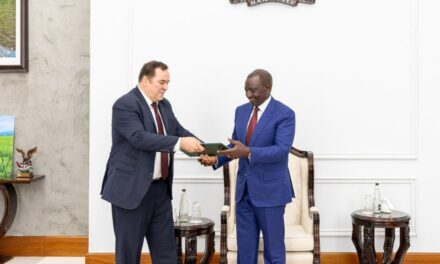
Russian Foreign Minister Sergei Lavrov and Kenyan Foreign Minister Musalia Mudavadi enter a hall during their meeting in Moscow, Russia, on March 16, 2026. Photo: Reuters
Kenya’s top diplomat, Musalia Mudavadi, arrived in Moscow on Sunday seeking answers to a scandal unfolding thousands of kilometres away on the battlefields of Ukraine.
Intelligence reports that more than a thousand Kenyans were recruited to join Russian military units have ignited anger at home.
This backlash forced the foreign minister into an unusually delicate mission to persuade Moscow to halt the recruitment without damaging a relationship Nairobi has long kept at arm’s length.
By the time Mudavadi stood beside Russia’s foreign minister, Sergey Lavrov, on Monday, the contours of the exchange were already clear.
Russia would acknowledge Kenya’s concerns, but it would not accept responsibility for the Kenyans already fighting.
“All Kenyans, as well as other nationals who signed contracts, did it voluntarily,” Lavrov said during a joint press conference following closed-door talks.
“The contracts did not have any provision for repatriation. When the contracts are effective, they can terminate them, but this is done under the Ministry of Defence.”
The exchange revealed much about the diplomatic terrain Mudavadi was navigating. Kenya had arrived seeking relief from a political scandal at home.
Russia, meanwhile, was determined to frame the issue as an administrative matter involving individuals who had freely entered military service.
The contrast could hardly have been sharper.
“Some of these Kenyans did not disclose their intentions,” Mudavadi said.
“In our laws, it is also illegal to do these things.”
Russia, Lavrov insisted, does not recruit foreigners as a matter of policy.
“People join voluntarily. No one can prevent their citizens from looking for jobs if they want to look for jobs,” he said. “We don’t target Africa specifically. We have citizens from Asia and other countries.”
For Kenya, the visit highlighted an uncomfortable reality. Nairobi has little leverage with Moscow.
Unable to threaten sanctions or exert meaningful economic pressure, Mudavadi instead leaned heavily on historical goodwill.
“Russia was one of the first countries to recognise Kenya’s independence,” he noted, speaking of the “traditionally friendly Russia–Kenya relations”.
This symbolism is visible even on Nairobi’s streets. The Russian embassy carries diplomatic licence plates marked 2 CD, a code signifying that the Soviet Union was the second country to establish formal diplomatic relations with Kenya after independence.
History, however, is rarely enough to move modern geopolitics.
From Moscow’s perspective, Kenya is often seen as a reluctant partner, one that maintains deeper economic and political ties with Western powers.
The Russian embassy itself sits within a high-security government corridor in Nairobi, not far from Kenya’s defence headquarters and State House.
The proximity is largely historical rather than strategic, though security agencies typically prefer distance from sensitive facilities.
Trade between the two countries remains modest. Coffee, tea and spices form the backbone of Kenya’s exports to Russia, Mudavadi noted.
Yet despite Russia importing more than $1.5bn worth of coffee and tea annually, Kenyan exports to the Russian market reached just $46m in 2024.
Both sides acknowledged the unrealised potential.
Lavrov reminded the Kenyan delegation that Moscow had proposed establishing a joint commission for cooperation during his visit to Nairobi in May 2023, a mechanism designed to accelerate trade and technical collaboration.
Two years later, the commission still had not been launched. Its revival during the Moscow talks suggests that the relationship has been quietly drifting.
Diplomatic engagement between the two countries has been sporadic, with both sides acknowledging the need for more structured coordination.
The last high-level Russian visit to Kenya came in 2023, when Lavrov met President William Ruto in Nairobi.
That visit included a symbolic gesture: Russia offered Kenya 34,000 tonnes of fertiliser free of charge, a welcome lifeline for farmers during a looming food crisis.
The fertiliser, however, carried its own geopolitical baggage.
It had originally been seized in Latvia due to European sanctions before being redirected to Africa as part of Moscow’s broader diplomatic outreach.
For Kenya, the shipment arrived at a politically convenient moment, as the Ruto administration struggled to fulfil campaign promises to reduce fertiliser costs for farmers.
Even so, relations between Nairobi and Moscow have also been marked by moments of tension.
In 2022 Kenya strongly criticised Russia’s recognition of the separatist regions of Donetsk and Luhansk in eastern Ukraine.
“Kenya registers its strong concern and opposition to the recognition of Donetsk and Luhansk as independent states,” Kenya’s then ambassador to the UN, Martin Kimani, said during a meeting of the United Nations Security Council.
Since Lavrov’s visit, Nairobi’s tone has softened.
Kenya has gradually shifted toward a more neutral stance on the war, aligning itself with the positions of the G77 and the African Group, which tend to adopt non-aligned approaches to global disputes.
The shift was reflected in the country’s 2025 foreign policy sessional paper adopted by Parliament.
Factoring this, Mudavadi’s Moscow visit was less about redefining Kenya’s relationship with Russia than about managing a domestic political crisis.
Mudavadi argued that Kenyan law prohibits enlistment in foreign armies.
“Section 68 of the Penal Code outlaws the enlistment of Kenyan nationals in the armed forces of a foreign state without written authority from the president,” he said, noting that violations can carry penalties of up to ten years in prison.
That Nairobi invoked the law only after hundreds of Kenyans had already been recruited has raised uncomfortable questions about the government’s response.
Reports also circulated earlier this year suggesting that Russia had already placed Kenya on a list of more than 40 countries whose citizens would no longer be recruited.
If that information had indeed reached Nairobi through diplomatic channels in January, Mudavadi’s trip to Moscow may have been less a diplomatic victory than a delayed confirmation of a decision already taken.
Either way, the visit revealed a relationship caught between caution and necessity.
Kenya seeks to maintain cordial ties with Moscow while preserving its long-standing partnerships with Western allies.
Russia, for its part, is expanding its diplomatic footprint across Africa but expects engagement to be reciprocated.
Your support empowers us to deliver quality global journalism. Whether big or small, every contribution is valuable to our mission and readers.