
















The Abstention Doctrine: Why Kenya Chooses Silence Over Naming, Shaming
By Mwangi Maina
| October 30, 2026
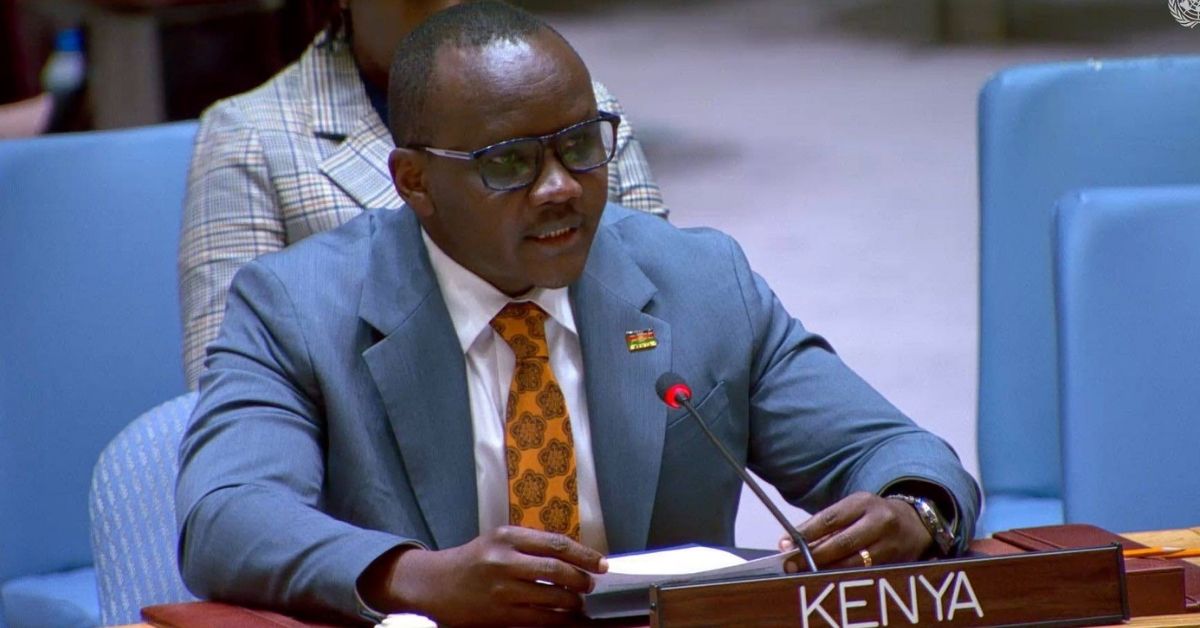
Kenya’s top envoy at the UN, Ambassador Erastus Ekitela Lookale, pictured at a past session in New York. He has steered the Kenyan delegation since August 2024. Photo: Handout
When Kenya voted against the American embargo on Cuba this week, some Kenyans were shocked.
“Rare wisdom from MFA,” wrote one user on X, praising the Foreign Ministry for a sudden burst of moral courage.
It was neither rare nor sudden. Kenya has voted to end the Cuban embargo every single year since 1992. It is a 34-year habit. The only thing rare about the vote was the public’s attention to it.
Kenya’s voting record at the United Nations is a study in contradictions—or so it seems. Nairobi votes loudly against American sanctions, yet stays silent on human rights abuses in Iran and Syria. Is this hypocrisy? A lack of moral compass?
An exhaustive review of three decades of UN voting data reveals a different truth. Kenya operates under a highly disciplined, institutionalised strategy of constructive abstention. According to pundits, it is a calculated doctrine designed to protect a middle power from being conscripted into great-power wars.
Defending the Global South
When Kenya speaks at the UN, it champions the Global South.
During the Cuba vote, Kenya’s deputy UN envoy, Yabesh Monari, delivered a sharp rebuke of American policy.
“Generalised sanctions and embargoes belong to a bygone era,” he said.
“Their continued application serves neither justice nor international peace.”
This is not a one-off. Kenya has voted against unilateral coercive measures—trade sanctions, asset freezes, travel bans—for 28 consecutive years.
It views these tactics as illegal bullying that violates the UN Charter.
If a resolution targets a systemic principle (like economic coercion) or a thematic issue (like protecting migrants), Kenya votes yes. It aligns with the African Union and the developing world.
But when a resolution targets a specific country, Kenya vanishes.
Avoiding the Trap
Look at the record on country-specific human rights resolutions.
Kenya abstained on human rights in Iran for 21 consecutive years (2004–2025). It abstained on Syria for 13 years (2013–2024). It abstained on Crimea and the temporarily occupied territories of Ukraine from 2016 to 2024. It has done the same for Belarus, North Korea, and Myanmar.
Why the silence?
Because in the theatre of the UN, country-specific resolutions are rarely just about human rights. They are drafted by Western powers—the US, UK, and EU—and deployed as geopolitical weapons against their rivals.
For Kenya, according to diplomats, this is presents a zero-sum dilemma. If Nairobi votes yes, it aligns with the Western bloc, alienating Russia, China, and the Global South. If it votes No, it looks like it defends authoritarian regimes, destroying its moral authority.
Abstention is the ultimate hedge and a polite diplomatic way of saying “your enemies are not our enemies.”
The Economics of Silence
Kenya’s abstentions are not just about politics; they are about groceries.
Nairobi refuses to sacrifice its economic interests at the altar of Western morality. In the first half of 2026, Russian agricultural exports to Africa surged 35% to $2.9 billion. Egypt, Sudan, and Kenya were the top destinations. Kenya needs that Russian grain and fertiliser to lower its cost of living.
Iran is also a vital trade partner. In 2024, Tehran imported about 13 million kilograms of Kenyan tea, valued at Kshs 4.26 billion.
You do not vote to condemn the countries buying your tea and selling you fertiliser.
Furthermore, Kenya views these Western-led resolutions as unwarranted external interference in the domestic affairs of sovereign states. Nairobi abstains to uphold the foundational African principle that states should not meddle in the internal affairs of others.
The Exceptions That Prove the Rule
There are rare moments when Kenya breaks its own doctrine.
In 2012, Kenya voted ‘yes’ on a resolution condemning Syria and calling for President Bashar al-Assad to step down. Why? The Arab Spring was at its peak. The pressure on Nairobi to act as a “responsible global citizen” was immense.
Kenya’s stance has also evolved on Ukraine. In 2022, Kenyan diplomat Martin Kimani delivered a widely praised speech condemning Russia’s invasion. Yet, when it came to human rights in Crimea, Kenya abstained.
By June 2025, Kenya formalised its neutrality. A new foreign policy document, approved by Parliament, shifted Nairobi’s position toward the G77 and the African Group—blocs that favour non-aligned approaches to global disputes.
Is Kenya’s voting record hypocritical?
As Finnish President Alexander Stubb, a close ally of President Ruto, once noted: “Foreign policy cannot be completely binary or black-and-white.”
Kenya appears to be playing a long game. By voting against economic coercion and abstaining on naming-and-shaming, Nairobi preserves its strategic autonomy. It keeps its diplomatic and economic channels open with both the West and the East.
Your support empowers us to deliver quality global journalism. Whether big or small, every contribution is valuable to our mission and readers.