Baltic Code: Estonia’s Man in Nairobi
By Mwangi Maina
| November 14, 2026
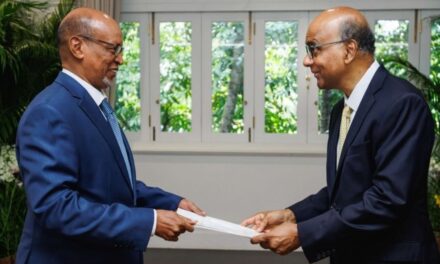
File image of Daniel Erik Schaer, Estonia’s first resident envoy to Kenya, presenting his credentials as Permanent Representative to the UN Office in Nairobi in September 2024. Photo: Handout
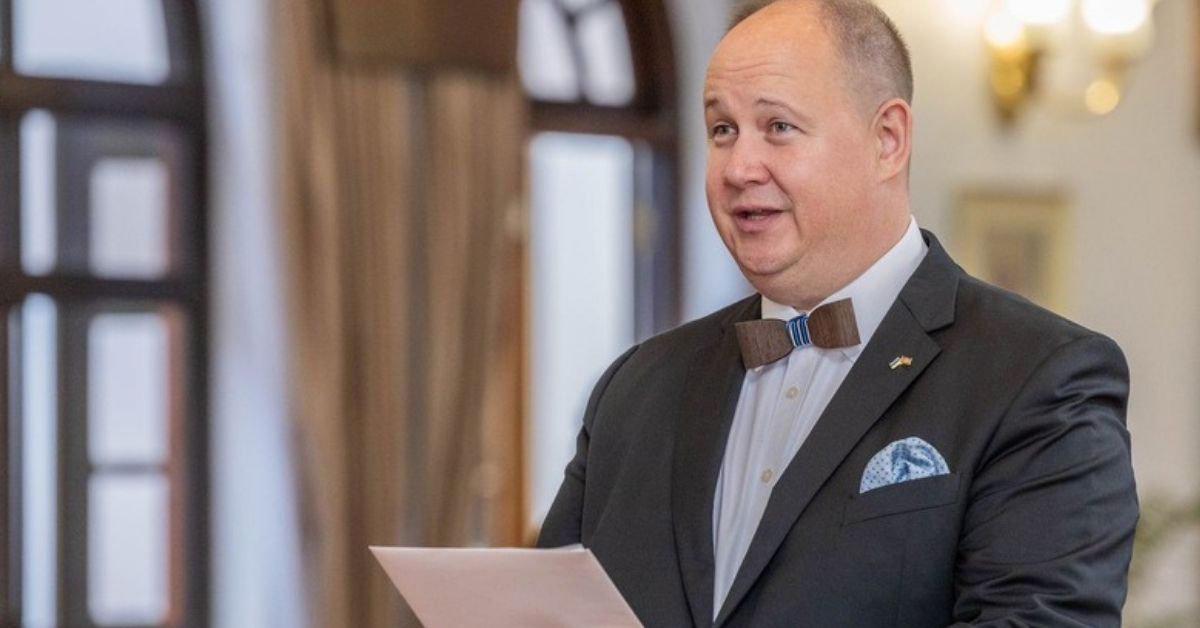
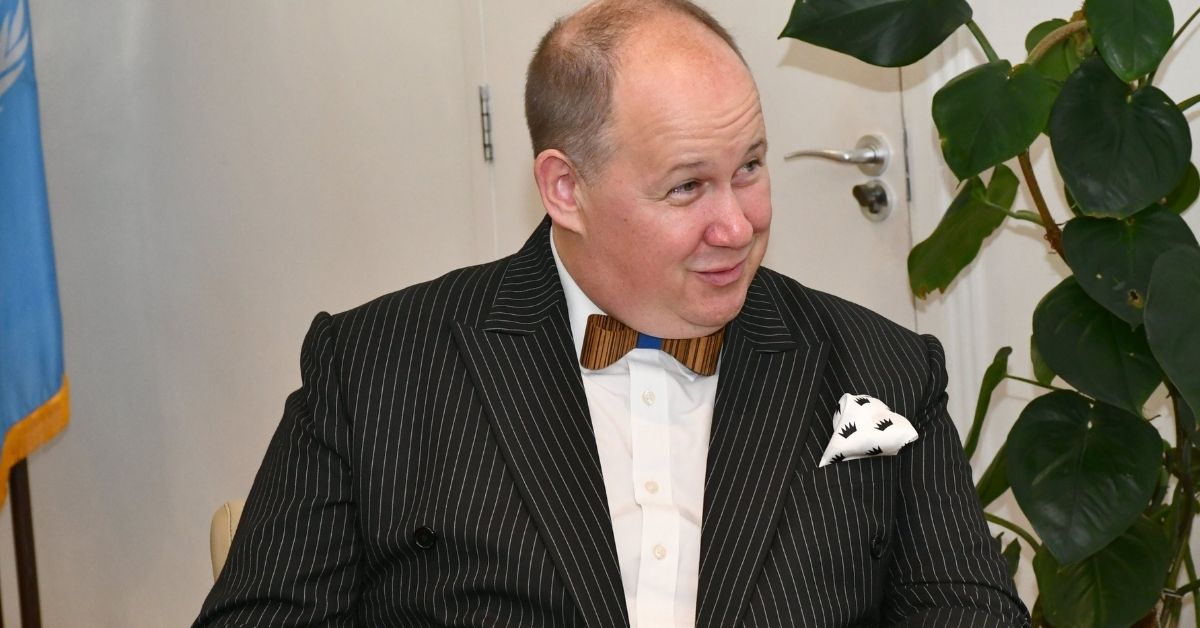
Meet Estonia’s ambassador to Kenya, Daniel Erik Schaer, and there is a good chance you will spot his signature wooden bow tie. He wears it on purpose. The day we met, it was missing. He was dressed casually, and I had to ask, ‘Where is your bow tie?’
He laughed. It is a question he knows well. “A friend of mine gave it to me as a present,” he said, recalling a trip to Africa where everyone commented on it.
“I found it was a good way to start talking about Estonia. The country is 50 per cent forest.” Then one day he went without it, and people asked where it was.
“Now I guess I have to wear the bow tie because it’s become sort of my thing,” he said, smiling. “It’s how people recognise me.”
Beneath the bowtie, the work is serious. The towering envoy, who joined Tallinn’s foreign service in 2003, is in Nairobi setting up Estonia’s second resident embassy in Africa. While the ribbon is cut on 3 December, the office will not officially open until early 2027 – furnished and decorated with pieces shipped from Estonia to showcase the beauty of its forests.
Estonians, they say, are easy to spot. A government booklet on the country claims they have not seen a paper bus ticket in ages and are supposedly unable to sign on paper because everything is digital.
Nairobi’s welcome – a paper trail of KRA PINs, bank forms, and agency letters – must have felt like time travel. His country, a small tech-savvy nation of 1.3 million people, sees great potential in Kenya. So far, Nairobi has treated him well.
“Very well. In some ways it’s similar to Estonia, the greenery, he says, “Karura forest next door helps.” He has been to Naivasha and the Maasai Mara. “Sampling pole pole,” he smiled, adopting the Swahili maxim for taking life slowly. He remembers a three-hour drive from the airport to Upper Hill.
“Luckily, that’s finished now.” Part of the credit goes to the Chinese-built Nairobi Expressway, which opened in 2022.
With Estonia’s only other African embassy in Cairo, why choose Kenya?
“I think it’s easy. We see Kenya as the doorway to the continent for us. Not only figuratively, but literally, with the infrastructure, the ports, the number of flights.”
The 48-year-old Toronto-born envoy points to Nairobi’s status as a diplomatic hub – home to over a hundred embassies and the UN’s only Global South headquarters – alongside regional business through the East African Community and development cooperation, where Estonia already runs 26 projects in Kenya.
“For a country that doesn’t have an embassy yet, that’s quite a lot,” noted Schaer, who previously led Tallinn’s diplomatic outreach across the continent.
Across Africa, partners inevitably ask how much Estonia plans to invest. His answer shifts the frame: “They always ask us: are you investing?’ How much are you investing? Our focus is a little different. We look for partnerships. We want to work with Kenyan and African companies to co-create and build together.”
He admits it’s a harder sell. “When people come to invest, someone proposing a partnership sounds like a different concept. We’re trying to explain that.” Still, he sees vast commercial potential in Kenya, a bet already validated by Estonian-born tech giants operating in the market, including ride-hailing app Bolt, cross-border payments firm Wise, and the now-retired communications pioneer Skype.
Yet winning over new partners requires adapting how Estonians do business. Back home, he says, they approach deal-making differently, efficiently, perhaps too efficiently.
“We often think, ‘Here’s my proposal, yes or no?’ We don’t always think; let’s sit down and have a coffee.”
Dubai’s Expo taught them a lesson. After what he recalls as the fourth high-level meeting, a minister of state told the Estonians: “We’ve met enough. Now we can become friends.” Estonia, he says, still needs to work on that. Its companies must learn that “it’s not just you make your offer and the deal is done.”
Nor is Schaer a newcomer to Kenya.
“People think that because we’re opening the embassy for the first time, we’re completely new, but we’re not.” He presented his credentials to President Ruto in December 2023, has visited 15 times in three years, and first arrived in 2007 with EU election observers in Kericho.
When post-election violence erupted, his team was cut off from Kisumu airport and forced to drive back to Nairobi. Looking back, he says, “The violence is not acceptable,” yet he views Kenyan openness as the other side of the same coin: citizens speak up, particularly around elections, and the press is “quite open.”
Nearly two decades after that first visit, the biggest shift he sees is the rapid evolution of Kenya’s middle class, a growing, confident consumer base that is reshaping both the capital’s skyline and its appetite for digital services.
The Digital Backbone
Estonia’s global calling brand is digitalisation. Yet Schaer argues the real secret is not the technology itself but the political will and the simplicity of the system. Take Estonia’s e-ID.
“It’s simple,” he said. “You do the online application. You put a little check in the box. And they immediately know which other banks you have loans with and what is the situation of the unpaid. Same with telco. Same with any debt.”
Under this “backbone” model, the state builds the core digital identity, and the private sector builds on top. In Kenya, the architecture is fragmented: the state runs its own systems while the private sector runs separate ones. That split raises a basic question of sovereignty and governance – who owns the citizen’s data, the government or the telco?
Schaer puts it plainly: “In Africa, we see often that the government has a backbone and the private sector has a backbone. Which is going to be, who do you trust more?”
Consider Huduma Namba, Kenya’s attempt to build a unified digital identity, which was shelved after public pushback. The timing was poor – launched just before an election when public trust was low.
Schaer calls it a textbook lesson in political discontinuity. “You have to make the decision at the beginning of a term and stick to it and deliver it. That is the key.”
The cost of shelving digital infrastructure is deep. He points to recurring voter registration drives as an example of wasted cash. “If you have a national registry that’s complete, why do you need to do voter registration? You know how old they are. You know whether they’re eligible for voting. So that whole savings of voter registration – it’s huge money.”
With some countries spending €20m or €30m per registration cycle, he added, “That same money you could do the entire database and have a system that updates regularly.”
Above all, he warned against the most common mistake governments make when going digital. “When we started digitalisation in Estonia, the goal was how to make the government’s life easier, how to make life easier for an official, not the citizen. And that’s what we understood later on. The goal of the government is not to make their life easier. Your goal is to make your citizen’s life easier. That’s how you build the trust.”
The AI Warning
Estonia and Kenya are both pushing hard on artificial intelligence, and Schaer praises Kenya’s ranking among the world’s top countries for AI usage among internet users, calling it a reflection of deliberate government policy to integrate the tech into public services.
Yet he offers a crucial distinction for Kenya’s classrooms. “In the education area, what we’re trying to focus on is how AI can be used as a learning machine, not as an answering machine.”
For youthful Kenya, AI must sharpen critical thinking rather than bypass it. The Estonian Centre for International Development (ESTDEV) is already acting on this through joint projects ranging from overhauling Kenyan digital services to funding local coding schools.
Even so, he does not sugarcoat the threat to entry-level tech jobs.
“AI does things, and you have less people employed. We’re seeing a little bit in the Estonian ICT sector already that there are layoffs, because AI can now do simple programming.”
The Grandfather’s Escape
Born in Canada, Schaer carries a family history that shapes his worldview today. His grandparents fled the Soviet occupation of Estonia in 1944 – and his grandfather narrowly cheated death in the process.
“My grandfather had tickets for a boat leaving Estonia, going to Germany,” he recalled. “And his boss had some challenges and gave him tickets for a bigger boat. The boat that he was originally supposed to be travelling on was sunk by the Soviet forces.”
For months, the family feared he had perished. “But he was lucky enough to get on a larger ship and make it to Germany. And then through the International Red Cross they were able to pass the message that they were alive.”
After his father was born in Switzerland and his mother in England, both families eventually settled in Canada.
“Why Canada was of interest was because it’s very similar to Estonia. The climate. Especially Ontario, where the forests and things like that, there’s various lakes. And the government was looking for labour.”
Growing up, he spoke Estonian at home, attended weekly language classes, and spent summers at scout camps.
“The friends were the groups who were always Estonian,” explained the ex-Balkan hand – he previously represented Tallinn in Bosnia and Herzegovina, North Macedonia, Montenegro, and Serbia.
The Estonian speaks fluent English and French alongside his mother tongue – a linguistic edge that quickly set him apart.
“The Estonians almost all speak English, but there aren’t that many French speakers. So that’s what opened the continent to me in the beginning: the French speaking.”
He always knew he would return to his ancestral homeland. “It was just a question of when.”
His chance arrived in 2003 via a childhood friend’s tip about a foreign ministry job for a native English speaker, leading him to fly home and pass the diplomatic entrance test.
Now 23 years into his foreign-service career, he credits his “Canadian openness” for making him an atypical Estonian. He illustrates the contrast with a pandemic joke: “It’s two metres of separation. And Estonians were asking, how do we get as close as two metres? We’re used to four.”
Yet he traces that reserve to history rather than mere personality. Under Soviet rule, neighbours were encouraged to report anyone flying an Estonian flag or celebrating Christmas.
“Fifty years of a culture of suppression and this fear has a little bit influenced the Estonian,” he notes.
Still, a younger generation is shedding that caution.
“Estonians love to travel,” he says. “Almost all young university graduates have done a year of exchange somewhere else around the world.”
The Superpower of Small Nations
Hardly a reserved Estonian, the self-described bridge-builder has already acquired a taste for Kenyan nyamachoma. Outside the chancery, the keen golfer and swimmer has quickly plugged into Nairobi’s social rhythm, booking tickets for a Nairobi Orchestra concert and cheering from the stands at the Safari Sevens.
Already the proud owner of a Kenyan rugby jersey, he is looking ahead to January, when Nairobi hosts the opening leg of the 2027 HSBC SVNS 2 series.
Yet establishing a permanent mission shifts his daily math: moving solo as ambassador-at-large was simple, whereas Nairobi means managing a nearly 12-strong team alongside his relocating family.
His diplomatic warmth stops at Moscow. Mindful of Estonia’s past under Soviet occupation, he sharply condemned Russia – and its conscription of Kenyans and other Africans into its armed forces.
For him, international law is not an abstract principle, but a survival strategy.
“International law is the superpower of small nations. So we believe in international law.”
He explains why that conviction runs so deep.
“We were colonialised. We were occupied for 50 years by Russia. People don’t know that after the Second World War, we lost about over 20 percent of our population to those who were exiled and those who were deported to work camps in Russia.”
This history shapes his view of global governance – a space he knows well after leading Estonia’s successful campaign for a UN Security Council seat. Recalling how crucial it was when neighbouring Lithuania sat on the council in 2014, he stresses the value of having voices at the table who understand small nations’ existential realities.
On the recruitment of Africans to fight in Ukraine, he is blunt about Moscow’s denials.
“There’s denial that there’s no involvement in the government. If they’re not participating, then how do they get to the frontlines? I mean, the Russian army is still, the last time I checked, is part of the government.”
He is equally critical of Russia’s historical courtship of Africa.
“They try to say that they were the big friend, very friendly with Africa during the Cold War. Or they were using the continent just as much as the other side is. So, in some ways, the pot calling the kettle black.”
Today, Schaer is focused on what a small, nimble state can bring to multilateral forums in Nairobi. Rather than competing on financial muscle, Tallinn plans to deploy its core specialty in data and digital governance to deepen bilateral ties with Kenya, including powering smarter climate decision-making.
Armed with a bowtie, an open mind, and a pragmatic playbook, Estonia’s man in Nairobi is betting that small nations can punch well above their weight.
Your support empowers us to deliver quality global journalism. Whether big or small, every contribution is valuable to our mission and readers.