

























Kenya Wants a Seat at the Court It Once Wanted to Quit
By Mwangi Maina
| November 5, 2026
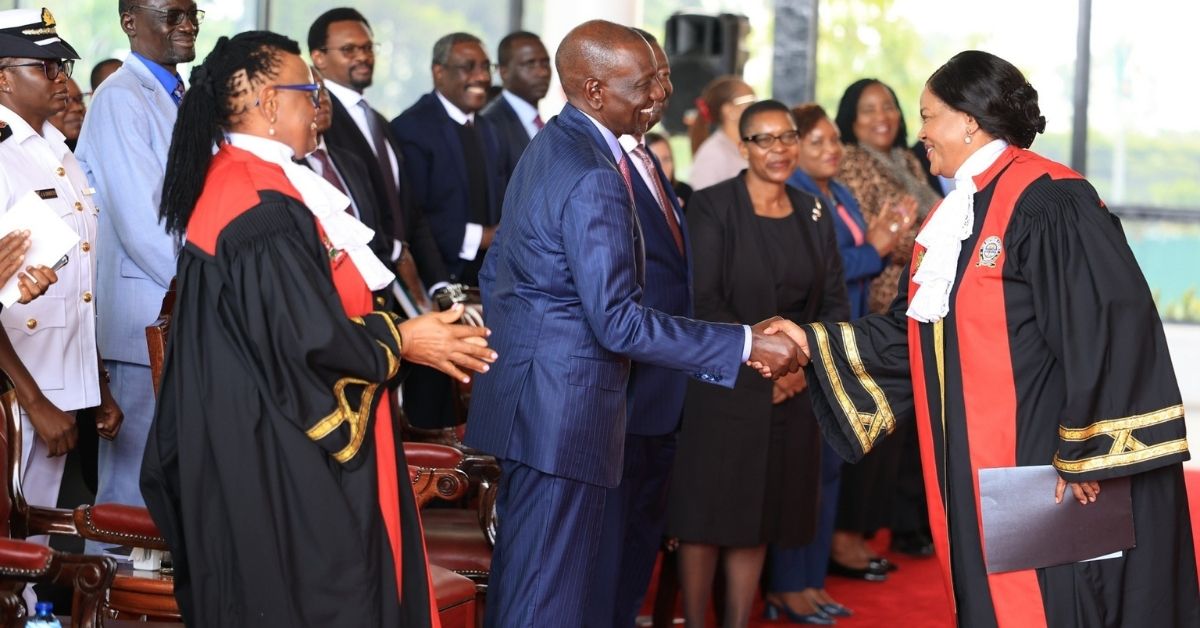
President William Ruto greets Justice Njoki Ndung’u at State House, Nairobi, during the launch of her bid for a seat on the ICC bench. Photo: Handout
Days after securing a landslide victory at the International Court of Justice, Kenya is pivoting to a far more contested battlefield: the International Criminal Court.
Nairobi is shoring up support for Justice Njoki Ndung’u, a Court of Appeal judge, seeking a seat on the bench of the same institution Kenya once rallied African peers to abandon as a “neo-colonial” project.
But the race is crowded; the African vote is fragmented. For Evans Ogada, an advocate and researcher at Migai Aketch Associates and Advocates, the candidacy represents a “significant shift in strategy, if not necessarily principle”.
“Seeking a seat on its bench suggests that Nairobi now recognises the value of influencing the institution from within rather than simply challenging its legitimacy from outside,” Ogada says.
However, he notes an apparent contradiction: “an institution cannot conveniently be dismissed as illegitimate when it exercises jurisdiction over one’s political leadership and embraced when national representation becomes possible. Kenya must explain the principles underpinning this change”.
Pragmatism or Genuine Shift?
Is Kenya’s ICC bid a genuine commitment to international justice, or pragmatic realpolitik?
“Primarily, it appears to be pragmatic realpolitik, although it could develop into a genuine institutional commitment,” Ogada argues.
“Kenya has not necessarily abandoned its criticisms of selectivity, unequal power relations and the historical marginalisation of African perspectives. Instead, it may have concluded that withdrawal, hostility and confrontation are less effective than participation and influence”.
The real test, he says, will be whether Kenya supports the ICC’s independence consistently, including when decisions are politically inconvenient to Nairobi.
“Supporting an African candidate is not, by itself, evidence of commitment to international justice”.
Kenya’s record gives that test teeth. In August 2010, Sudan’s Omar al-Bashir, then under ICC arrest warrants, came to Kenya for the promulgation of the new constitution. He was not arrested.
The court asked the Security Council and the Assembly of States Parties to act against Kenya for failing to arrest him. The Kenyan government defended its failure, citing “strategic interest” in Sudan.
As a party to the court, Kenya was legally obliged to arrest Bashir. The ICC has no police force and relies on member states to enforce its warrants.
In 2016, Nairobi led the charge at the African Union, backing a Kenyan proposal for a mass withdrawal from the court, repeating claims that it unfairly targeted the continent.
At the time, Chad’s president now late, Idriss Deby criticised the court for focusing its efforts on African leaders.
“Elsewhere in the world, many things happen, many flagrant violations of human rights, but nobody cares,” Deby said during the leaders’ summit, which had an official theme on human rights.
“We refuse to be carried along in a vehicle that has strayed off course to the detriment of our sovereignty, security and dignity as Africans,” said Uhuru Kenyatta in a statement.
Those plans were later shelved, and no country, including Kenya, withdrew.
Having a judge on the bench gives a state a voice in the interpretation and development of international law. Ogada says a Kenyan judge can bring an African perspective to debates on sovereignty, immunity, and the court’s jurisdiction.
It is an open secret in international relations that states believe a national on the bench is better positioned to defend their interests. But Ogada argues “an ICC judge is not Kenya’s representative”.
“Once elected, Justice Ndung’u would owe allegiance to the judicial office, not Nairobi. Article 40 of the Rome Statute guarantees judicial independence. Kenya therefore gains influence through participation, not control over judicial decisions”.
According to the Oxford Public International Law, the judges of the ICC do their work in a highly political environment, illustrated by the fact that the court – mandated to address threats to the peace, security, and well-being of the world – is designed to focus prosecutions on those bearing the most responsibility for heinous crimes.
In practice, this means prosecutions against heads of state and high-level leaders.
It is a court that, by design, sits in judgement of the powerful. Kenya’s candidate for the ICC bench is no stranger to the forces that first brought her country into the court’s orbit.
She served on the Committee of Experts that redesigned Kenya’s constitutional framework in the wake of 2007-08 post-election violence – the very crisis that triggered the ICC’s high-level prosecutions of then-President Uhuru Kenyatta and his deputy, William Ruto, now serving as President.
But there is a more fundamental problem: Justice Ndung’u does not appear to have any documented experience in international criminal law, criminal law generally, or public international law generally. She is nominated under List A, the category reserved for candidates with extensive experience in criminal proceedings. But she has never served as a trial judge.
Her only relatively brief criminal trial experience is as state counsel from 1989 to 1993 – a career detour that ended more than three decades ago. Compared with the other candidates across all regions, her qualifications do not appear to be directly relevant to the ICC, at least not as a List A judge.
Crucially, Kenya has fielded candidates in two high-profile international judicial elections within weeks of each other: the ICJ race already concluded in November and the ICC in December 2026. The fact that Kenya’s ICJ candidate, Judge Phoebe Okowa, is an incumbent who won a re-election and a highly qualified international lawyer may boost Ndung’us’ chances.
But the ICJ victory is a double-edged sword. It does not change the arithmetic of the ICC race. If anything, it raises the stakes for the remaining candidates, who now view Kenya as the candidate to beat.
Nairobi is, however, no newcomer to the ICC electoral process and knows how to run a campaign for the bench.
In 2008, Nairobi first nominated Justice Onesimus Mutungi for the bench – only to withdraw his candidacy months later and front Justice Joyce Aluoch instead.
Aluoch won the seat and served for nine years until 2018. But her tenure was defined as much by what she did not do as by what she did.
She did not sit on the bench that would later strike out the cases against ex-president Uhuru Kenyatta and his deputy, William Ruto, in 2014 and 2016, respectively.
The court’s founding treaty, the Rome Statute, requires judges to recuse themselves if their impartiality might reasonably be doubted.
The official records we reviewed from the court show that when Kenya was under investigation, Judge Aluoch was assigned to other high-level profile cases – most notably the trial of Congolese politician Jean-Pierre Bemba.
This signals a careful, deliberate separation where Kenya’s national on-the-bench was kept far from Kenya’s national crisis.
In fact, Aluoch, who had also served as vice president of the ICC, had to formally request to be excused from certain administrative functions of the court’s presidency in the Bemba case to avoid any appearance of impropriety.
The Fragmented African Vote
The AU’s failure to unite behind one ICJ candidate – a deadlock only broken when Sierra Leone withdrew and endorsed Kenya’s Phoebe Okowa signals the risks of a divided African vote.
The same danger now looms over the ICC elections to be held this December in New York, where eight African candidates are competing for two effectively available African seats.
“The immediate danger is the weakening of Africa’s collective diplomatic bargaining power,” Ogada warns.
“Competing African candidatures make it more difficult to consolidate support behind one candidate.”
“Africa cannot consistently demand greater representation in international institutions while failing to coordinate its own diplomatic strategy. African representation without African coordination risks becoming symbolic rather than transformative.”
The Battlefield
Africa currently holds four seats on the court. Two judges – Reine Alapini-Gansou of Benin and Solomy Balungi Bossa of Uganda – are leaving. Two others, Haykel Ben Mahfoudh of Tunisia and Miatta Maria Samba of Sierra Leone, will serve until 2030 and 2033, respectively.
The race for the two open seats is better understood as a battle for the Anglophone and Francophone Africa seats – a division that reflects the linguistic and legal traditions that shape African diplomacy at The Hague.
The English-speaking field, where Kenya is competing, includes Justice Ndung’u, Uganda’s Rosette Muzigo-Morrison, Ghana’s Evelyn Ankumah, and Gambia’s Veronic Wright. The withdrawal of Malawi and Tanzania narrowed the field, but it doesn’t resolve the Anglophone contest. Kenya still faces three competitors for the seat that will be vacated by Uganda’s Solomy Bossa.
Uganda is defending that seat, and its stake is larger than most. It was the first state to refer its own case to the court, and LRA’s Dominic Ongwen’s conviction came from that case. Kampala also has a standing to rebuild: a pre-trial chamber in 2020 found Uganda failed to execute the Bashir warrant during his 2016 visit for the inauguration of President Yoweri Museveni and referred it to the assembly, which is composed of member states.
Western diplomats walked out of the ceremony as the Ugandan leader railed against the court, calling it “useless” in his speech.
The Francophone field has only two candidates. Senegal’s Abdoulaye Seye and the DRC’s Ezechiel Cirimwani are competing for the seat to be vacated by Benin’s Reine Alapini-Gansou.
Africa is the largest regional bloc in the court, with 33 member states out of 125. That is more than a quarter of the Assembly of States Parties.
Your support empowers us to deliver quality global journalism. Whether big or small, every contribution is valuable to our mission and readers.





