


















MSF to Tackle Grim Health Outlook in Sub-Saharan Africa at Nairobi Meeting
| December 2, 2024
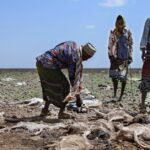
Pastoralists from the local Gabra community walk among carcasses of some of their sheep and goats on the outskirts of a small settlement called ‘Kambi ya Nyoka’ (snake camp) suspected to have succumbed due to sudden change in climate in Marsabit county January 29, 2022. – A devastating drought in Kenya late-last year, that appeared to give way to flash storms that yielded flooding and chilly weather conditions in early 2022, has seen pastoral communities in the east african nation’s arid north lose their livestock, first to drought and then floods and cold. Photo: AFP
Médecins Sans Frontières (MSF), also known as Doctors Without Borders, is scheduled to convene a high-profile meeting in Nairobi to address the deteriorating health conditions across Sub-Saharan Africa.
This gathering will bring together humanitarian health and climate experts, including representatives from the Kenyan Ministry of Health, the United Nations, and the International Committee of the Red Cross, to discuss strategies to mitigate the impacts of the worsening climate crisis.
“Climate change drives emerging infectious diseases and amplifies existing health issues, straining healthcare systems and humanitarian responses,” said MSF General Director Rolland Kaya ahead of the meeting.
He warned of severe consequences for millions of people in Eastern Africa, where extreme weather events are intensifying malnutrition, water scarcity, disease outbreaks, and forced displacements.
In recent years, Eastern Africa has experienced severe droughts, unpredictable rainfall, and rising temperatures, causing widespread population displacement and infrastructure damage.
These climate-driven crises compound existing challenges like poverty and conflict, pushing healthcare systems to their limits.
Kenya’s Baringo and Turkana counties have been particularly hard-hit, with extreme weather patterns disrupting agriculture and causing food insecurity.
In 2024, MSF screened over 46,000 children in Baringo for malnutrition, finding that 30% were acutely malnourished, while 8% suffered from severe malnutrition.
Neighbouring South Sudan is also grappling with a worsening health crisis as it faces floods, rising temperatures, and prolonged droughts.
“Not only is South Sudan one of the most vulnerable countries to climate change, but it also has the least capacity to adapt to its consequences,” said Dr. Maria Guevara, MSF’s International Medical Secretary.
For MSF and other humanitarian organisations, the climate crisis has redefined emergency response.
Extreme weather demands rapid, innovative solutions as it fuels health crises, displacement, and resource competition. In Kenya, South Sudan, and Somalia, the climate emergency is not only a health issue but also a driver of conflict and instability.
“Without immediate action, climate change will continue to drive health and humanitarian crises worldwide,” Dr. Guevara added, calling for urgent investment in climate-resilient healthcare systems, water and food security initiatives, and infrastructure.
MSF’s meeting in Nairobi is a wake-up call for world leaders to address the intertwined challenges of climate change and health.
Bold commitments to climate adaptation and healthcare funding are needed to prevent further loss of lives and to protect vulnerable populations.
Your support empowers us to deliver quality global journalism. Whether big or small, every contribution is valuable to our mission and readers.