Kenya and Hungary Deepen Ties with Pacts on Education, Agriculture, and Energy
By Mwangi Maina
| March 12, 2025
Foreign and Diaspora Affairs CS Musalia Mudavadi speaks at the Hungarian Diplomatic Academy in Budapest on March 11, 2025. Photo: Handout
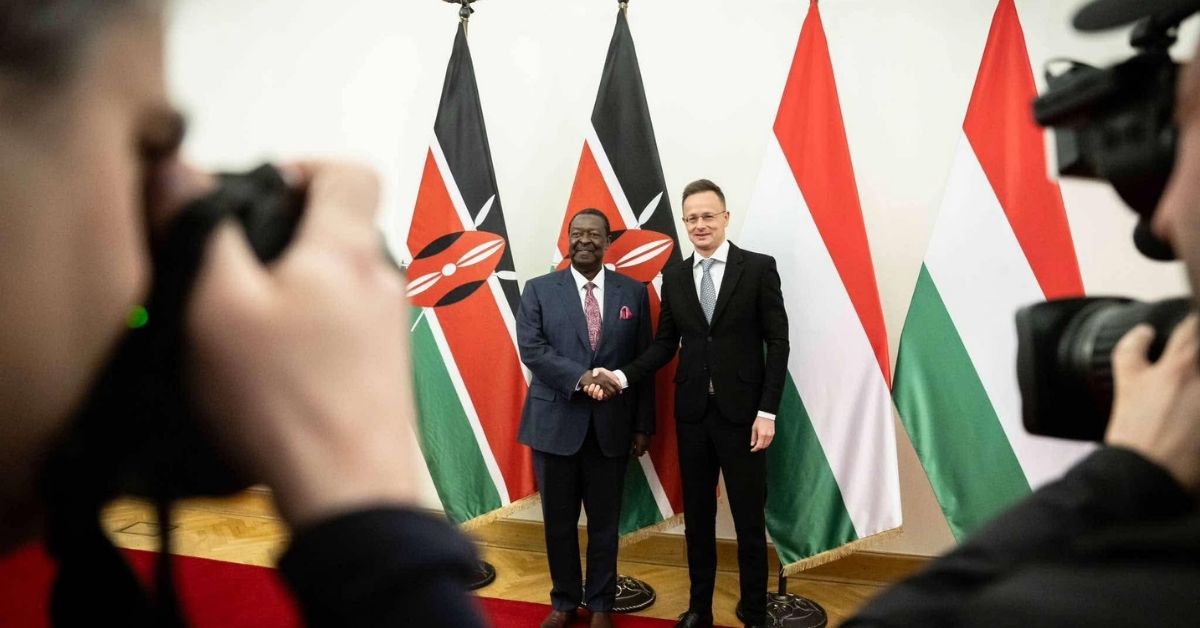
Kenya and Hungary have taken a significant step in strengthening their six-decade-long diplomatic relationship, signing key agreements in education, agriculture, and energy cooperation.
The move signals a broader effort to enhance economic collaboration, knowledge exchange, and investment flows between the two nations.
Leading the Kenyan delegation to Budapest, Prime Cabinet Secretary Musalia Mudavadi emphasized that the Memoranda of Understanding (MoUs) would catalyze foreign direct investment (FDI) and bolster technical cooperation.
“I appreciate the Hungarian government for the 200 scholarships offered annually to Kenyan students through the Stipendium Hungaricum Programme. These scholarships have driven significant transformation across various sectors in our economies,” Mudavadi stated after signing the agreements with Hungary’s Foreign Minister Péter Szijjártó.
Agricultural Innovation and Investment
Beyond education, agriculture emerged as a major pillar of cooperation. Hungary has invested in a demonstration farm in Kenya, aimed at transferring advanced farming techniques and agri-tech innovations to enhance productivity.
“Once we implement the outcomes of our discussions, we expect a surge in foreign direct investment, particularly in agricultural value addition industries,” Mudavadi noted, underlining the sector’s potential for job creation and food security.
Kenya to Open Embassy in Budapest
In a move signaling closer diplomatic engagement, Kenya announced plans to establish an embassy in Budapest—a decision approved by President William Ruto and the Cabinet, pending budgetary allocation.
“The opening of a Kenyan diplomatic mission in Hungary will further solidify our ties and expand opportunities for trade and cooperation,” Mudavadi confirmed.
Energy Partnership
Kenya and Hungary are also deepening their collaboration in the energy sector, particularly in nuclear power development.
The two nations have resolved to implement an MoU on the Training and Education of Atomic Industry for the Peaceful Uses of Nuclear Energy, an agreement first signed during Szijjártó’s visit to Nairobi last year.
Trade, ICT, and Global Financing Reform
The discussions in Budapest extended beyond bilateral trade, touching on global financing architecture and multilateral reforms. Kenya sought Hungary’s backing for a more equitable international financial system, a key agenda in President Ruto’s global economic diplomacy.
“I had the opportunity to seek Hungary’s support in championing a fair and just multilateral system with a more inclusive global financing architecture,” Mudavadi said.
Both countries agreed to accelerate negotiations on an Agreement on Promotion and Reciprocal Protection of Investment and to initiate talks on an Agreement on Avoidance of Double Taxation.
To further boost business-to-business ties, the two sides committed to holding the next Joint Trade and Economic Committee (JTEC) session before year-end.
Hungary’s Foreign Minister Péter Szijjártó emphasized that Nairobi remains a key partner in East Africa, reaffirming Budapest’s commitment to expanding cooperation across multiple sectors. He also underscored both countries’ shared stance on international stability.
“Hungary and Kenya continue to urge all aggrieved parties to give diplomacy and dialogue a chance as an alternative method for dispute resolution,” Szijjártó said.
The agreements signed in Budapest mark a new phase in Kenya-Hungary relations, expanding opportunities in education, agriculture, energy, and trade.
Sustainable communication, diligent follow-ups, rigorous monitoring, and full implementation of these agreements will be essential in unlocking economic opportunities for Kenya as it seeks to position itself as a strategic entry point for European investment into East Africa.
Your support empowers us to deliver quality global journalism. Whether big or small, every contribution is valuable to our mission and readers.