What the France-Africa Summit Says About Kenya’s Pragmatism
By Judy Mbugua
| May 14, 2026
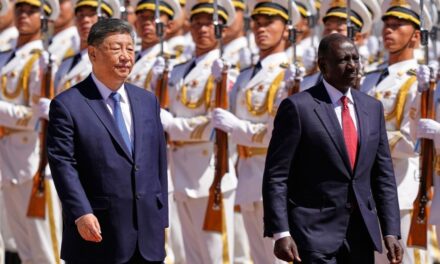
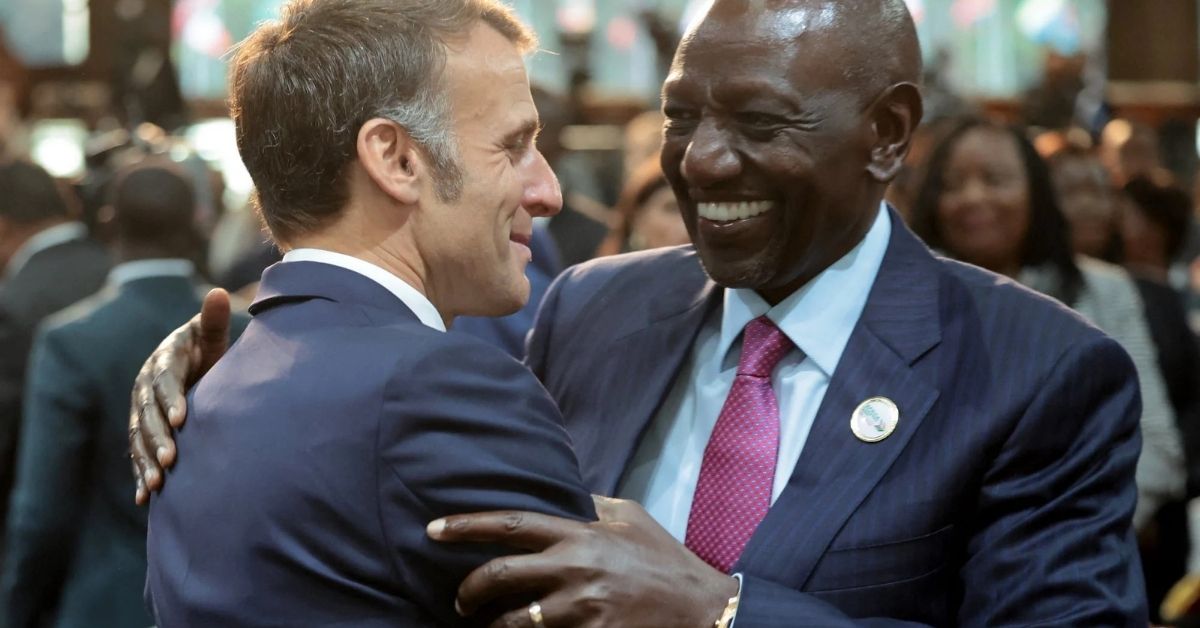
France’s President Emmanuel Macron greets Kenya’s President William Ruto at the opening plenary session of the Africa Forward summit in Nairobi on 12 May 2026. Photo: AFP
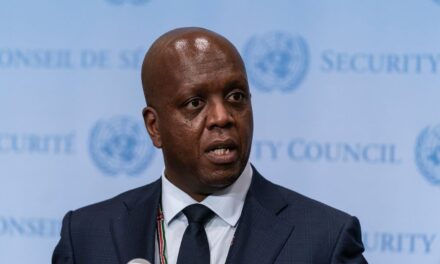
When Musalia Mudavadi, Kenya’s Prime Cabinet Secretary and Foreign Affairs Cabinet Secretary, addressed Chatham House earlier this year, he framed Africa’s place in the emerging global order around a central question: whether African states will leverage their economic, critical minerals and demographic potential into geopolitical influence or remain peripheral actors and recipients of foreign aid.
He presented Kenya’s strategy of pragmatic multi-alignment and diversified partnerships as an effort to expand its diplomatic options and convert the country’s strategic assets into leverage.
He also pointed to Kenya’s growing responsibility as a voice for the Global South in the face of increasing geopolitical fragmentation.
As Nairobi hosts the France–Africa summit this week, the first of its kind in an Anglophone country, this strategic pragmatism is becoming more pronounced. However, it also exposes a growing tension between principle and practice
For Kenya, the summit reflects its role as a hub for high-level diplomacy and its emerging position as a bridge between Africa and external partners.
However, in parts of the continent, it is also being read through the historical experience of French colonial rule and the continuing influence of France’s postcolonial political and economic relationships in Africa.
In the Sahel, for example, where France has been expelled following sustained backlash over its security presence, the summit carries a more politically charged meaning.
For some Nairobi is offering itself as an alternative gateway for the re-articulation of French interests and influence in Africa.
These perceptions have been reinforced by Kenya’s expanding security and diplomatic partnerships with external powers, including Israel, the United Arab Emirates, EU as well as its designation as a major Non-NATO Ally.
These positions point to two competing interpretations of Kenya’s foreign policy. One that views its multi-alignment as strategic statecraft in a fragmented global order. The other sees it as increasingly detached from the broader continental political sentiment including, more critical assessments of external involvement in Africa’s economic, political and security affairs.
Kenya’s approach, however, reflects a realist understanding of international politics, which holds that national interests override ideological considerations.
In an anarchic international system, foreign policy is shaped less by fixed values than but by pragmatic responses to uncertainty and competition.
A useful comparison can be found in India’s foreign policy following Russia’s invasion of Ukraine
India has maintained strategic relations with Russia, particularly in energy and defence, while simultaneously deepening engagement with the United States and its European partners in trade, technology, and security in the Indo-Pacific.
This pursuit of strategic autonomy has strengthened New Delhi’s positioning as a prominent voice of the Global South, most visibly during its 2023 G20 presidency, under which the African Union was admitted as a permanent member of the bloc.
Kenya’s hosting of the France–Africa Summit reflects a similar logic. Nairobi is seeking to engage competing power centres while the summit provides a platform through which Africa can renegotiate the terms of its engagement with France.
This is particularly evident in the politics of critical minerals. Africa holds an estimated 30% of the world’s critical minerals with some of the world’s most important reserves of cobalt, manganese, lithium, and rare earth minerals that are increasingly central to the global energy transition and emerging technology supply chains.
As global competition for these resources intensifies, African governments are increasingly pushing for local value addition and industrialisation rather than remaining exporters of raw materials.
At the same time, European states, including France, are seeking more stable and diversified supply chains as geopolitical competition reshapes access to these strategic resources.
The summit therefore offers a platform where these interests can converge through negotiations centred on investment, co-production, and industrial partnerships.
Technology and human capital development are also emerging as key areas of cooperation. Africa’s young population and expanding labour force are increasingly central to global debates on the future of work, digital transformation, the green revolution, and innovation-driven growth.
However, realising this potential depends on sustained investment in skills development, education, and training.
Partnerships between Africa and France in this space reflect converging interests, supporting Africa’s skills development and employment needs while strengthening cooperation in innovation, training, and emerging sectors of the global economy.
On security, the summit comes at a moment of wider reassessment across the continent. The crisis in the Sahel exposed the limitations of external security arrangements that relied heavily on military and financial support without political legitimacy and local ownership.
Similar debates are emerging elsewhere, including in the Horn of Africa, where long-term foreign security engagement has produced little to no outcome.
The France–Africa Summit therefore presents an opportunity to rethink security cooperation around more politically sustainable and regionally driven frameworks.
Ultimately, the France–Africa summit reflects a broader reality: in an increasingly fragmented global order, engagement with multiple external powers is a question of strategic necessity.
Kenya’s decision to host the summit illustrates this shift, leveraging external partnerships to advance industrialisation, investment, technology and security cooperation. Whether Kenya succeeds, however, will depend less on the symbolism of the summit than on the tangible benefits it delivers for African states and their populations.
Your support empowers us to deliver quality global journalism. Whether big or small, every contribution is valuable to our mission and readers.