




















Emirati Ruler’s Kenya Visit Uncertain, Trade Deal to Be Signed in Abu Dhabi
By Mwangi Maina
| January 13, 2025
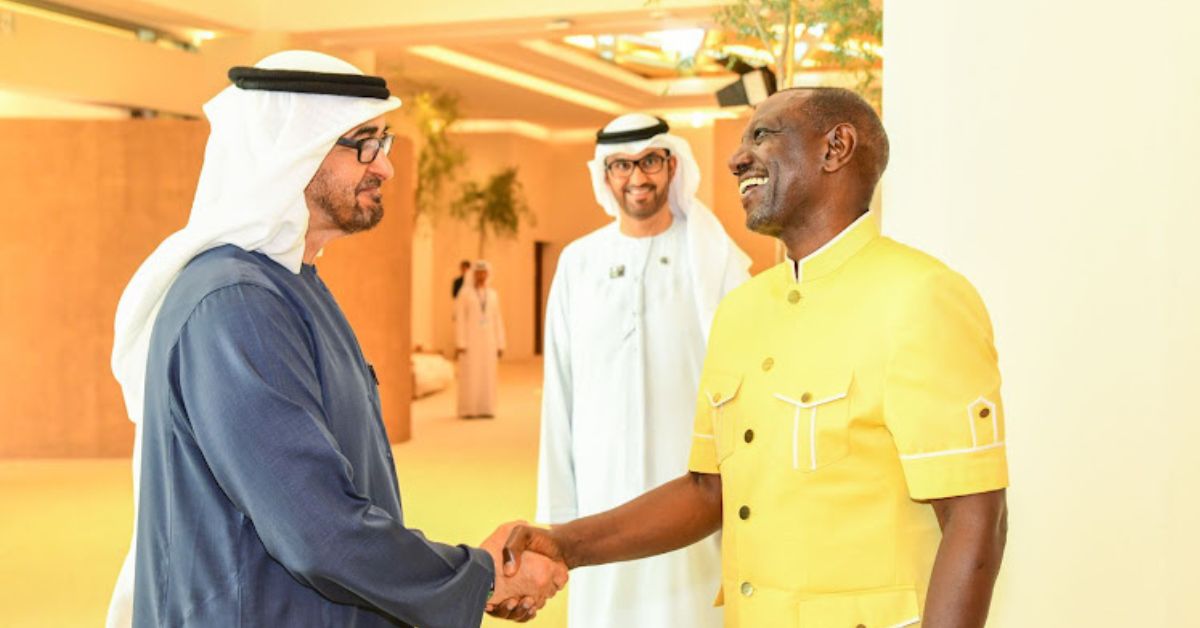
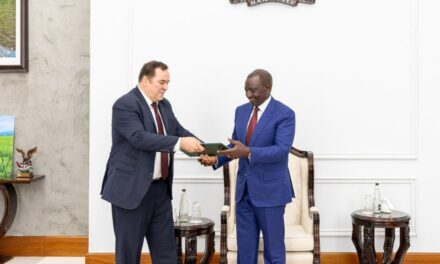
President William Ruto met the United Arab Emirates (UAE) President Sheikh Mohamed bin Zayed Al Nahyan on the sidelines of COP28, December 2023. Photo: Handout
Nairobi had been preparing to warmly welcome Emirati ruler Sheikh Mohamed bin Zayed Al Nahyan for a state visit during which Kenya and the UAE were set to sign a Comprehensive Economic Partnership Agreement (CEPA).
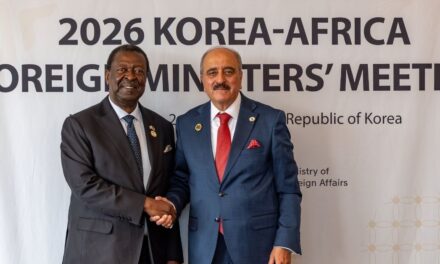
However, it appears the visit has been canceled, and the CEPA will now be signed in Abu Dhabi by Kenya’s top foreign policy official, Musalia Mudavadi.
Kenya had ramped up its engagements with senior government officials to finalize the draft document for bilateral agreements last year.
Mudavadi had visited Abu Dhabi in July 2024, where a Joint Commission for Cooperation (JCC) took place between the two countries.
The office of the Prime Cabinet Secretary, who also serves as Cabinet Secretary for Foreign and Diaspora Affairs, announced on Sunday evening that Mudavadi would be leaving for Abu Dhabi for a one-week visit.
“Musalia Mudavadi, Prime Cabinet Secretary, and Cabinet Secretary for Foreign and Diaspora Affairs will today leave for Abu Dhabi, United Arab Emirates (UAE) for bilateral meetings and the signing of the long-awaited Comprehensive Economic Partnership Agreement (CEPA) deal with the Middle East Country between 12th – 17th January 2025,” a statement from his office read.
The statement continued, “Kenya and the UAE have enjoyed a long-standing diplomatic, political, and economic agreement and the CEPA will give the country a unique opportunity to enter into a reciprocal bilateral trade and development deal with the United Arab Emirates, which is Kenya’s 7th largest export market.”
This confirms that the Emirati ruler’s visit will not take place, particularly after the UAE has been under scrutiny from Kenyans on social media regarding its involvement in the carbon credits market.
When asked by KFP whether the visit would still take place, Foreign Affairs PS Korir Sing’oei stated, “The Comprehensive Economic Partnership Agreement will be signed this week in Abu Dhabi.”
He did not provide further details on the visit.
Notably, no high-level visit from an influential foreign leader has taken place since the Gen Z uprising in Kenya last July.
In October 2023, Blue Carbon, a UAE royal-owned company, signed a deal for millions of hectares of forest in Kenya, and the Kenyan government’s illegal eviction of the Ogiek community from the Mau forest sparked further controversy.
Diplomatic relations between Kenya and the UAE began in 1982 when Kenya opened its embassy in the UAE, and the UAE reciprocated by establishing a mission in Nairobi in 2012.
The first state visit by a Kenyan leader to the UAE was made by President Daniel Moi in 1980, followed by a reciprocal visit in 1984 by the late Sheikh Zayed Bin Sultan Al Nahyan, the UAE’s founding father. Former Presidents Mwai Kibaki and Uhuru Kenyatta also made state visits to the UAE.
In recent years, the UAE has sought to expand its geopolitical influence and assert its presence in the Horn of Africa and across the continent.
This expansion challenges the dominance of established players like the US and the BRICS nations, including India, Russia, and China. The UAE has become one of the largest investors in Africa among GCC states, and it is the fourth-largest global investor in Africa, following China, Europe, and the United States.
According to real estate consultancy Knight Frank, in 2018 alone, the Abu Dhabi Fund for Development financed more than 66 projects in 28 African countries, valued at $16.6 billion.
Between January 2016 and July 2021, the UAE invested $1.2 billion in sub-Saharan Africa, accounting for a significant 88 percent of the GCC’s total investment in the region during that period.
Currently, Riyadh, Abu Dhabi, and to some extent Doha, are competing for strategic influence and trade across the continent.
When Addis Ababa finalized a sea access agreement with Somaliland, a breakaway region of Somalia, Abu Dhabi had already exerted considerable influence in developing and expanding the Berbera port, emphasizing the UAE’s strategic interests in the Horn of Africa.
Abu Dhabi’s influence was particularly evident when DP World, a maritime trade conglomerate based in Dubai, entered a $422 million deal with the government of Somaliland in 2016 to transform the port into a key regional trade hub.
In neighboring Tanzania, DP World won a bid in late 2023 to upgrade and operate part of the Dar es Salaam port.
Your support empowers us to deliver quality global journalism. Whether big or small, every contribution is valuable to our mission and readers.