Ruto’s Anti-Coup Rhetoric Tested by Madagascar Junta Visit
| May 13, 2026
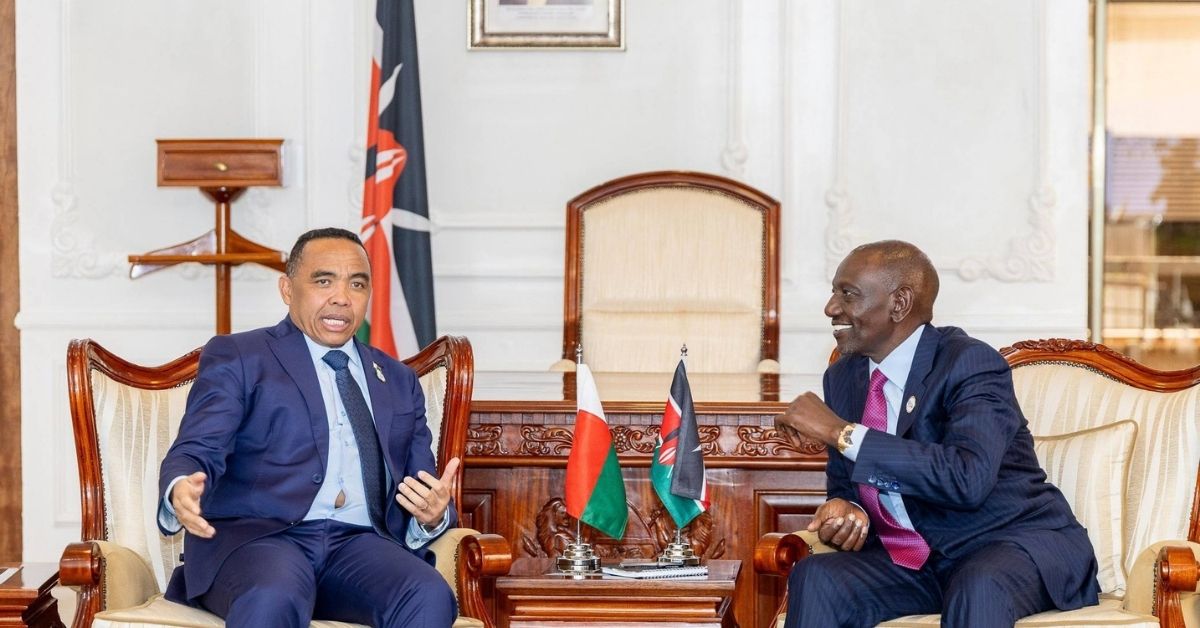
President William Ruto hosts the Madagascar’s junta leader Michaël Randrianirina in Nairobi on May 12, 2026. (Photo: PCS)
President William Ruto has long presented himself as one of Africa’s more outspoken opponents of military coups.
Yet Nairobi’s decision this week to send a private jet frequently used by the Kenyan president to collect Madagascar’s junta leader for the Africa Forward Summit highlighted the growing gap between continental rhetoric and geopolitical practice.
The aircraft was dispatched to pick up Colonel Michael Randrianirina, who seized power in Madagascar last year after unrest forced former president Andry Rajoelina from office.
Upon arrival in Nairobi, the junta leader was received with ceremonial courtesies typically reserved for recognised heads of state.
Ruto himself reinforced that symbolism at State House, Nairobi. At the State banquet, the Madagascar junta leader was seated strategically just two seats from President Ruto’s right — a placement unlikely to be considered accidental in diplomatic protocol.
“Held talks with President Michael Randrianirina of Madagascar at the sidelines of Africa Forward Summit in Nairobi,” the Kenyan leader wrote after the meeting.
“We agreed to continue strengthening diplomatic ties between our two countries.”
He went further, commending Randrianirina on governance reforms and constitutional initiatives, before lobbying him to support Kenya’s candidate for the International Criminal Court bench.
The language was significant. In diplomacy, titles are rarely incidental. Referring to a junta leader as “Mr President” before continental recognition is restored is not merely etiquette but a form of political signalling.
Awkward contradiction
That creates an awkward contradiction for Nairobi. Kenya has consistently condemned unconstitutional changes of government in Africa and has often aligned itself with the African Union position set out in the Lomé Declaration and the AU Constitutive Act.
Both frameworks reject military takeovers and call for the suspension of offending regimes until constitutional order is restored.
Indeed, Ruto has positioned himself as a continental advocate for tougher anti-coup measures.
During an AU reform session in Luanda late last year, he backed proposals for stricter sanctions against coup leaders.
“We have also proposed strengthening AU norms against unconstitutional changes of government,” Ruto said at the time.
“This will help restore constitutional order and deter future violations.”
When soldiers overthrew Mohamed Bazoum in 2023, Ruto condemned the coup as an unconstitutional act that undermined democratic gains and regional stability.
An exception
Madagascar, however, now appears to be an exception. Unlike several leaders from Africa’s recent coup wave who attended the summit after later organising elections and regaining continental legitimacy, Madagascar’s junta remains outside full AU recognition structures.
Why Nairobi chose to engage now remains the more pressing question.
Geography may offer part of the answer. Madagascar sits in a strategically important position in the Indian Ocean at a time when external powers are recalibrating their influence across the region.
France, the island’s former colonial power, retains deep economic and political interests there.
The timing was also notable. Relations between Paris and Antananarivo have deteriorated sharply in recent months after Madagascar expelled a French diplomat over alleged destabilisation activities — accusations France rejected as false.
Former president Rajoelina himself fled the country with French assistance as protests over water and electricity shortages spiralled into a political crisis.
Your support empowers us to deliver quality global journalism. Whether big or small, every contribution is valuable to our mission and readers.