
















Kenya’s Mistake of Turning Continental Elections into a Political Rally
| February 14, 2025

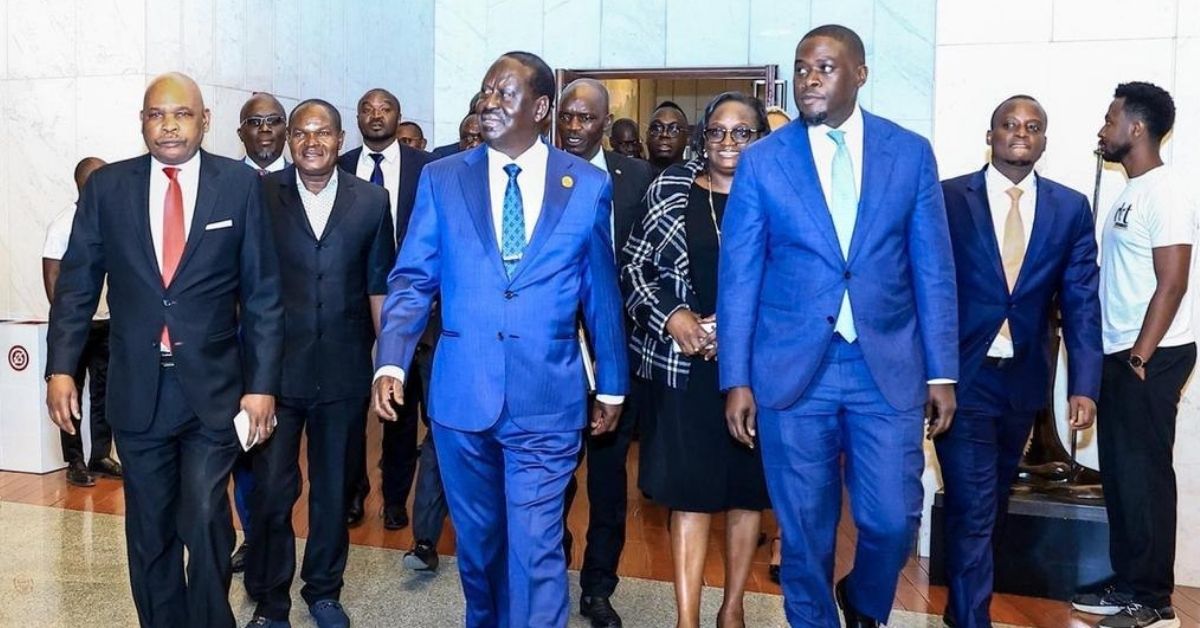
A crowd of Kenyan parliamentarians, governors, and village politicians packed into an Addis Ababa hotel, jubilantly singing and showering praise on Raila Odinga, who sits at the center like the undisputed boss ahead of Saturday’s polls. Photo: Handout
In 2017, Kenya’s bid for the African Union Commission (AUC) chairmanship ended in a bruising defeat when Amina Mohamed lost to Chad’s Moussa Faki.
It wasn’t just a diplomatic heartbreak; it was a glaring lesson in how continental politics doesn’t work like a political rally.
Fast forward to 2025, and it seems Kenya hasn’t quite learned the lesson.
As Raila Odinga faces his most formidable diplomatic test in Addis Ababa, Kenya appears to be replicating the razzmatazz and fanfare of local politics on the continental stage.
A reported 100 Kenyan MPs in a baffling display of diplomatic naivety have already arrived in Addis to “cheer” him on in the high-stakes African Union race.
Videos reviewed by Kenyan Foreign Policy reveal a crowd of Kenyan parliamentarians, governors, and village politicians packed into an Addis Ababa hotel, jubilantly singing and showering praise on Raila Odinga, who sits at the center like the undisputed boss.
But this begs the question—does diplomatic success really hinge on numbers and noise?
Diplomatic Showmanship vs Quiet Lobbying
Continental diplomacy thrives on quiet, calculated maneuvers. Backroom deals, strategic alliances, and silent but steady persuasion define multilateral elections.
Yet, Kenya’s approach often appears overly theatrical—turning serious diplomatic contests into noisy political campaigns.
In 2017, Kenyan lawmakers and high-profile officials trooped into Addis with a sense of inevitability, confident that Amina Mohamed’s credentials and public endorsements guaranteed her victory.
But when it came to the secret ballot, reality hit hard. Some of Kenya’s closest neighbors—countries Kenya counted on—did not vote for Amina.
The result? A humbling loss and a painful lesson on how public endorsements don’t always translate into votes despite spending a leg and an arm in flashy campaigns.
A Continental Game with Different Rules
Unlike Kenya’s local politics, where mass mobilization and public spectacle can shift the narrative, continental diplomacy plays by different rules.
Public displays of support rarely influence voting outcomes. In fact, they can alienate undecided voters or raise suspicions about a candidate’s intentions.African Union elections are not won in plenary halls filled with applause. They are won in closed-door meetings at Sheraton or Hyatt Regency, through strategic compromises, and by presenting a compelling case for why a candidate represents not just their country’s interests but the continent’s broader agenda.
There’s a reason big continental powers like South Africa, Egypt, and Nigeria know when to step back and play the long game.
On Wednesday, during the elections of AU commissioners in Addis, Pretoria secured a decisive victory with 41 votes for their candidate, Lerato Mataboge, as AU Infrastructure and Energy Commissioner.
Meanwhile, Nigeria’s seasoned diplomat Bankole Adeoye retained the powerful Political Affairs, Peace, and Security seat in the first round.
Ghana followed suit with an overwhelming 45 out of 49 votes when its experienced diplomat, Amma A. Twum-Amoah, was elected AU Commissioner for Health, Humanitarian Affairs, and Social Development.
These are the people to observe and learn from for lessons in diplomatic strategy and coalition-building.
But can Kenya deliver a 2/3 majority win for Raila Odinga—let alone a commanding 40-vote victory?
A Risky Approach
By sending a large political entourage to Addis, Kenya risks giving off the wrong impression—that this race is about domestic political ambitions rather than a genuine desire to serve Africa’s interests.
While Raila Odinga’s candidacy is strong, the strategy surrounding it could backfire.
Continental leaders may interpret Kenya’s overwhelming political presence as a power grab, especially given Kenya’s recent history of bidding for several continental positions.
In 2022, Kenya lost the bid to host the AU Humanitarian Agency to Uganda—a reflection of growing fatigue over Nairobi’s high appetite for continental leadership roles.
Learning from Past Mistakes
For Kenya to succeed, it must abandon the razzmatazz approach and focus on diplomatic substance during these final hours. This means fewer selfies and noise in Addis and more strategic, behind-the-scenes lobbying.
Nairobi must recognize that diplomacy isn’t a popularity contest. It’s about trust, alliances, and the ability to navigate delicate regional dynamics.
Nairobi has to whisper to the right ears.
In 2025, Kenya is once again in the spotlight. Raila Odinga’s race for the AUC chairperson position is a chance for Nairobi to redeem itself and prove that it has matured diplomatically.
But to do so, it must play by the rules of continental diplomacy—not domestic politics.
Your support empowers us to deliver quality global journalism. Whether big or small, every contribution is valuable to our mission and readers.