Kenya’s Haiti Gamble: No Money, No Backup, and Now, the First Casket Returns Home
By Mwangi Maina
| March 6, 2025

President William Ruto greets members of the Kenya Police after he arrived in Haiti to review security assistance at the Toussaint Louverture International Airport, in Port-au-Prince, Haiti, September 21, 2024. Photo: PCS
Kenya’s mission in Haiti is unraveling fast.
What was framed as a bold humanitarian and security intervention is quickly turning into a high-risk, underfunded operation with no clear endgame.
With the first Kenyan casualty set to return home in a casket, the reality is sinking in: Kenya has stepped into a battlefield without the necessary resources, adequate financial backing, or a defined strategy for success.
The United States, the mission’s main orchestrator, remains hesitant—and with no clear funding commitments from Washington, the Kenyan-led Multinational Security Support (MSS) Mission is now dangerously exposed.
The First Casualty: A Harsh Reality Check
Until now, the conversation around Kenya’s Haiti mission has been largely political. The Kenyan government has defended its role in restoring stability, while critics have questioned the wisdom of deploying police officers into an active urban insurgency halfway across the world.
But now, the situation has turned deadly. The first Kenyan casualty has confirmed what many security analysts feared—Kenya underestimated the nature of the fight in Haiti.
The streets of Port-au-Prince are controlled by gangs that operate like militias, wielding military-grade weapons, enforcing territorial dominance, and carrying out acts of brutality that have left Haitian authorities powerless.
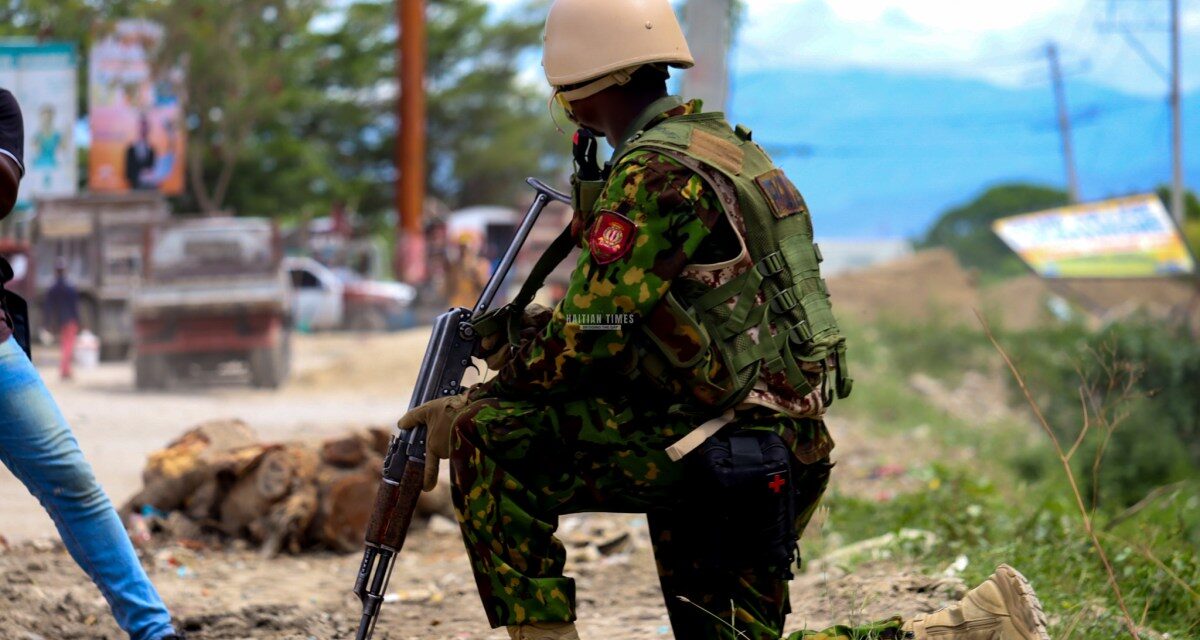
Kenyan police officers—trained for urban law enforcement, not war zone combat—are now finding themselves outgunned, outnumbered, and with little to no support from the very countries that pushed for the mission in the first place.
No Money, No Reinforcements, No Clear Plan
Beyond the human cost, the financial reality is just as grim.
Kenya entered Haiti under the assumption that the MSS mission would be backed by a fully funded financial trust, but that has not materialized.
Contributions have been slow and inconsistent, leaving the force stretched thin on resources, equipment, and personnel.
“The MSS had not been supported to reach full capacity of 2,500 troops and had only 400 at the time of the request. Hence it was premature to talk of transformation when its full capability had not been tested,” Kenya’s Permanent Representative to the UN, Erastus Ekitela Lokaale told KFP.
As of now, the MSS has just 1,000 personnel deployed—less than half the force size initially envisioned.
Without money, reinforcements, or proper infrastructure, the mission is already struggling. And the biggest red flag? The U.S.—the main architect of the mission—is showing no urgency in committing more funding or military support.
The Biden administration, which strongly lobbied Kenya to take the lead in Haiti, is out of power and the new regime has largely remained silent since the mission launched.
There are no visible signs that Washington intends to step in with logistical support, aerial surveillance, or emergency reinforcements, leaving Kenya to shoulder the burden alone.
Kenya’s Diplomatic Tightrope: Stay or Exit?
With a casualty count beginning and funding nearly nonexistent, Kenya faces an urgent decision: Does it double down and push forward, hoping international donors eventually step up? Or does it begin laying the groundwork for an exit strategy before the mission collapses entirely?
For now, President William Ruto’s administration appears determined to push on, hoping that by proving commitment on the ground, financial backers—including the U.S., Canada, and European nations—will be forced to follow through.
But the risks are escalating faster than the funding.
“Since our mandate is to support Haitian authorities, we supported their request BUT insisted on a PKO WITH A ROBUST MANDATE,” Lokaale emphasized.
Yet, as it stands, the MSS is neither a traditional UN peacekeeping mission (PKO) nor a fully equipped counterinsurgency force.
It sits somewhere in between—underfunded, under-equipped, and dangerously exposed to Haiti’s gang warfare.
The Haitian Battlefield: Why Kenya is Outmatched
Haiti is not just another fragile state—it is a failed state where armed groups control more than 80% of Port-au-Prince.
Unlike other Kenyan peacekeeping operations in Somalia, the terrain, politics, and enemy forces in Haiti are entirely different.
The Gangs are Heavily Armed: Haiti’s criminal groups wield military-grade weapons smuggled from the U.S, and the Government is Weak: Haitian authorities are barely functional, with no real ability to govern beyond their immediate compounds.
The Geography is Hostile: Unlike Somalia, where Kenyan forces had open-field battlegrounds, Haiti is an urban warfare setting with densely packed slums—making ambushes easier and security harder.
For Kenyan officers, the lack of terrain familiarity, language barriers, and intelligence limitations put them at significant risk.
And now, with casualties beginning to emerge, Nairobi must acknowledge the true scale of the mission’s dangers.
With the first casket returning home, it is no longer just a diplomatic venture—it is a life-and-death decision for Kenyan officers on the ground.
The Ruto administration must urgently clarify its long-term strategy: Is there a plan for reinforcements? Or will the current force remain inadequate and stretched thin? Will Kenya demand stronger financial backing before deploying more officers? If casualties rise, will Nairobi consider withdrawing?
What was initially billed as a historic security intervention now risks turning into a prolonged, costly entanglement.
For Kenya, the cost of miscalculating Haiti’s crisis is no longer theoretical. It is now measured in human lives.
And as Washington continues to hesitate, Nairobi may soon have to decide how much longer it is willing to carry the burden alone.
Your support empowers us to deliver quality global journalism. Whether big or small, every contribution is valuable to our mission and readers.