Canada Takes Aim at Rwanda Over DRC Conflict, Kigali Fires Back
By James Kinyua
| March 4, 2025
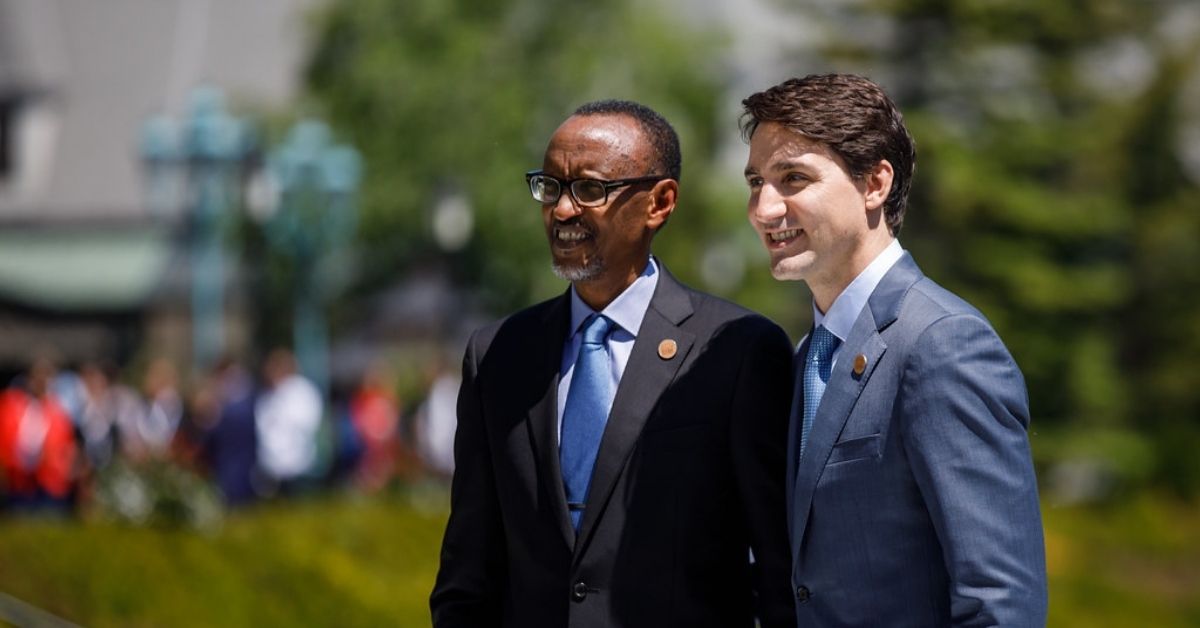
Prime Minister Justin Trudeau welcomes President Kagame to the G7 Summit outreach session | Quebec, 9 June 2018. Photo: Handout
Rwanda has fired back at Canada’s decision to impose punitive measures over Kigali’s alleged role in the escalating conflict in eastern Democratic Republic of Congo (DRC), dismissing Ottawa’s stance as “shameful” and one-sided.
In a strongly worded statement on Tuesday, Rwanda’s Ministry of Foreign Affairs condemned Global Affairs Canada’s attribution of alleged atrocities to Rwanda, describing it as “unacceptable” and insisting that Kigali would be “seeking clarification” from the Canadian government.
“Canada cannot claim to welcome the efforts of regional actors in the peace process when it places the blame for all kinds of violations on Rwanda and fails to hold the DRC government accountable, emboldening it to escalate attacks against its own civilians,” Rwanda’s foreign ministry declared.
The sharp response comes after Canada announced a series of restrictive measures, including suspending export permits for controlled goods and technologies to Rwanda, halting government-to-government business relations, and reviewing its participation in international events hosted in Kigali.
A Hardening Stance from Canada
Ottawa’s latest measures signal a growing Western consensus that Rwanda bears responsibility for fueling instability in eastern Congo.
In its statement, Canada explicitly linked the new restrictions to “Rwanda’s actions in the eastern DRC.”
The measures include:
Suspending the issuance of export permits for controlled goods and technologies to Rwanda.
Halting new government-to-government business engagements and trade support activities.
Reviewing Canada’s participation in events hosted in Rwanda and reconsidering Kigali’s future hosting of international events.
While these sanctions stop short of directly targeting Rwandan officials, they align with broader diplomatic efforts—led by the United States, the European Union, and the United Kingdom—to increase pressure on the administration of President Paul Kagame over its alleged backing of the M23 rebel group.
The Canadian government’s decision reflects concerns that Rwanda’s military and intelligence structures are actively supporting M23, a militia that has seized key territories in eastern DRC, displacing thousands.
Rwanda’s Counteroffensive: Western Hypocrisy and Selective Outrage
For Rwanda, the Canadian position is nothing short of diplomatic hypocrisy—one that conveniently ignores atrocities committed by the Congolese government and its allied militias while singling out Kigali.
“This includes the ongoing daily bombing and attacks on Banyamulenge villages in South Kivu by FARDC, FDLR, and Wazalendo. Canada’s silence on these grave human rights violations is wrong and shameful,” Rwanda stated.
Rwanda has consistently rejected claims that it supports M23, instead pointing fingers at Kinshasa’s collaboration with the FDLR, a Hutu extremist group with historical ties to the 1994 Rwandan Genocide.
Kigali argues that Western powers are ignoring the Congolese government’s complicity in fueling instability, while unfairly scapegoating Rwanda.
“The measures against Rwanda announced by Canada will not solve the conflict,” the foreign ministry added, insisting that Rwanda would continue working within the “agreed African-led mediation process” while safeguarding its national security.
This statement reflects Rwanda’s broader diplomatic strategy—rejecting external intervention in favor of regional conflict resolution mechanisms, a position it has repeatedly emphasized in forums such as the East African Community (EAC) peace process.
Geopolitical Implications: Rwanda’s Increasing Isolation
Canada’s move marks yet another diplomatic setback for Rwanda, as the country faces mounting isolation over its role in eastern DRC.
Despite Kagame’s administration maintaining strong alliances with some Western partners, the accusations of supporting M23 have led to:
The suspension of military aid from the U.S
EU discussions on additional sanction
A growing rift with France, which has backed Kinshasa’s position on the conflict
The biggest concern for Kigali, however, is that the pressure campaign could translate into deeper economic and diplomatic consequences.
Canada’s review of participation in Rwanda-hosted events raises questions about the country’s ability to continue positioning itself as a global diplomatic hub.
The suspension of government-to-government business engagements could affect Rwanda’s bilateral trade and investment opportunities.
More significantly, if other G7 nations follow Canada’s lead, Rwanda could face further restrictions on arms procurement and security cooperation.
The Kigali-Ottawa standoff highlights how the DRC conflict is increasingly shaping Rwanda’s international relationships.
With Canada now taking a stronger stance, the question is whether this will set off a chain reaction among other Western allies, or whether Rwanda can hold its diplomatic ground through regional mechanisms.
For now, Kagame’s administration is signaling defiance, rejecting Canada’s accusations while doubling down on its criticism of Western double standards.
Your support empowers us to deliver quality global journalism. Whether big or small, every contribution is valuable to our mission and readers.