




















Uganda Turns to Tanzania Rail Corridor as Geography, Politics and Trade Converge
By Mwangi Maina
| February 11, 2026
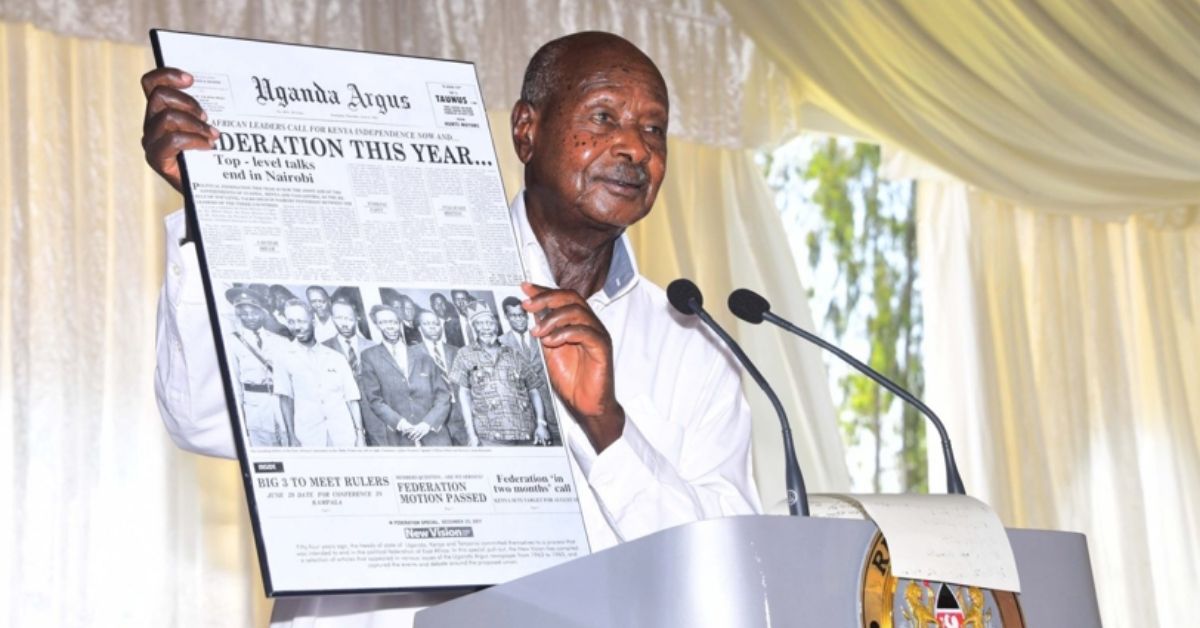
An August 2024 image shows Uganda’s President Yoweri Museveni in Zanzibar holding up an old newspaper headline during discussions on East Africa Community political federation. (Photo: X/Yoweri Museveni)
Uganda and Tanzania have outlined plans to extend a standard gauge railway linking Kampala more directly to the Indian Ocean, a move that signals far more than a transport upgrade.
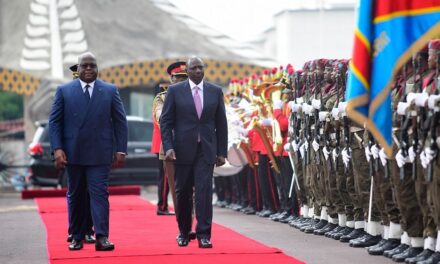
The understanding was sealed during an official visit by Ugandan President Yoweri Museveni to Dar es Salaam, his first foreign trip since his mid-January re-election and the first outbound head-of-state visit hosted by President Samia Suluhu Hassan since Tanzania’s contentious October polls.
For Uganda, a country without a coastline, rail corridors are not merely economic infrastructure but instruments of strategic autonomy, a response to what geopolitical writers describe as the enduring limits imposed by geography.
President Museveni has in recent months sharpened his rhetoric on potential future conflicts over maritime access, framing sea routes less as conveniences than as matters of national survival.
The renewed focus on Tanzania comes even as Kenya has advanced parallel proposals to anchor Uganda’s trade through the port of Mombasa, a corridor Kampala has long relied upon for its imports and exports.
Uganda’s apparent tilt toward Dar es Salaam suggests a deliberate diversification strategy, if not a full shift: reduce dependence on a single outlet, expand bargaining leverage and hedge against political or logistical disruptions.
The logic echoes the thesis popularised in Prisoners of Geography by Tim Marshall — that states do not escape their physical location, but learn to negotiate with it. Landlocked countries, the argument goes, often seek multiple gateways to the sea not out of rivalry but necessity.
Rail lines, pipelines and ports become tools of foreign policy as much as engines of commerce.
Uganda’s importance to Kenya’s economy illustrates the stakes. More than half of transit cargo through Mombasa port in 2024 was destined for Uganda, making it the leading external user of the facility, according to Kenya’s port authorities.
Policymakers in Nairobi understand how disruptions — even technical ones — can ripple across the region. When Uganda’s customs systems briefly went offline earlier this year due to elections, thousands of trucks jammed the Malaba border in a gridlock stretching nearly 15 kilometres, while containers piled up at Mombasa’s terminals.
“You cannot declare goods to a system that is offline,” said Roy Mwanthi, chair of the Kenya International Freight and Warehousing Association, in a January press interview.
“Our drivers are sleeping in their cabins, the perishable goods are rotting, and the demurrage charges are mounting. This election is expensive for everyone.”
Any blockage along Uganda’s border with Kenya effectively chokes the entire Northern Corridor, affecting Rwanda, South Sudan and eastern Congo. In East Africa, the map quietly shapes diplomacy as much as ideology.
Uganda and Tanzania also find common ground in political posture. Both governments, led by long-ruling parties, the NRM in Kampala and CCM in Dodoma have at various points faced criticism from Western capitals over electoral credibility and governance standards.
That shared experience has nudged them toward closer bilateral alignment and an emphasis on sovereignty and non-interference. Their cooperation on rail and energy projects therefore carries both economic and symbolic weight, projecting a measure of regional solidarity independent of external approval.
Kenya, by contrast, occupies a different lane in the regional imagination. With its more overt pro-Western alignments, liberalised economy and status as a hub for international finance and diplomacy, Nairobi is often viewed as the region’s most outward-facing and capital-driven economy.
While Kenya remains Uganda’s largest trading partner and a critical transit route, its economic dominance and political orientation have at times stirred unease among segments of the Ugandan and Tanzanian political class, who frame diversification as insurance rather than rejection.
Museveni, a self-described student of history, often refers to it as “current affairs.” During his Dar es Salaam visit he warned African elites against what he called “arrogance and egoism,” urging unity in the face of external coercion and citing India’s strategic resilience as an example.
Speaking fluent Swahili, a nod to his early years studying political science and economics at the University of Dar es Salaam, the old man with a hat reiterated his long-standing mantra of “independence, prosperity and strategic security”.
Historical memory also colours the calculus. During periods of tension in the 1970s, Kenya leveraged its coastal advantage to restrict Ugandan access to Mombasa, illustrating how geography can be wielded as pressure. More recently, disputes have surfaced in court. In filings before the East African Court of Justice in late 2023, Uganda accused Kenyan authorities of restraining petroleum import licensing, arguing that roughly 90 per cent of its refined fuel traditionally transits through Mombasa and the Kenyan pipeline network.
Though relations have since stabilised, the lesson appears to have endured. Uganda’s renewed push toward Tanzanian rail links underlines a broader economic diversification drive, not an abandonment of Mombasa, but a widening of options.
The railway proposals sit at the intersection of geography, economics and perception. They are as much about ensuring fuel and goods reach Kampala without bottlenecks as they are about signalling political flexibility in a region where infrastructure doubles as diplomacy.
Whether the first vessel from Tanga to Lake Victoria via Musoma will depart on schedule, as projected by President Samia Suluhu Hassan, remains uncertain.
Your support empowers us to deliver quality global journalism. Whether big or small, every contribution is valuable to our mission and readers.