By Mwangi Maina
| December 23, 2025
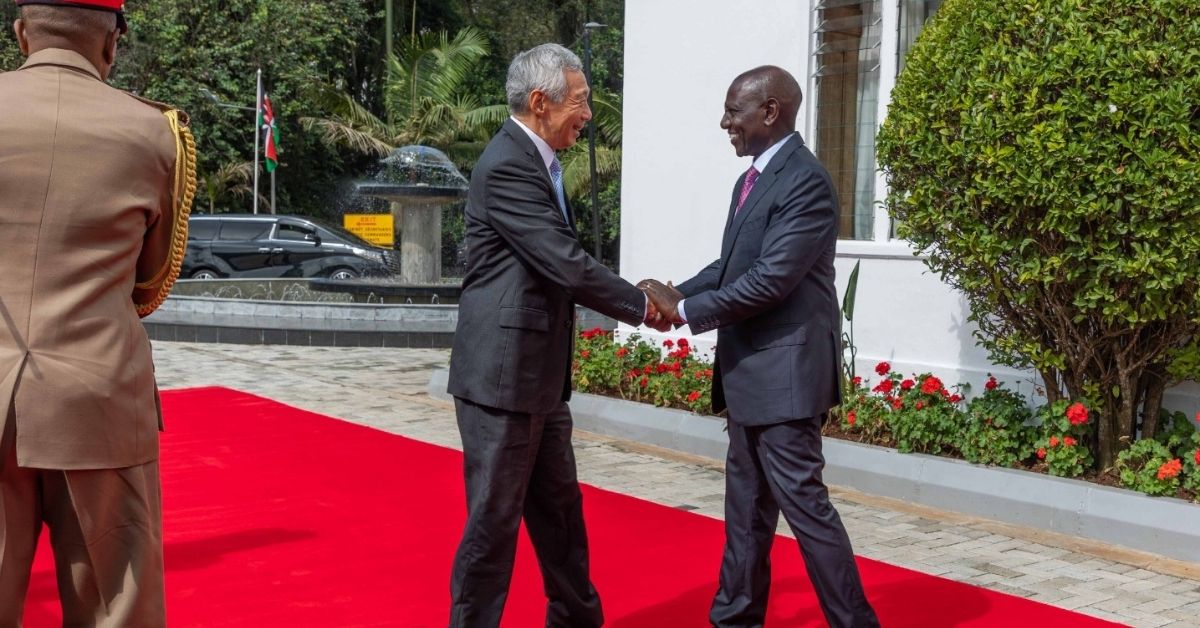
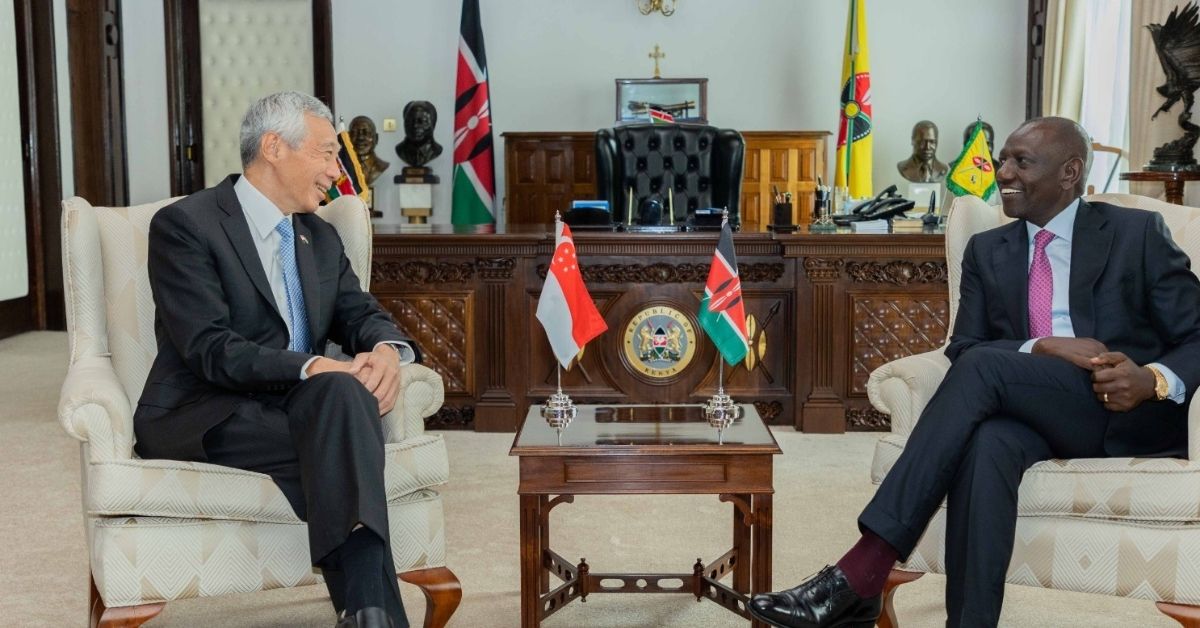
President William Ruto hosts then Singapore Prime Minister Lee Hsien Loong at State House, Nairobi in May 2023. Photo: Handout
Kenyan leaders have long fantasised about turning the country into the “Singapore of Africa.”
President William Ruto has revived the slogan with missionary zeal, vowing to drag Kenya into the ranks of high-income economies.
But the dream is older than his administration—and older than his predecessor’s.
When Daniel arap Moi visited the White House in 1980, President Jimmy Carter raised an unexpected concern: Kenya’s surging population.
Carter wondered whether Moi—“a father of seven”—could credibly lead a national campaign on family planning. Moi countered that he had been studying Singapore’s demographic discipline and development model, a template he hoped to adapt at home.
Carter agreed that Lee Kuan Yew had done “a good job,” then added a caveat: Singapore was small; Kenya was not.
Diplomatic cables from the meeting show American officials proposing a population-policy conference in Nairobi to “stimulate interest in the problem,” an idea that Moi and his entourage welcomed.
Four decades later, the ambition endures, but the road remains stubbornly unmapped.
Kenya’s Singaporean aspiration continues to hover somewhere between political rhetoric and a long-running national illusion.
Uhuru Kenyatta also flirted with the comparison. On a 2019 visit to Singapore he praised the city-state as a model for Kenya’s Vision 2030.
President Ruto, who repeatedly cites Singapore’s discipline and efficiency, has yet to make the pilgrimage himself.
Singapore’s founding premier, Lee Kuan Yew, built a legacy now admired across Africa—particularly in Kenya and Rwanda, two countries fond of invoking his methods.
His formula rested on three principles: effective authority, institutional continuity, and a graceful transfer of power. Kenya has struggled with all three.
Lee’s governance philosophy was unapologetically technocratic.
His successors, including current Prime Minister Lawrence Wong, run the state like a high-performing corporation: academically top-tier ministers, competitive salaries to deter corruption, measurable performance indicators, and a bureaucracy designed to facilitate—not frustrate—ideas.
In Singapore, one scandal ends a political career overnight. In Kenya, a scandal is more likely to earn someone a Cabinet appointment.
Singapore’s Corrupt Practices Investigation Bureau reports directly to the prime minister and treats graft with the severity other countries reserve for terrorism.
Singapore also excels in the unglamorous mechanics of statehood: regulatory quality, ease of doing business, public-service efficiency, and long-horizon economic planning.
Its development strategy is measured in 30-year arcs; Kenya’s policy-making struggles to see beyond the next five-year electoral cycle.
Vision 2030, once Kenya’s big bet on long-term planning, is now only a few years away—and still feels like a slogan hunting for substance.
Transparency International ranks Singapore 5th globally for clean governance, Asia’s least corrupt country and cleaner than most European democracies. Kenya sits in a very different bracket.
Ruto insists his administration is laying the foundations to make Kenya the “Singapore of Africa,” arguing that reforms will bear fruit “much sooner than critics think.”
His supporters see a government working through the friction; his critics see a government creating it.
For now, the comparison remains aspirational. Singapore is a high-capacity state with disciplined politics, an elite bureaucracy, and an intolerance for corruption.
Kenya has energy, ambition, and flashes of reform but also entrenched patronage, bureaucratic drag, and politics that regularly swallow policy.
Your support empowers us to deliver quality global journalism. Whether big or small, every contribution is valuable to our mission and readers.