








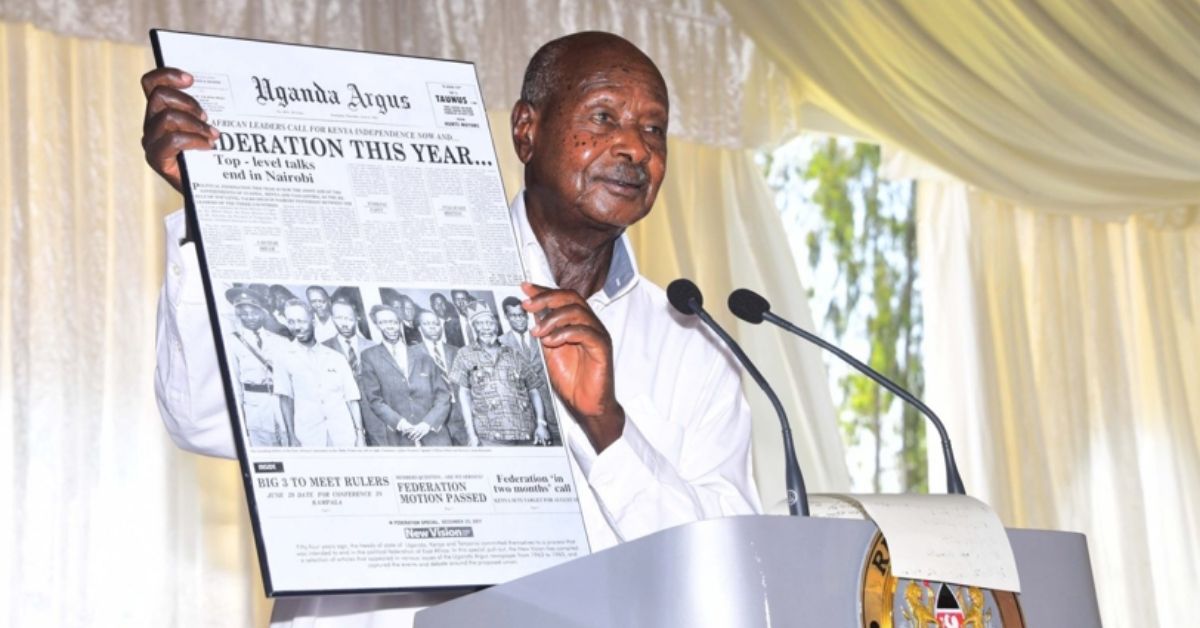
Museveni’s Regional Federation Dream Meets East Africa’s Fractured Reality
By Mwangi Maina
| December 23, 2025
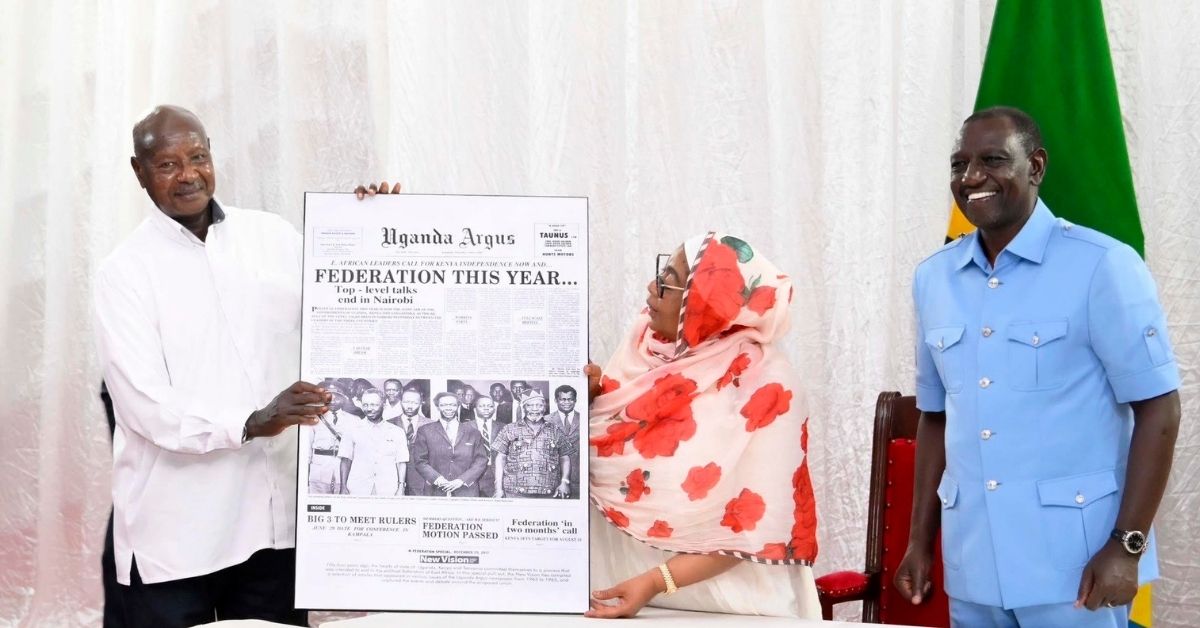
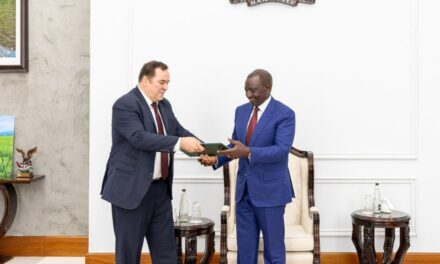
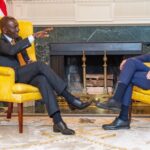
In Zanzibar, March 2024: Uganda’s Yoweri Museveni, Tanzania’s William Ruto hold up a historic Uganda Argus fron page as they revived the decades-old ambition of an East African federation. Photo: William Ruto (X).
Uganda’s President Yoweri Museveni has revived one of his most enduring political obsessions: the creation of an East African political federation, the supposed “final stage” of regional integration.
He has floated the idea since taking power in 1986, and once again returned to it on the campaign trail ahead of Uganda’s January 2026 elections.
Speaking this week from his Kisozi ranch, dressed in his trademark camouflage jacket – a garment meant to conjure “combat mood” and revolutionary legitimacy – Museveni lamented, again, Uganda’s lack of an ocean coastline.
“Kenya and Tanzania, which are closer to the ocean, did not make sufficient effort to achieve this,” he said in Luganda, in remarks translated by state broadcaster UBC.
His solution, now familiar: forge a federation and “develop together”.
Museveni, who styles himself the “old man with a hat”, remains the region’s loudest evangelist for the federation.
In his charming telling, political union offers prosperity, strategic heft, and continental influence.
The idea is hardly new. It has circulated since the 1960s, collapsing each time under mistrust, uneven reforms, and competing national ambitions. Little has changed.
The East African Community (EAC)—founded by Kenya, Tanzania, and Uganda in 1967, collapsed ten years later, and revived in 1999—now counts eight members, including the Democratic Republic of Congo and Somalia.
The bloc still describes political federation as its “ultimate goal”, anchored in common foreign and security policies and good governance.
A 2004 summit in Nairobi even endorsed a fast-track mechanism. Two decades on, the dream lives mostly on paper.
The obstacles are legion. Tanzania, despite Julius Nyerere’s early enthusiasm, is deeply protective of sovereignty.
Kenya’s policymakers, while polite in public, understand the political and economic risks.
Newer members have imported their own quarrels: DRC accuses Rwanda of sponsoring the M23 rebellion; Rwanda fires back with talk of self-defence and Burundian meddling.
Uganda is deeply entangled in eastern Congo. Somalia and Kenya remain locked in a maritime dispute.
The bloc’s expanded geography has widened, not narrowed, its fault lines. Regional history offers its own cautionary notes.
Declassified diplomatic cables show that in 2005, Tanzania’s newly inaugurated president Jakaya Kikwete already doubted Museveni’s intentions.
Kikwete told Jendayi Frazer, then U.S. assistant secretary of state, that Museveni appeared to be positioning himself for the presidency of a future federation.
East Africans, he warned, might reject a leader “with such a record” and a reputation for “disregarding the opinions of others”.
Senior Ugandan figures—“the historicals”—had already urged Museveni to step aside, he said. They were ignored.
Frazer agreed that integration was economically important, but not a reason to cling to power.
Kikwete concurred: to “die in office”, he said, would be a disservice.
Museveni, then two decades into his rule, had suggested he might leave by 2013 and then move to the East African presidency.
Two decades later, he remains firmly in place.
Support for federation has always been strongest in rhetoric. Tanzania’s Benjamin Mkapa once argued it would bring “safety in numbers” and help fight poverty.
Yet the political terrain has hardened. The EAC’s membership has grown from three to eight, but so have its divisions.
The bloc remains preoccupied with border spats, security crises, and ideological mismatches rather than institutional convergence.
Uganda’s president, who quips that history is merely “current affairs” because he lived it, continues to sell a vision that has repeatedly collapsed under historical weight.
Two decades after its revival, the federation remains a pipe dream, kept alive largely by the one leader who has outlasted nearly all his regional contemporaries.
Your support empowers us to deliver quality global journalism. Whether big or small, every contribution is valuable to our mission and readers.