Echoes of War: Somalia’s Chaos and Kenya’s Fragile Defences
By Kiyo Nganga
| March 31, 2025
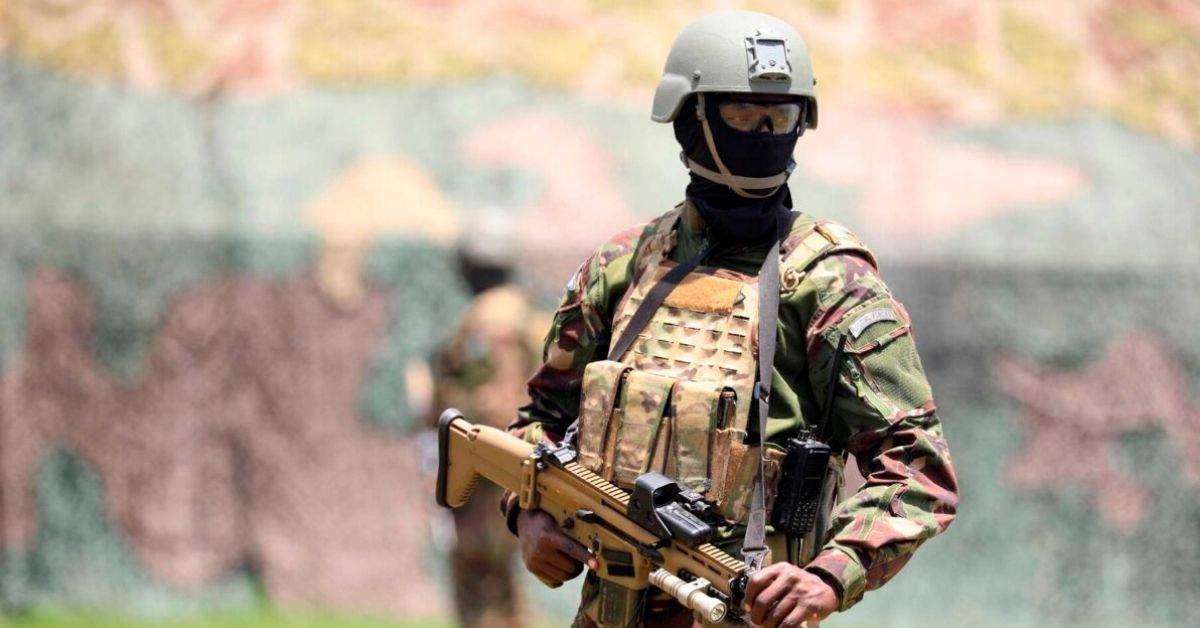
An archival image of a Kenya Defence Forces (KDF) officer captured during a public ceremony. Photo: Handout
Over the past few weeks, the Kenya and Somalia security environment has been characterised by a resurgence of terrorist activities orchestrated by the Somalia-based Alshabaab militant group.
Somalia has suffered one of its worst offensives, with a threat of Mogadishu falling into the wrong hands.
The war is not new; this is the 21st year of Somalia authorities fighting Alshabaab since the reconstitution of the Somalia National Army (SNA) in 2004 after its disintegration during the Somalia civil War in the late 1980s, SNA has been fighting Alshabaab since then with the support of international partners in different formations, missions and forms from AMISOM, US-AFRICOM to ATMIS etcetera.
The war has been won and lost in equal measure. The events of recent activities in Somalia paint a picture of a security threat environment where the Federal Government appears to be fast losing grip, despite earlier successes that saw over 250 locations liberated through a multifront counter Alshabaab offensive.
Alarming is the recent holding of forte by Alshabaab just 39 minutes away from Mogadishu Airport, seizing control of the highway connecting Mogadishu to Afgoye, and cutting off the 20-kilometre road leading to Balcad from Mogadishu.
The targeting of these Main Supply Routes (MSRs) signals a strategic intent to disrupt and potentially isolate the city before a takeover.
The militant group has been encircling within a 6 km radius of Mogadishu city, overruning multiple villages and towns surrounding the city.
Most perplexing was the March 18th bomb attack on the presidential convoy as it travelled through the Mogadishu Eel-Gaab area— a short distance from the presidential Palace.
The attack deemed an assassination attempt on President Hassan, left a trail of death and injuries, underscoring the fragility of Somalia’s security situation.
While much can be said about the concluded security operations and exited international missions in Somalia, the second term of President Hassan Sheikh Mohamud in 2022 came with a renewed hope of ending the Ashabaab’s terror reign in Somalia; upon retaking the office he launched a multi-front counter Alshabaab offensive, Operation Black Lion which sparked a sweeping anti-al-Shabaab wave across Somalia.
The Federal Government incorporated local clan militias jointly known as Macawiisley, this saw the realisation of a string of success liberating locations that were long-held alshabaab pockets and strongholds including the Alshabaab capital- Harardheere in Galmudung state, a major financing hub.
It was a revolution, a chapter of success to be deeply engraved in Somalia’s history.
As Sun Tzu states in The Art of War, “Tactics without strategy is the noise before defeat” Despite Somalia gaining swathes of territories in the counter-insurgency operation, it yielded only a short-term tactical success. The operation came to a halt in 2023 as it geared to enter its second phase targetting regions further south in Southwest state, Lower Shabelle and Jubbaland, an offensive towards Kenya’s buffer regions.
The halting would be blamed on a lack of political settlement in regional governments such as South West State and Jubbaland State, exposing a broader dysfunction in Somalia’s governance.
This setback quashed the hopes of Somalia ever standing on its own feet and maybe the last chance if left unchecked.
The threat of Alshabaab remains extant with the militia demonstrating resilience, capacity and capability to wage both soft and complex attacks in Somalia and across its borders.
They have since regained strongholds that had previously been liberated in the Hirshabelle and Galmudung regions and seized new territories, including two districts in Middle Shabelle. Their capacity to control these regions projects power and grip over the country’s arteries.
The deteriorating situation in Somalia emboldens Alshabaab to conduct attacks both home and away.
What does this mean for Kenya, a neighbour vulnerable to a porous border and proximity to a faltering Somalia now in the hands of an enemy?
Historically, In their patterns and modus operandi, Alshabaab has used Kenya as its optics ground due to Kenya’s strategic value and international presence; an attack on Kenyan soil gives them their much-needed international audience, and they use the attacks for optics to make their presence known, seen and felt internationally.
Despite this unsettling reality, Kenya continues to suffer systemic surveillance failure along the Somalia border.
In the wake of the 15th of March, Kenyans were stunned by reports from Lamu, where over 150 suspected Alshabaab infiltrated Mangai village in the vicinity of the Mangai Border Patrol Unit (BPU) camp.
They gathered residents for a public baraza, gave propaganda sermons for close to 30 minutes, distributed dates for Iftar and vanished into Boni Forest undetected.
The same weekend, Kenya witnessed yet another undetected incursion further north in Mandera’s Bula-Hawo corridor. Here, 20 suspected agents of Somalia’s National Intelligence and Security Agency (NISA) crossed the border, attacked a five-man Kenya police patrol, killed an officer, injured another and seized their riffles, this in a bid to forcefully rescue a Somalia National who was being detained by the Kenyan authorities.
Adding to the list of recent cross-border surveillance failures, on 3rd February, Five government officials were kidnapped from Kenya into Somalia by suspected Alshabaab militants, a shameful blow to security in the wake of President Ruto’s tour of the North Eastern region.
On Tuesday,18th March the US Embassy issued a travel advisory cautioning its citizens against travels to Garissa and other counties along the Kenya- Somalia border due to the threat of terrorism.
Can Kenya afford these glaring systemic failures in cross-border surveillance amidst the resurgence in Somalia? Predictively, Kenya is expected to witness flare-ups of terror activities within its borders as counter Insurgency action intensifies in Somalia.
The question therefore goes, where is “Kenya’s eyes in the sky”? At the start of the year 2025, Turkish defence manufacturer Baykar announced plans to provide Kenya with six advanced Bayraktar TB2 unmanned Combat aerial vehicles (UCAVs); it is high time Kenya thought in this wavelength, enhance air to surface surveillance and while coordinating on-foot patrols along the borders.
Kenya should recruit, train and fund more police reservists while specialized like SOG and BPU leave their base inland and activate in the border regions.
More community-led policing structures and intelligence-sharing models reactivation would prevent such incidents like ” Lamu Alshabaab lectures”, where militants entered and exited with no alert to the authorities.
Kenya heavily invested effort and resources into creating a county Action Plan for Preventing and Countering Violent Extremism (P/CVE) and Terrorism where each county developed their localised counter-terrorism strategies, intelligence sharing models and channels; it is time to recoup this investment.
A falling Somalia is a resounding alarm for Kenya to recharge its batteries of surveillance and defence. Kenya is a nation at war by extension
The author is a Criminologist and Security Risk Practitioner, currently serving as the Head of Security Information Services at Armistice Security Consult International.
Your support empowers us to deliver quality global journalism. Whether big or small, every contribution is valuable to our mission and readers.