


























Ruto’s Leadership: A Masterclass in Fumbling, Force, and Foreign Blunders
| March 10, 2025
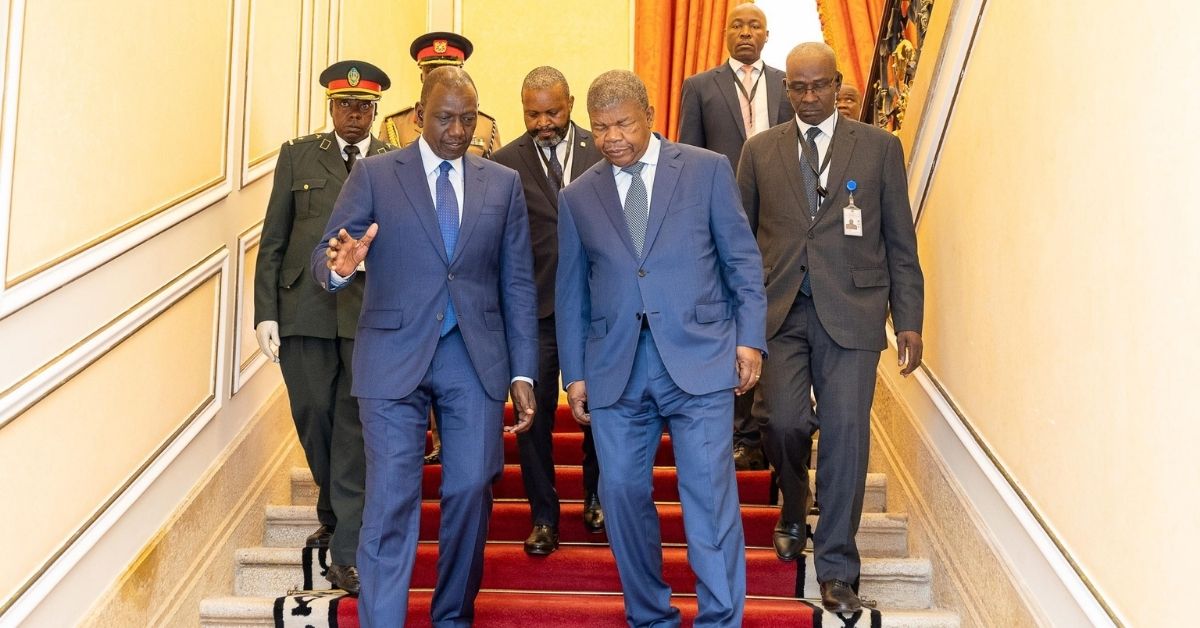
Presidents William Ruto and João Lourenço of Angola at the Angolan presidential palace in Luanda. Photo: Handout
While recently finishing up Simon Sinek’s book, ‘Leaders Eat Last’ it occurred to me that it has been two years and four months since Ruto took oath of office.
Later I was triggered by the words his deputy Kithure Kindiki had said earlier, “What President William Samoei Ruto has done in two years, it took Kibaki five years,” he said.
On October 27, 2022, when Dr. William Ruto took the oath of office as Kenya’s fifth president, he stepped into the highest political seat with luxurious promises of economic transformation and regional influence.
However, his governance is under intense scrutiny, marred by domestic unrest, international diplomatic missteps, and a leadership style that increasingly echoes authoritarian tendencies rather than democratic diplomacy.
While I wish anyone could tell Ruto to spare some time and at least skim through Sinek’s copy to understand his perspective why ‘Leaders Eat Last’, his approach to governance and diplomacy paints the picture of a leader shooting in the dark, lacking the finesse, pragmatism, and strategic vision required to navigate both local and global affairs.
Governance by Intimidation
Ruto’s presidency has been anything but smooth. His governance style has triggered widespread dissent, most notably among the youth, defined by the ‘Gen Z’ pseudo, they staged mass protests in June 2024 sparked by provisions laid out in the country’s annual Finance Bill.
These demonstrations were also a response to economic hardships, punitive tax policies, and perceived government excesses.
At the time, instead of engaging constructively, Ruto’s administration resorted to forceful crackdowns, including arbitrary arrests, abductions, and intimidation of young activists, actions that to date with continued forced disappearances, showcases a leader more inclined to suppress voices than to listen, exposing the chasm between the state and its people.
His response to protests echoes a governance style that is one inch short of a ruthless dictator.
While he has hidden meticulously well behind a few instances to engage in meaningful dialogue, his administration has flaunted following the rule of law fostering draconian measures that undermine civil liberties.
Ruto’s reluctance to foster open discussions with disgruntled citizens paints him as a leader who lacks the wherewithal to engage in domestic diplomacy — a necessary tool for national stability and cohesion.
Corruption and Dubious Deals
Diplomacy is not only about international relations; and those who have excelled at it over time have shown and taught us that it extends to how a leader manages domestic affairs.
At the start of this year, 2025, Ruto was ranked second, after Syria’s Bashar Al-Assad as the most corrupt person of the year by the Organized Crime and Corruption Reporting Project (OCCRP).
Corruption remains a thorn in Ruto’s administration, with the most recent glaring case being the controversial government contract with India’s Adani Group. The deal, which was awarded under opaque circumstances, reeked of favouritism and potential graft, further eroding public trust.
His inability to ensure transparency in such dealings subsequently raises critical questions about his commitment to ethical governance.
Rather than strengthening institutions that would enhance accountability, his administration has fostered an environment where corruption flourishes, further straining the country’s economic recovery.
Surprisingly, Ruto has also been on the spot for hosting and holding meetings with individuals linked to questionable dealings in the past.
Weeks after hosting former U.S. Congressman Mark Deli and South Sudanese politician Albino Mathom Abuog, he recently met controversial Zimbabwean businessman Wicknell Chivayo at State House.
All these individuals Google Search results bear no good news!
To date, kickbacks and the Toa Kitu Kidogo (bribery) culture in Kenya are yet to come to an end.
This mismanagement is not only a domestic concern but also a diplomatic red flag, as genuine investors and international partners increasingly question the credibility of his leadership.
Somehow, every single project or initiative launched by President Ruto, his administration and cronies seem to be marred by corruption scandals, raising serious concerns about accountability and transparencyFrom the controversial fertilizer subsidy program to inflated government contracts, mismanagement of public funds has become a recurring theme.
The latest scandal surrounding the Social Health Authority (SHA) for Universal Healthcare is no different—billions of taxpayer shillings meant to improve healthcare access are allegedly being funneled into dubious deals and politically connected pockets.
Instead of delivering much-needed relief to struggling Kenyans, these initiatives turn into avenues for looting, leaving citizens worse off while a select few enrich themselves. At this rate, it’s no longer a question of whether corruption will happen, but rather how much will be stolen and who will be implicated next.
Ruto’s Regional Relations Missteps
On the continental stage, there have been several glaring diplomatic blunders, for instance, his handling of the crisis in the Democratic Republic of Congo (DRC) -His decision to deploy Kenyan troops as part of the East African Community Regional Force (EACRF) was initially seen as a proactive move and later the abrupt withdrawal of the troops, coupled with contradictory statements on Kenya’s stance, exposed his lack of a coherent regional strategy.
DRC’s President Félix Tshisekedi has openly criticized Ruto’s handling of the matter, and relations between Nairobi and Kinshasa have soured significantly including, Mr. Tshesekedi snubbing his call recently for an emergency EAC meeting of the ongoing situation in Goma.
Ruto’s inconsistency and failure to adopt a nuanced approach to conflict resolution demonstrate his lack of diplomatic depth. An educated statesman would have engaged all stakeholders, crafted a clear position, and worked within multilateral frameworks to ensure Kenya remained a trusted mediator.
Instead, his haphazard approach has only weakened Kenya’s influence in the region evidenced by regional news outlets blatantly calling out his role in regional politics.
Consequently, and most recently, the decision to allow Sudan’s Rapid Support Forces (RSF) to establish a parallel government in Nairobi is a major diplomatic blunder that threatens Kenya’s credibility on the international stage.
By giving legitimacy to a militia accused of war crimes and atrocities, his administration without a doubt undermined regional peace efforts and jeopardized Kenya’s role as a neutral mediator in the Sudanese conflict.
This move did spark outrage from Sudan’s government and raised questions about both his and Kenya’s foreign policy strategy—whether it is driven by personal interests or a blatant disregard for diplomatic protocol. Instead of fostering stability, Kenya now risks being entangled in a geopolitical mess that could strain relations with Sudan and other regional partners.
No Diplomatic Finesse
Beyond Africa, Ruto’s diplomatic engagements with global powers have been a mixed bag of grandstanding and miscalculated alliances. Anyone can give him credit that he has positioned himself as a Pan-Africanist and reformist, (tongue-in-cheek) but his salt’s worth on foreign policy lacks substance.
Let us start by his frequent international trips that have yielded little tangible benefit for Kenya, with many questioning whether his diplomatic engagements are more about personal brand-building than national and domestic interest.
Moreover, his administration’s alignment with certain global players while alienating others has raised eyebrows and this is evidenced by his approach to Kenya’s international partnerships appearing reactionary rather than strategic, for instance, when he made comments after Trumps assumption of office on gender types being only male and female.
In an era where diplomacy demands tact, negotiation skills, and long-term vision, Ruto’s leadership has displayed none of these qualities.
Kenya Deserves Better
Ruto is not new to power, he has been a key player in Kenya’s political scene for over three decades. Yet, his leadership, both at home and abroad, lacks direction, accountability, and credibility. Kenya deserves a leader who can; govern through dialogue, not repression, tackle corruption with action, not empty words, and engage in real diplomacy, not clout chasing on the global stage.
At this rate, if Kenyans do not demand accountability, they will wake up in 2027 with a broken economy, a battered democracy, and a leader who has mastered the art of power retention at any cost. The time for scrutiny is now. The time for action is today.
The writer is a Strategic Communications Specialist with a focus on ESG frameworks, Peace & Security, Humanitarian Assistance and Sustainability.
Your support empowers us to deliver quality global journalism. Whether big or small, every contribution is valuable to our mission and readers.





