
China’s Renewed Push for Soft Power in Kenya
| March 6, 2025
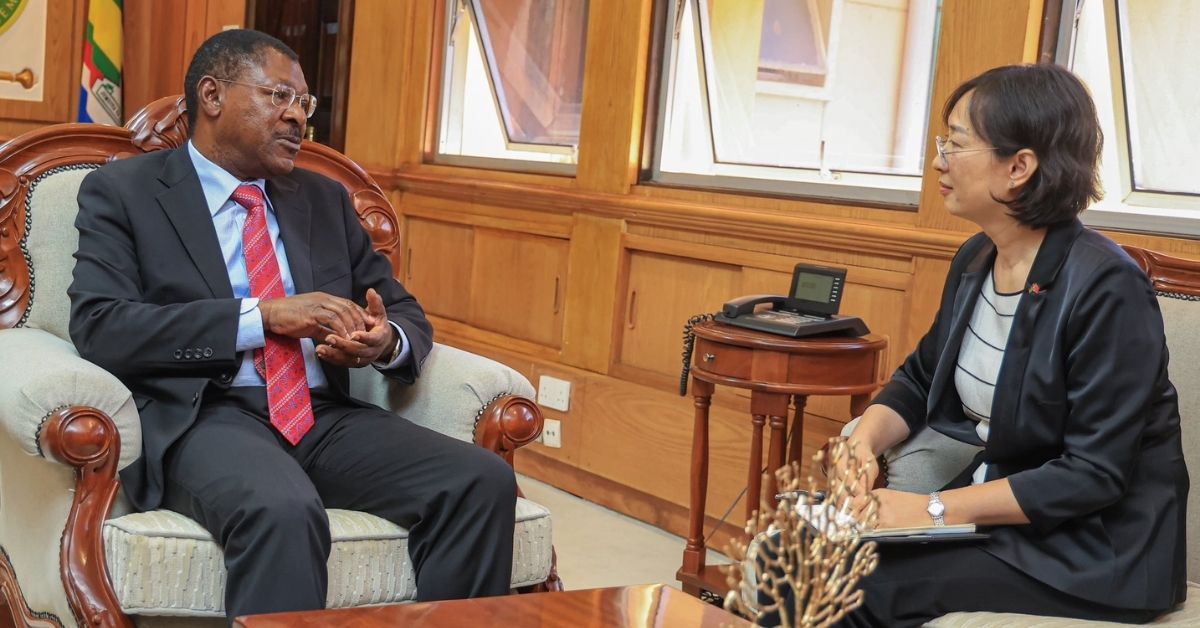
Kenya’s National Assembly Speaker, Moses Wetangula, met with China’s new ambassador to Kenya, Guo Haiyan, on Thursday in Nairobi to discuss bilateral relations. In May 2023, reports surfaced accusing Chinese government-backed hackers of launching a widespread cyber-espionage campaign targeting Kenya’s key ministries and state institutions. Photo: Handout
Beijing’s deepening ties with Nairobi are no longer just about infrastructure projects and trade; they now extend to digital governance, education, and strategic foreign policy alignment.
The latest meeting between National Assembly Speaker Moses Wetang’ula and China’s new ambassador to Kenya, Guo Haiyan, signals a renewed push for soft power, raising key geopolitical and technological concerns.
At the heart of the discussions on Thursday were China’s continued role in Kenya’s development, Kenya’s commitment to the One China Policy, and Beijing’s influence in the country’s digital and governance transformation.
One of the biggest takeaways from these meetings? China’s pledge to construct Kenya’s Ministry of Foreign Affairs Headquarters building—an infrastructure project with significant diplomatic weight.
“China values its partnership with Kenya and remains dedicated to supporting key development initiatives in infrastructure, trade, and education,” said Ambassador Haiyan.
China’s Digital Influence: Strategic or a Trojan Horse?
One of the more concerning aspects of China’s expanding engagement is its offer to help digitise Kenya’s Parliament.
Speaker Wetang’ula emphasised that Kenya seeks China’s expertise in modernizing parliamentary systems, improving efficiency, and enhancing public engagement.
“Technology-driven legislative processes will enhance transparency and governance. We seek China’s expertise in this area to modernise our parliamentary systems,” Wetang’ula stated.
However, China’s involvement in digital governance raises serious questions.
Beijing has previously been accused of having a track record of embedding surveillance capabilities in digital infrastructure projects across Africa.
The African Union (AU) headquarters in Addis Ababa, built and donated by China, was later found to have been transmitting data back to servers in Shanghai—raising alarm over potential espionage.
China rejected the claim as “preposterous” and baseless.
French newspaper Le monde in a 2018 report cited anonymous AU sources as saying that for five years, data had been transferred nightly from computers in the building to Chinese servers. It said hidden microphones had also been found.
Would China’s role in Kenya’s digitalisation process introduce data security vulnerabilities? Could critical government communications and legislative records be compromised if Chinese-built digital systems have backdoor access?
In May 2023, reports surfaced accusing Chinese government-backed hackers of launching a widespread cyber-espionage campaign targeting Kenya’s key ministries and state institutions.
According to cybersecurity research and intelligence reports, the cyber intrusions spanned three years and were allegedly aimed at gathering intelligence on Kenya’s debt repayment strategies.
The hacking campaign, which began in late 2019 and continued until at least 2022, reportedly compromised at least eight Kenyan ministries, including the National Intelligence Service (NIS), the Foreign Affairs office, and the Finance ministry.
The breach started with a spear phishing attack, where a Kenyan government employee unknowingly downloaded an infected document, allowing hackers to infiltrate multiple government networks.
The One China Policy: Kenya’s Public Commitment
Beyond digital transformation, the meeting reinforced Kenya’s diplomatic alignment with Beijing. Wetang’ula explicitly reaffirmed support for the One China Policy, recognising China’s territorial claims and sovereignty.
“Kenya fully supports the One China Policy and appreciates China’s role in global affairs. The strong historical ties between our nations will continue to grow through mutual respect and cooperation,” he emphasised.
This commitment comes at a time when geopolitical tensions over Taiwan are intensifying, and nations are being pushed to take clear positions.
Kenya, by aligning itself publicly with Beijing, reinforces China’s influence in its foreign policy direction.
China’s Hand in Kenya’s Foreign Affairs Ministry Building
Perhaps the most symbolic move in China’s latest wave of engagements with Kenya is its promise to construct Kenya’s Ministry of Foreign Affairs Headquarters’ building.
While infrastructure donations are not new, a foreign power building the very institution responsible for managing Kenya’s global diplomatic relations presents significant geopolitical and sovereignty concerns.
This follows a pattern seen elsewhere in Africa, where China has built key government facilities, often with little oversight on security implications. The question remains: what level of access and influence would China have over Kenya’s foreign affairs operations in a building it funds and constructs?
China’s Soft Power Shift: From Roads to Minds
A striking element of this evolving relationship is China’s push to shape Kenya’s education and culture.
The expansion of Confucius Institutes and Mandarin language programs across Kenyan institutions shows a deliberate strategy to embed Chinese influence into Kenya’s next generation of leaders, businesspeople, and policymakers.
“The expansion of Confucius Institutes and Mandarin language training will equip our young people with skills needed in today’s global economy, especially as Chinese companies continue to expand their presence in Africa,” Wetang’ula stated.
While this creates opportunities, it also normalises China’s worldview and governance philosophy, ensuring that Kenya’s workforce and policy elite remain engaged with China’s economic and political frameworks for the long term.
Your support empowers us to deliver quality global journalism. Whether big or small, every contribution is valuable to our mission and readers.