

























Two African Absences as UN Passes Slavery Resolution
By Mwangi Maina
| March 26, 2026
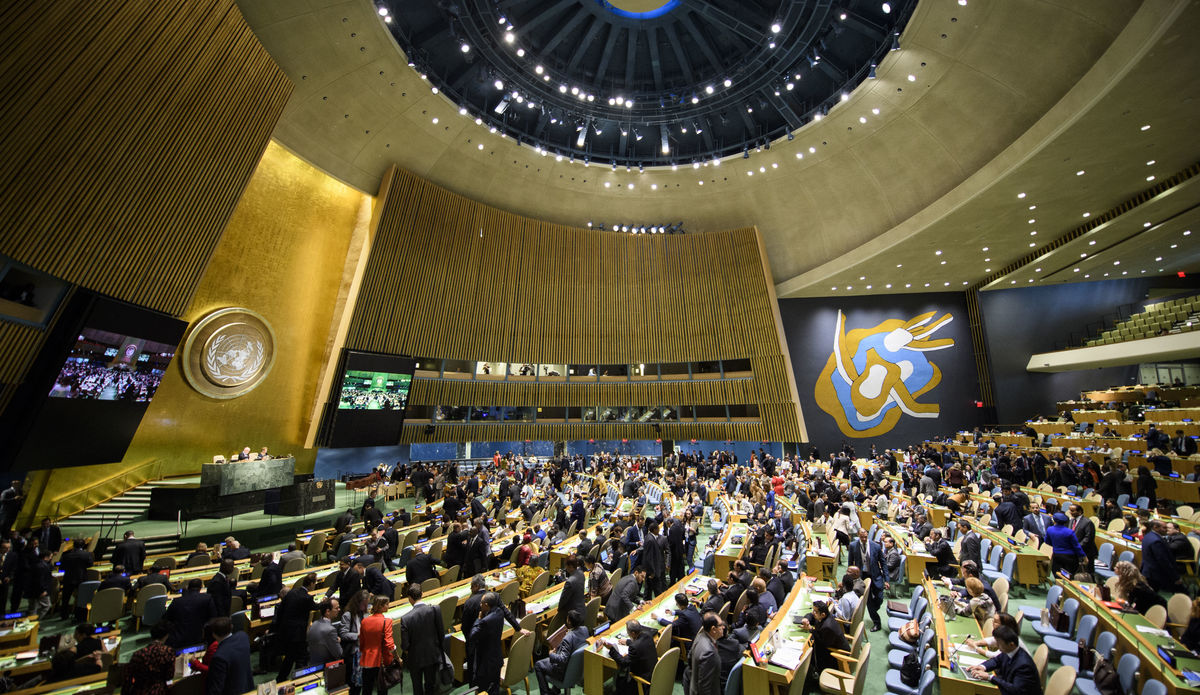
A wide view of the United Nations General Assembly hall at the opening of a past session. Photo: UN
Out of 54 African states at the United Nations General Assembly, only two — Madagascar and Benin — were absent when a Ghana-led resolution condemning the transatlantic slave trade as one of humanity’s gravest injustices came to a vote on Wednesday.
The optics are striking. Africa, often fragmented on trade, security and diplomacy, spoke here with near unanimity.
That unity matters. In multilateral politics, numbers are currency, and on this question the continent arrived with a full purse. The absence of two states did not dent the outcome, but it punctured the symbolism.
UN voting records are unambiguous. In the General Assembly’s digital roll call, countries that vote “yes”, “no” or “abstain” are clearly marked. Those that are not present appear unmarked, a blank space in a crowded ledger. That is precisely how both Madagascar and Benin appeared: not dissenting, not abstaining, but absent.
Diplomatically, absence is softer than abstention. It avoids taking a position while escaping the scrutiny that comes with a recorded vote.
Yet in a resolution so tightly bound to African historical memory, even silence can echo loudly. One African diplomat, speaking privately, described the absence as “traitorous”—a word less about procedure than about expectation.
The irony is particularly sharp in the case of Benin.
The territory of the former Kingdom of Dahomey was a central node in the transatlantic slave trade for over two centuries. Its rulers captured and sold thousands of people to European traders.
Today, the country is attempting to reckon with that past. President Patrice Talon has promoted heritage tourism around slave sites and introduced policies to reconnect descendants of the enslaved with their ancestral home.
That such a state was not present for a vote of this nature raises uncomfortable questions, none of which it has yet publicly answered.
Madagascar’s history is no less entangled. The island served both as a source of enslaved people and as a site of internal systems of servitude. Its absence, too, sits awkwardly against a continent-wide push to define slavery in the strongest legal and moral terms.
That push has gathered pace. The African Union has declared 2025–2035 the Decade of Reparations, seeking to forge a common African position on historical justice.
The strategy is incremental but deliberate: build legal language, consolidate political will, and internationalise the claim.
In this effort, multilateral forums matter. Resolutions at the General Assembly do not compel action, but they shape norms. They are the slow chisels of international law.
The passage of this resolution, backed not only by Africa but also by countries across Latin America, the Caribbean and much of Asia, suggests that the moral argument is widening its coalition.
Resistance, however, remains where power is concentrated. The United States, Argentina and Israel voted against. Many European states abstained. Their hesitation reflects less a dispute over history than a concern about its legal consequences. To define slavery as a crime of such magnitude is to edge closer to the question of reparations, where law, money and politics collide.
So the vote tells two stories at once. One is of a Global South increasingly capable of setting the moral agenda. The other is of a Global North still cautious about where that agenda might lead.
Between them lies the quiet significance of two empty seats.
Your support empowers us to deliver quality global journalism. Whether big or small, every contribution is valuable to our mission and readers.





