

























Looking Forward, Together Apart
| June 5, 2026
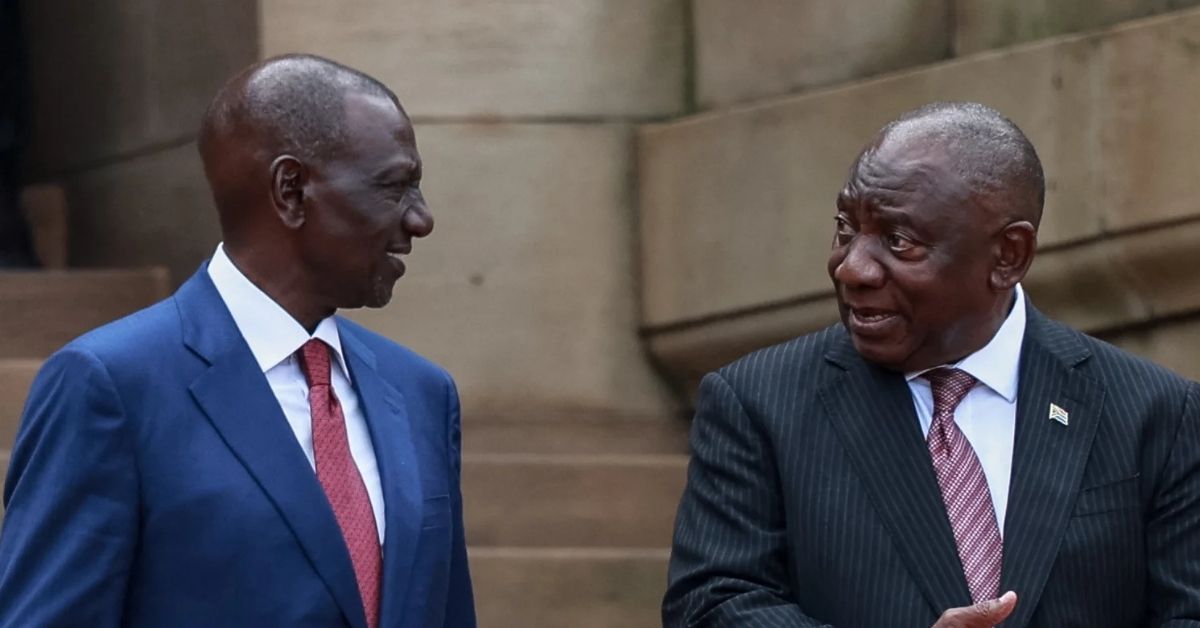
South Africa’s President Cyril Ramaphosa welcomes Kenya’s President William Ruto at the Union Buildings in Pretoria on 4 June 2026. Photo: AFP
Kenya and South Africa agree on Africa’s destiny. They just disagree on who should drive.
“Neither East nor West. We are looking forward.” President William Ruto’s favourite phrase made another appearance, this time in Pretoria.
Before a room of South African journalists, he invoked Kwame Nkrumah’s spirit and argued that African states should not be forced to choose between rival global powers.
The continent, he said, should shape the world’s debates, not merely react to them.
His host, Cyril Ramaphosa, nodded along. Yet beneath the diplomatic warmth, a more complicated reality simmered.
Kenya and South Africa are Africa’s two most influential economies south of the Sahara. Both want greater African agency and reform of global institutions. But they increasingly embody competing models of engagement.
Kenya pitches itself as a pragmatic bridge to the West. South Africa, through BRICS and its advocacy for a multipolar order, strikes a more assertive Global South posture.
Mr Ramaphosa was quick to reject any suggestion of a rift when a journalist raised the issue.
“There is no truth to the assertion that Kenya is aligned to the West and South Africa to the East,” he insisted.
Both countries, he added, are equal and complementary, bound by “friendship, respect and equality.”
Yet complementarity has not stopped them from occasionally tripping over each other.
Consider the Democratic Republic of Congo. Kenya led the East African regional force until relations with Kinshasa soured. South Africa then stepped in as the main troop contributor to a rival mission under SADC. Both were framed as peace efforts. Neither was coordinated.
Or South Sudan. Kenya poured diplomatic capital into the Tumaini Initiative, which sputtered. South Africa, through its leadership of the African Union’s Committee of Five, took a different track. The two parallel processes barely acknowledged each other.
The pattern is not rupture. It is something more subtle: a quiet contest for influence conducted through separate lanes.
Both leaders, of course, emphasised cooperation. Mr Ramaphosa noted that when Congo’s troubles escalated, “it was the two countries that fostered the whole quest for peace.”
He praised Mr Ruto’s upcoming trip to the G7 summit in France, just as Mr Ruto had praised South Africa’s hosting of the first G20 on African soil.
“We have chosen not to be spectators,” Mr Ramaphosa declared. “We are noisy Africans.”
The noise, however, is not always in harmony. As global power politics intensify, Kenya and South Africa increasingly find themselves heading toward the same destination—an Africa with a seat at the table—but using different maps.
For now, they smile, shake hands, and insist there is no rivalry. And perhaps they are right. It is not rivalry. It is two alpha lions circling the same pride, each convinced its roar carries further.
Your support empowers us to deliver quality global journalism. Whether big or small, every contribution is valuable to our mission and readers.





