




















By Mwangi Maina
| February 27, 2025
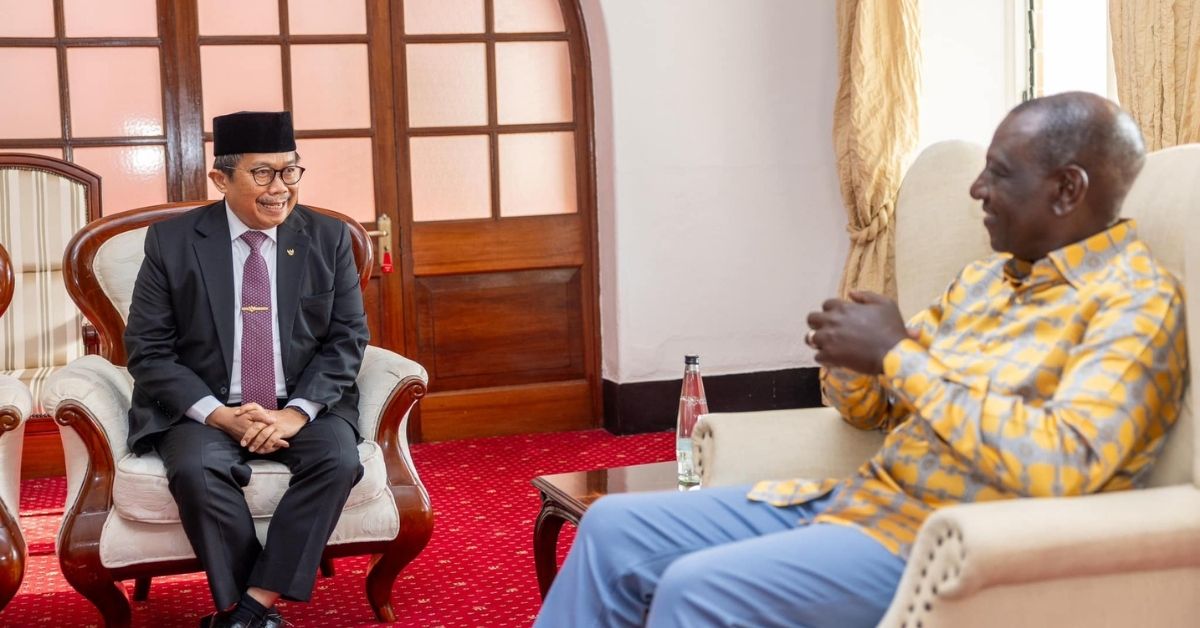
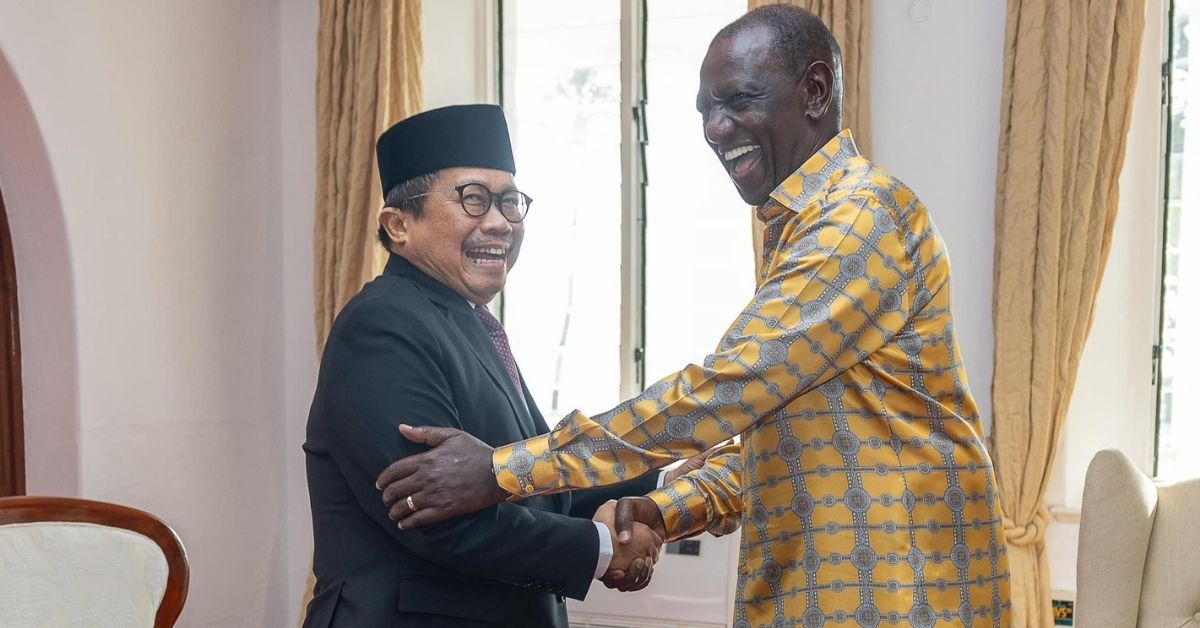
President William Ruto with outgoing Indonesian Ambassador, Mohamed Hery Saripudin at Statehouse in Mombasa on February 26, 2025. Photo: Handout
Dr. Hery Saripudin, Indonesia’s ambassador to Kenya, concluded his diplomatic tenure on Wednesday, bidding farewell to President William Ruto in Mombasa.
His departure marks the end of an era of active engagement and a deepened partnership between Nairobi and Jakarta.
Saripudin, a career diplomat leaves behind a notable diplomatic legacy, having played a key role in strengthening bilateral ties across economic, cultural, and political spheres.
Since presenting his credentials to former President Uhuru Kenyatta in December 2020, he has been a visible and proactive envoy, actively shaping Indonesia’s diplomatic footprint in East Africa.
He was also accredited to Uganda, the DRC, and Somalia.
“Indonesia remains a key partner in expanding investment opportunities, particularly in renewable energy, edible oils—especially palm oil—and seaweed production,” President Ruto remarked in a post on X, underscoring the significance of the relationship.
Indeed, Indonesia’s growing economic influence in Kenya is hard to ignore.
The country, Southeast Asia’s largest economy, has been at the forefront of industrial transformation, from its booming manufacturing sector to its ambitious transition to electric vehicles and renewable energy.
If Kenya is to carve a stronger position in the global economy, Jakarta’s model offers critical lessons.
Diplomatic relations between Indonesia and Kenya date back to 1979, with Jakarta opening its embassy in Nairobi in 1983.
Under Saripudin’s stewardship, these ties have expanded considerably. One of his most significant contributions was lobbying for Kenya’s diplomatic mission in Jakarta, which finally materialized in 2022—a move that signaled Kenya’s recognition of Indonesia as a key geopolitical and economic partner.
His tenure also witnessed a historic moment in 2023, when Indonesia’s then-President Joko Widodo made the first-ever state visit to Nairobi.
That visit underscored a growing alignment in economic cooperation, trade, and investment.
As Kenya seeks to diversify its global partnerships beyond traditional allies, Indonesia—a G20 economy with strong trade networks—presents a compelling opportunity.
Expanding Trade & Cultural Ties
Beyond diplomatic milestones, Saripudin has been instrumental in boosting economic ties between the two nations.
One of the key highlights of his tenure was the launch of the Hybrid Trade Showcase 2021, an initiative aimed at promoting Indonesian products to businesses in Kenya and other African markets.
Dubbed “Soko la Indonesia,” the showcase, launched in collaboration with Kareem International—an Indonesian export aggregator—serves as a trade bridge between Nairobi and Jakarta.
More than 75 Indonesian companies have displayed their products at the “Indonesian Products House” within the Indonesian Embassy, a setup that has remained active.
The exhibition reflects Indonesia’s growing trade influence in Kenya, a presence that is already visible in daily life.
Indomie, one of Indonesia’s most popular exports, has become a household name in Kenya, widely consumed across different social strata.
Other Indonesian consumer products, from cooking oils to textiles, are increasingly penetrating the Kenyan market, solidifying Jakarta’s economic footprint.
Economic Lessons for Kenya
Indonesia’s economic trajectory offers Kenya a blueprint for industrialization and green growth.
As one of the world’s top palm oil exporters, Indonesia has mastered value addition in its agricultural sector—something Kenya, with its vast agricultural base, can emulate.
More notably, Indonesia has embarked on an ambitious green transition, aggressively pushing electric vehicle (EV) adoption and leveraging its rich nickel reserves to position itself as a global EV battery hub.
Kenya, which has recently taken steps toward e-mobility, can learn from Jakarta’s policy incentives, infrastructure development, and private sector mobilization in making EVs a viable reality.
Beyond that, Indonesia’s energy strategy—focusing on renewables while balancing fossil fuel dependency—mirrors the very choices Kenya faces today.
With Indonesia’s expertise in geothermal energy, a sector in which Kenya is a continental leader, deeper collaboration in energy policy and investment could be mutually beneficial.
Saripudin’s tenure serves as a reminder that diplomacy is most effective when backed by economic depth.
His active engagement ensured that trade and investment conversations translated into tangible outcomes, from scholarships for Kenyan students to increased business interactions.
As Kenya recalibrates its foreign policy to focus on economic diplomacy, it should not let this momentum fade.
Deepening relations with Indonesia—one of the world’s most dynamic emerging economies—could yield far greater benefits than currently realized.
The next phase of engagement should focus on structured trade agreements, investment in critical sectors, and learning from Indonesia’s success in transitioning to a green economy.
If Nairobi is serious about elevating its global economic standing, Jakarta should be more than just an ally—it should be a model.
Your support empowers us to deliver quality global journalism. Whether big or small, every contribution is valuable to our mission and readers.