




















How China Fear is Driving Washington’s Pivot Towards Africa
| June 13, 2024
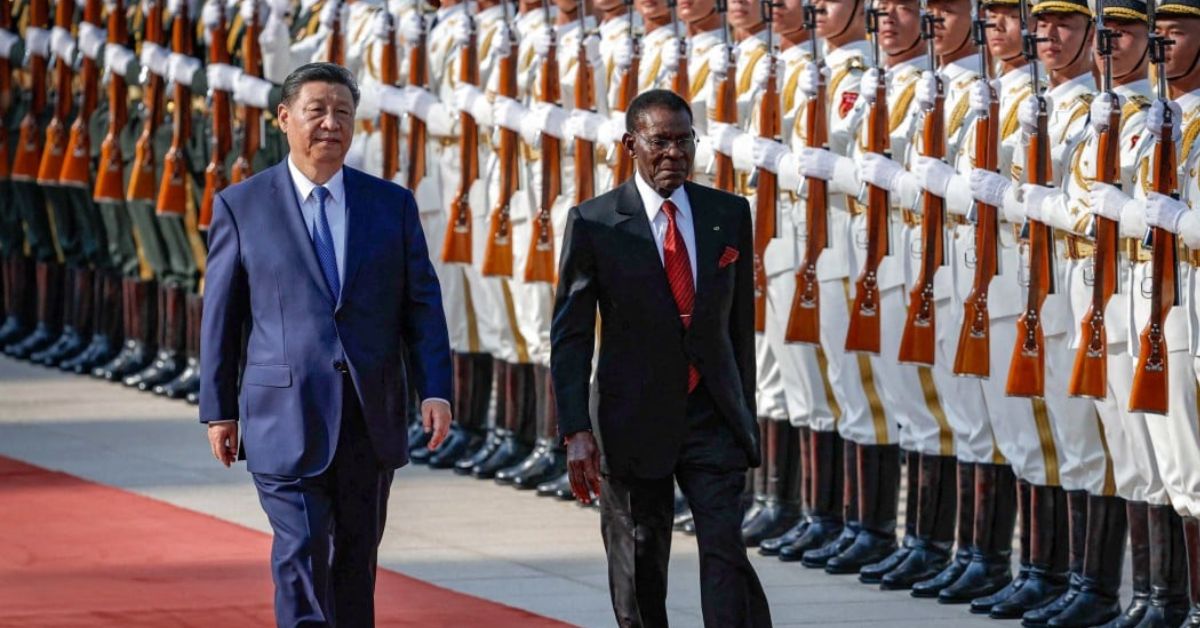
Chinese President Xi Jinping and President of Equatorial Guinea Teodoro Obiang Nguema Mbasogo attend a welcome ceremony at the Great Hall of the People in Beijing in May, 2024. Photo: AFP
The United States of America is in a new pivot towards Africa. The Biden administration has spruced up the US Strategy towards the continent, placing emphasis on the tremendous, positive opportunities that exist in Africa.
Anchored on four main objectives namely openness, democracy promotion, economic prosperity and climate adaption, Washington is doubling down on its visibility in Africa, home to one of the largest free trade areas in the world and plethora of natural resources.
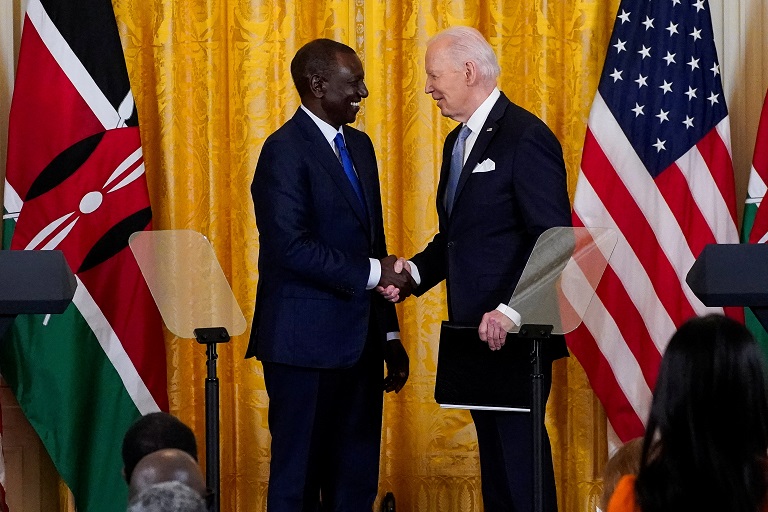
A key outcome of this renewed interest was the recent state visit by President William Ruto to the US. During the event, only the second state visit by an African leader in two decades, Biden rolled out the red carpet for the Kenyan leader and later staged a fancy state dinner on the lush lawns of the White House.
Ruto, a new vision career for the pan African agenda, had a raft of issues he hoped to get consensus on with his host. All was going well for President Ruto in the US until CNN journalist Richard Quest dropped the veil behind Washington’s increasing appetite for Africa.
Quest wanted to know who between China and US President Ruto would choose. While the Kenyan leader diplomatically dribbled past the question, maintaining that Nairobi was facing neither East nor West and that Kenya was solidly facing forward, the incident revealed how the fear of China’s successful partnership with Kenya and other African countries was driving policy makers in Washington insane.
A closer look at the deals signed between Kenya and the US during the state visit all points to desire by Washington to reduce China’s influence in the region.
Kenya was designated as a major non NATO ally, in continuity of enduring pursuit of US national security interest in Africa. A new promise was issued on the construction of Nairobi-Mombasa highway, first announced in 2013 when China and Kenya began the journey to construct a new railway between the two cities.
To countervail flow of young Kenyans to Chinese universities, Biden announced scholarships for Kenyan students reminiscent of the 1960s African students airlift to America.
Even the wording of the so called Nairobi-Washington Vision on public debt management was in many ways pointed at Beijing. In essence, China was the watermark in every document signed during the state visit.
Yet, as President Ruto remarked to CNN, Kenya and the rest of Africa are only interested in international partnerships that can help the continent overcome its development challenges.
There is enough space for everyone who has interest in joining Africa’s quest for economic viability, political stability, peace and global competitiveness as outlined in the Agenda 2063 blueprint.
For the most part, China has become very close to Africa because of its foreign policy posture that is responsive to development needs of African countries.
From trade, technology transfer, infrastructure construction, and even peacebuilding, Beijing has lived up to the desires of Africa. Effective mechanisms such as the Forum on China Africa Cooperation has facilitated dialogue between Chinese and African leaders, leading to important consensus on development cooperation between the two sides.
The US and China are the foremost economies in the world. Leveraging their comparative advantages, rather than fear, can help propel Africa to realise sustainable development goals.
African countries shouldn’t be pushed to a binary choice of either Beijing or Washington, because there is no alternative universe.
Dr. Adhere is an international relations specialist with a focus on China-Africa Development Cooperation.
Your support empowers us to deliver quality global journalism. Whether big or small, every contribution is valuable to our mission and readers.