


























Djibouti Schools Kenya on Diplomacy After AUC Defeat
| February 17, 2025
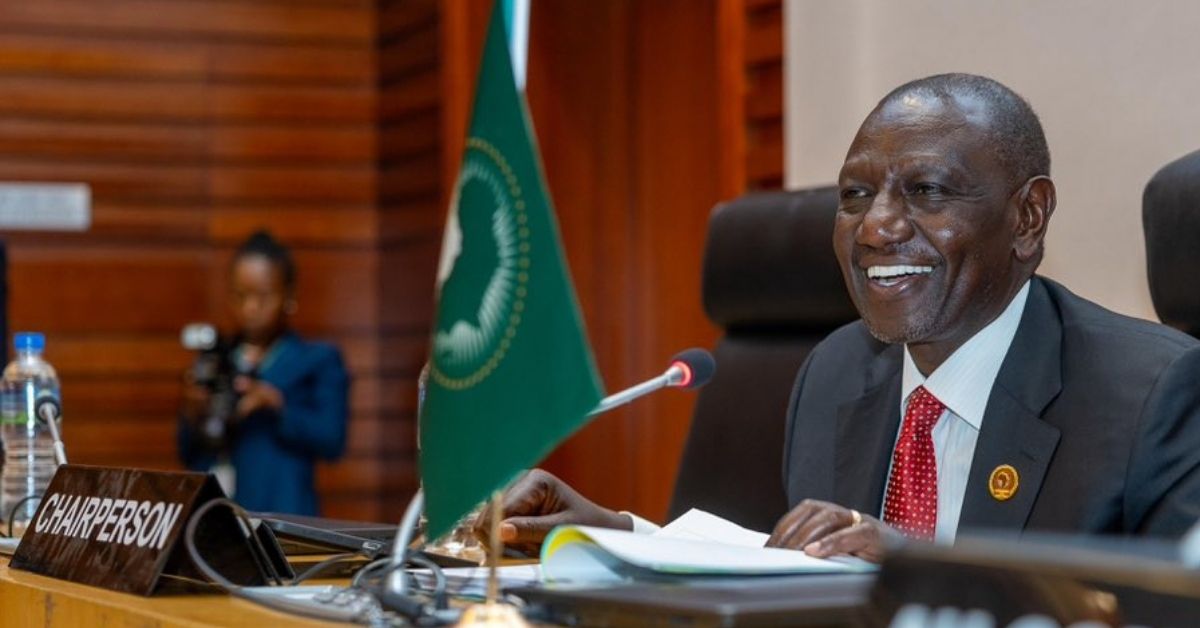
President William Ruto chairs the Continental Committee of African Leaders on Climate Change in Addis Ababa on Sunday, February 16, 2025—a position he holds in apparent violation of AU rotational rules and regulations. Photo: Handout
Kenya’s bruising defeat in the African Union Commission (AUC) elections has been met with a sharp diplomatic rebuke from Djibouti, exposing Nairobi’s miscalculations on the continental stage.
The backlash followed Mahmoud Ali Youssouf’s decisive victory, where he clinched the AUC chairmanship with a two-thirds majority after seven grueling rounds, ultimately standing alone in the final duel.
Djibouti’s Director of Communications at the Ministry of Foreign Affairs, Ambassador Moussa Mohamed Omar, wasted no time dismantling President William Ruto’s post-election spin on Citizen TV.
Responding to Ruto’s claim that Africa had “lost an opportunity,” Omar dismissed the remarks as dishonest political posturing, framing Youssouf’s win as a rejection of Kenya’s attempt to entangle the AU in domestic politics.
“Claiming Africa ‘lost an opportunity’ is dishonest. 33 heads of state chose Mahmoud—the right choice for Africa’s challenges—refusing to let the AU be hostage to Kenyan domestic politics. Africa deserved better than Raila,” Omar posted on X.
A Measured but Firm Response
Unlike his communications chief’s cutting critique, Mahmoud Ali Youssouf took a more diplomatic approach.
In a carefully worded social media post, he acknowledged Ruto’s reluctant congratulations while subtly reinforcing his own legitimacy and authority.
“I thank HE pdt [sic] William Ruto for congratulating me on my victory. He is the African champion for reforms. I am honored to work with him to advance our continental agenda. Asanti sana Mze,” Youssouf posted.
While diplomatically phrased, the message carried an unmistakable undertone: Kenya would now have to fall in line.
A French-Laced Reproach from Djibouti’s President
Meanwhile, Djibouti’s President Ismaïl Omar Guelleh delivered his own verdict—this time in French.
In an address to the nation, he emphasized that Djibouti’s campaign had been modest, principled, and free of “condescension or ostentation,” pointedly adding that it had avoided personal attacks and underhanded tactics.
A thinly veiled swipe at Kenya’s high-profile, media-driven campaign, which heavily relied on social media optics and private jet diplomacy—all bankrolled by Kenyan taxpayers.
His mention of “underhanded tactics” was particularly pointed, echoing pre-election speculation that Raila Odinga’s team had attempted to buy off Djibouti’s candidate.
As voting day approached, anonymous online campaigns emerged to discredit Youssouf, a last-ditch effort that collapsed spectacularly when he secured 33 votes in the final round, leaving Raila eliminated—not by external sabotage, but by sheer loss of momentum.
Kenya’s Diplomatic Miscalculation
Kenya entered the race confident of securing the AU’s top post, but ultimately overplayed its hand.
Ruto’s team prioritized optics over substance, failing to recognize that AU elections are decided in backrooms, not newsrooms or social media platforms.
Djibouti, despite having a fraction of Kenya’s diplomatic reach, played the long game, securing quiet commitments while Kenya courted the cameras.
The outcome serves as a brutal lesson in realpolitik—one Kenya would do well to heed before its next continental bid.
Your support empowers us to deliver quality global journalism. Whether big or small, every contribution is valuable to our mission and readers.





