


























Congolese President Accuses Kenya’s Ruto of Hijacking Peace Process, Backing Rwanda
By Mwangi Maina
| July 25, 2024
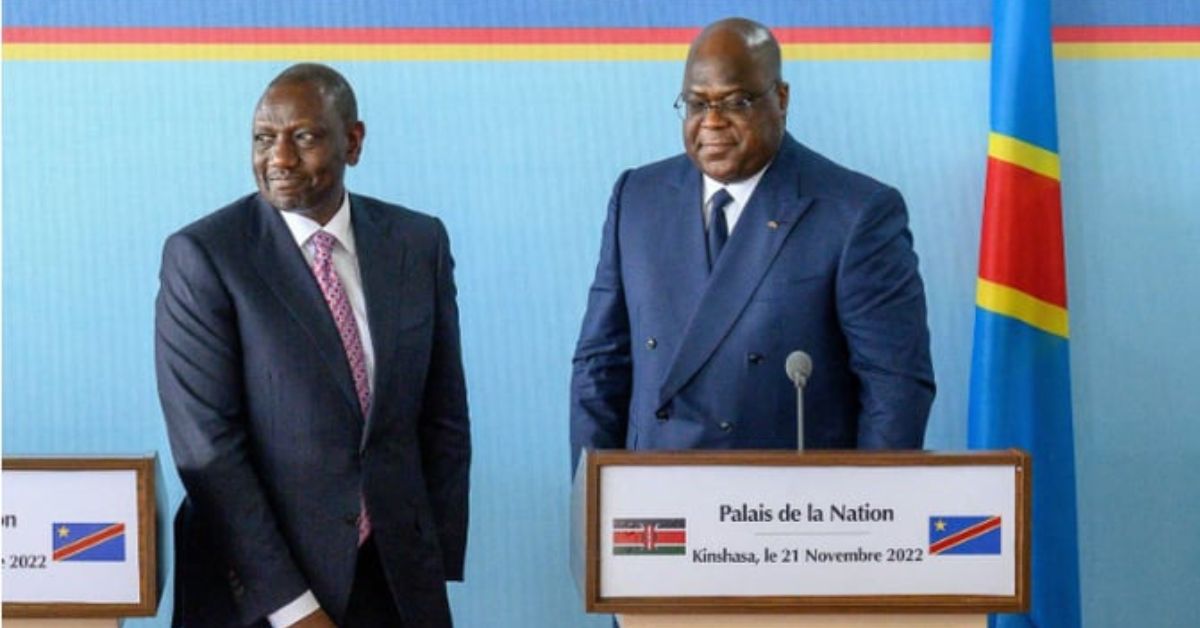
President William Ruto and Congolese President Felix Tshisekedi, who accused him of openly supporting Rwanda, during a state visit in Kinshasa in November 2022. Photo: Handout
Congolese President Felix Tshisekedi has, for the first time, publicly accused Kenya’s embattled president, William Ruto, of hijacking the Nairobi Peace Process led by his predecessor, Uhuru Kenyatta, and openly supporting Rwanda.
Tshisekedi, who won a second term last December and is a close ally of President Kenyatta, made these remarks during a DRC session hosted by the Brookings Institution on Tuesday, discussing the challenges and opportunities in the mineral-rich country and the peace initiatives in place to silence the guns.
“There are two processes, and the first one is the one for the East African Community launched by former Kenyan President Uhuru Kenyatta, and it was later supported by his successor, President William Ruto,” Tshisekedi said in French.
He added, “this project was mishandled and it could be considered dead now,” arguing that President Kenyatta is still the facilitator of the process but “I must confess, President Ruto is supporting Rwanda, and I won’t say anything more about that.”
President Tshisekedi coming out openly to accuse Ruto of supporting Rwanda, which is deemed a hostile country by Kinshasa is a sign of how enraged the Kinshasa-government is about Ruto’s comments on the country.
The Congolese leader, who sought the help of East African Community partner states, was pulled towards joining the regional bloc by then-President Uhuru Kenyatta in early 2022, just months before Kenyatta retired from the presidency and handed over to Ruto.
Kenya played a key role in Eastern Congo, especially when it led the now-removed East African Community Regional Force.
This accusation against President Ruto comes days after Congolese Ambassador John Kalunga Nyakeru ended his tour of duty early after two years in Nairobi, just weeks after he returned from a diplomatic recall.
In late May, Mr. Ruto asserted that the security crisis in eastern DRC and the ongoing tensions are primarily a Congolese issue, not a Rwandan one.
These remarks increased tensions between Nairobi and Kinshasa, following Nairobi’s recent efforts to contain the situation.
President Paul Kagame of Rwanda and Felix Tshisekedi of the Democratic Republic of Congo have been feuding over the M23 rebels, with Tshisekedi accusing Kagame’s government of backing them.
In January, the Congolese president urged the United Nations, the African Union, and regional organizations to impose punitive sanctions on Rwanda for allegedly supporting the M23, which has been wreaking havoc in the eastern DRC.
Rwanda has repeatedly denied these accusations.
During an interview recorded in May with Jeune Afrique and the Africa Report in Kigali at the Africa CEO Forum, Ruto maintained skepticism regarding the crisis being attributed to Kigali and the M23.
He emphasized that there is no basis for accusing Rwandan leader Paul Kagame of backing the rebels because its members are Congolese.
“How is the M23 Kagame’s problem? It’s a Congolese problem,” said the Kenyan leader, who spoke in Kigali, a capital deemed hostile by Kinshasa.
“As heads of state, during a meeting, we asked: the M23, are the members of this group Rwandan or Congolese? And the DRC told us: They’re Congolese.’ End of question. If they are Congolese, how does this become a Rwandan problem?”
Ruto also raised a question posed by the M23: “Do we surrender our arms before having a conversation, or do we engage in dialogue first?”
He said the leaders emphasized the need to address grievances and requested the government in the Democratic Republic of the Congo to consider engaging in dialogue with its citizens to resolve the issue.
Ruto said the suggestions put forth by the M23 resonated with all regional leaders, prompting them to urge the government in the DRC to initiate a dialogue with its citizens to address the issue at hand. He did not elaborate on when this happened.
“We in the EAC believe that the challenge in eastern DRC cannot be resolved solely through military force if those involved are open to dialogue,” Ruto stated.
In protest, Kinshasa, which is now Nairobi’s fastest-growing EAC export market, has consistently declined to accredit the Kenyan ambassador-designate to the DRC for months.
Your support empowers us to deliver quality global journalism. Whether big or small, every contribution is valuable to our mission and readers.





