ARWA: East Africa’s Problems Demand a Federal Solution
| July 1, 2026
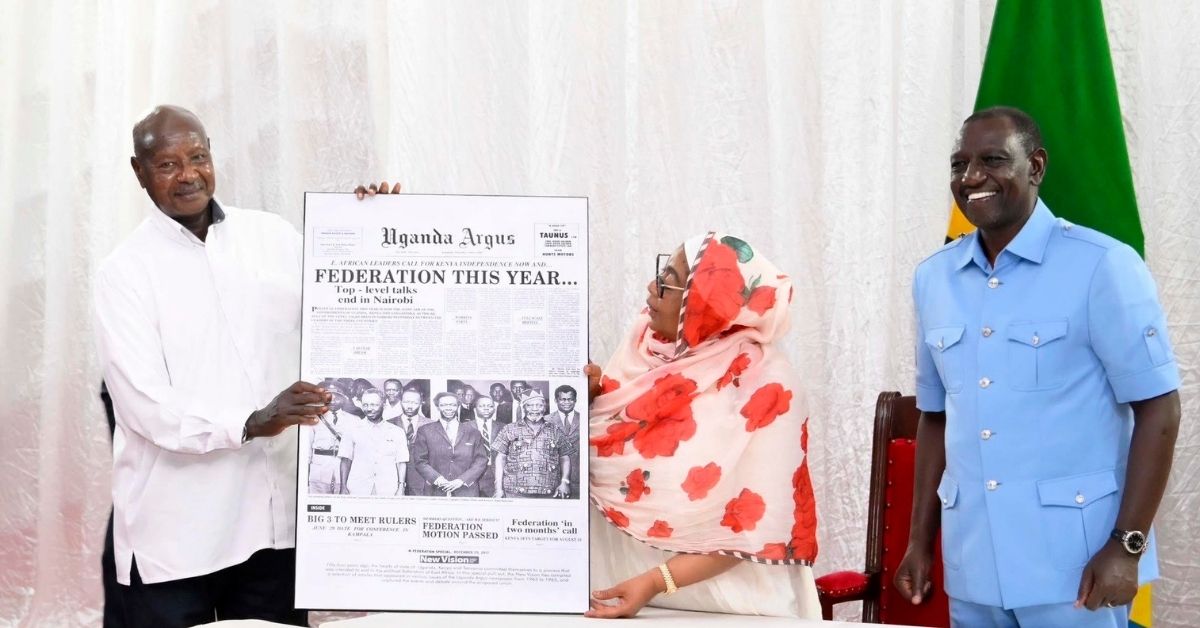
Uganda President Yoweri Museveni (left) hands over a framed vintage newspaper to Tanzanian President Samia Suluhu as Kenyan President William Ruto looks on in Zanzibar on March 15, 2024. Photo: PCS
President Yoweri Museveni of Uganda has consistently advocated for deeper regional integration within the East African Community (EAC), most recently urging the formation of a federation with shared military capabilities, including a unified navy.
I believe this aspiration deserves greater attention, as enhanced integration represents a significant step toward realising African solutions to African problems, particularly within the EAC.
It is important to recognise that the community is already pursuing integration through mechanisms such as the Customs Union and the Common Market.
The Customs Union establishes common external tariffs and non-tariff barriers, while the Common Market guarantees the free movement of goods, labour, persons, services, capital, and the right of establishment and residence for EAC citizens, as outlined in the respective protocols.
However, the implementation of these protocols faces substantial obstacles. Trade disputes have arisen among nearly all EAC partner states, and some have unilaterally entered trade agreements with non-EAC members, contravening the Customs Union Protocol.
For example, Kenya independently concluded a trade pact with the United Kingdom. Other violations include Tanzania’s ban on non-nationals trading within its borders, which contradicts the Common Market Protocol.
These challenges largely stem from entrenched nationalism, a legacy since independence that contributed to the collapse of the first EAC in 1977. Addressing this issue requires the establishment of a political federation, which would shift the focus from nationalism to supranationalism.
Although the EAC Heads of State Summit in 2017 selected a political confederation as the preferred model due to constitutional differences, varying economic development, and uneven progress in integration, a confederation would not resolve unilateralism, as member states would retain sovereignty and the central authority would remain weak.
Only a political federation, governed by common laws and a federal constitution with greater legal enforcement force than treaties or protocols, can effectively address unilateral decision-making.
A stronger central institution (federal government) would eliminate barriers to the movement of goods, services, and people, and prevent individual states from negotiating independently with external actors. This would facilitate the realisation of the customs union and common market objectives.
Nevertheless, I must acknowledge that the concept of political federation is not widely embraced by young Kenyans. In my lectures to international relations and diplomacy students, many express strong oppositions, citing governance issues and persistent violent conflicts in several prospective member states.
Given the diverse backgrounds of university students, it is reasonable to infer that these concerns reflect broader apprehensions among Kenyans. Some even suggest that President Museveni’s interest in federation is motivated by a desire for access to the Indian Ocean.
While many Kenyans perceive governance and security challenges as barriers to federation, I consider these to be temporary obstacles that can and should be overcome. I view federation as a means to address these very challenges.
For example, violent crackdowns on political protests in several partner states, resulting in numerous casualties, have been enabled by state sovereignty, which limits supranational intervention. Federation could empower a federal government to protect victims of state violence, as demonstrated in the United States during the 1965 Selma-to-Montgomery protests, when federal authorities intervened to safeguard civil rights marchers.
I also regard the EAC federation as a potential solution to persistent regional conflicts, many of which are prolonged by weak states or direct state involvement. The Federation would introduce new rules and structures to address these issues.
The challenge of terrorism could also be more effectively managed, as the federal government would not require United Nations Security Council approval to intervene within member states.
Economically, a federal government representing approximately 400 million people and a GDP of $350 billion would possess greater bargaining power in negotiations over trade including the utilisation of the fed’s natural resources with multinational corporations and other states.
Ultimately, I contend that East Africans would be stronger and more prosperous united than divided. The current colonial borders do not serve the interests of East Africans, as they were not designed with their welfare in mind. Achieving greater prosperity requires redrawing borders to reflect the region’s true interests.
However, before this can occur, it is essential to address the fears of those whose support would be necessary in a referendum on federation.
These concerns can be mitigated by promoting good governance, democracy, and the rule of law, including the conduct of free, fair, and credible elections in partner states and upholding human rights. In this way, East Africans need not fear that federation would perpetuate poor governance.
The writer is a lecturer in International Relations and Diplomacy at Zetech University and a PhD researcher at the University of Nairobi.
Your support empowers us to deliver quality global journalism. Whether big or small, every contribution is valuable to our mission and readers.