

















The Kinshasa Blind Spot: What a Kenya-DRC Détente Really Takes
| November 20, 2026
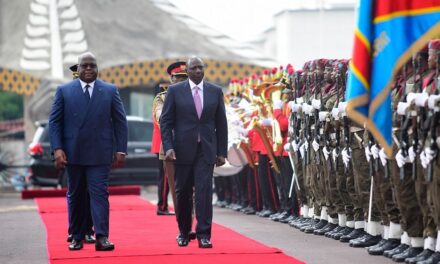
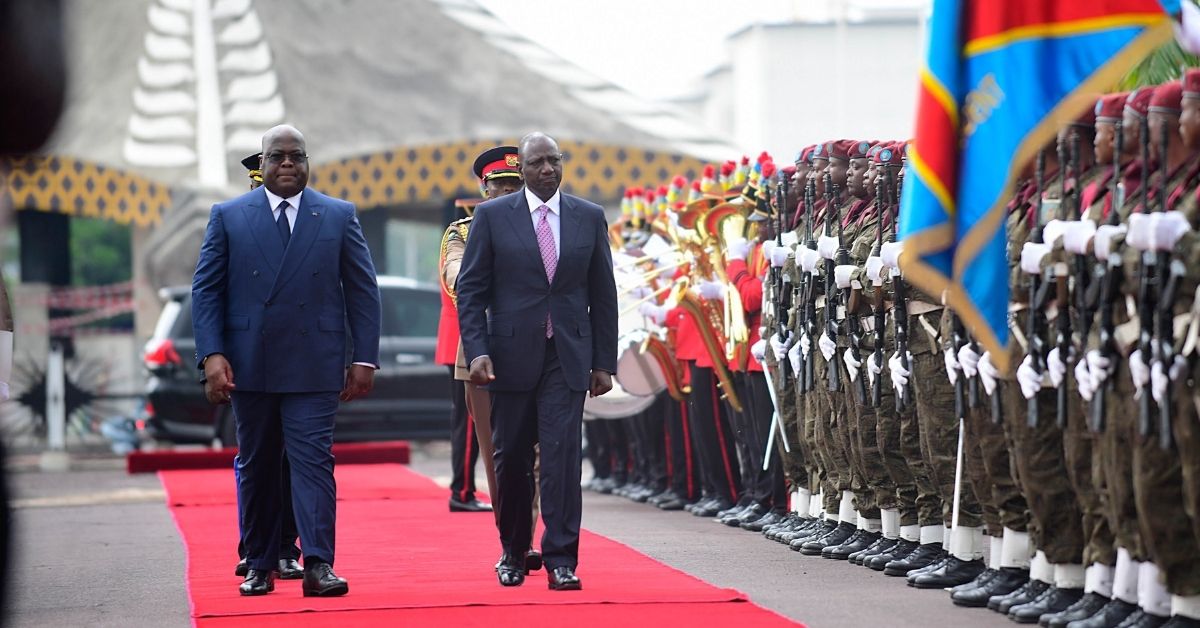
DRC President Félix Tshisekedi receives Kenyan counterpart William Ruto during a state visit to Kinshasa in November 2022. Photo: Handout
When President William Ruto sought a reconciliation meeting with his Congolese counterpart, Felix Tshisekedi, he turned to a third party to broker it.
According to Africa Intelligence, Ruto asked the Republic of Congo’s veteran president, Denis Sassou-Nguesso, to host and mediate a November 22 mini-summit to mend fences.
That Nairobi had to route its overtures to Kinshasa through Brazzaville is a quiet admission of just how badly ties have frayed between the two East African Community partners.
For Kenya’s business community, this diplomatic chill is no longer just an inconvenience. It is a commercial threat. Senior executives at Nairobi-listed firms with heavy exposure in the DRC warn privately that political friction is rapidly eroding Kenya’s hard-won goodwill in Kinshasa – and fear that if ties worsen, Kenyan assets and branches could quickly become targets.
Policymakers in Kinshasa have weighed similar retaliatory options, though the regime has so far held back in favour of a cautious wait-and-see approach. That restraint makes the prospect of a Brazzaville détente doubly welcome and offers relief to both Kenyan boardrooms with billions on the line and to regional observers hoping to pull East Africa’s biggest market back from the brink.
That commercial goodwill has turned the DRC into the premier regional growth engine for Kenya’s corporate champions, from lenders like KCB and Equity to insurers such as Britam and major retail chains.
Trade data in Nairobi confirms the country has emerged as one of Kenya’s fastest-growing East African Community export markets. According to a joint foreign investment survey by the Kenya National Bureau of Statistics, the Central Bank of Kenya, and the Kenya Investment Authority, Kenyan investors injected nearly Sh100 billion into the DRC in 2022 alone following its entry into the bloc.
Yet Nairobi’s diplomacy has struggled to match its corporate ambition. During recent closed-door discussions on the crisis, one observer noted that Kenyan officials often leave the impression they are neither communicating nor attempting to communicate effectively with Kinshasa.
If accurate, that assessment exposes a glaring blind spot in Nairobi’s much-touted “economic diplomacy” doctrine. Corporate leaders know the DRC is too big to lose – and are quietly pressing politicians to mend fences before that goodwill runs dry.
Yet fixing the breach will take more than a quick phone call or a single Brazzaville sit-down; it demands a fundamental reset in how Nairobi’s deals with Kinshasa.
The Warning Signs Were There
To understand why Kinshasa is so angry, one must look at the flashpoints that have defined the last three years and the intelligence that was seemingly ignored.
According to a diplomatic source who served in the DRC at the height of the tensions, Kenya’s intelligence community advised President Ruto to tone down his rhetoric on the eastern Congo conflict – particularly while visiting Kigali. Yet in May 2024, speaking from a capital, Kinshasa, view as hostile, Ruto publicly dismissed claims that Rwanda was fuelling the M23 insurgency.
The intelligence advice has been simple: hedge your bets and stay engaged. Instead, Nairobi’s public posturing deepened Kinshasa’s suspicion that Kenya was tilting too close to Rwanda.
Two months later, in July 2024, that private suspicion boiled over in public. Speaking at a Brooking’s Institution session, Tshisekedi accused Ruto of mishandling the Nairobi Peace Process and openly taking Kigali’s side.
“I must confess, President Ruto is supporting Rwanda, and I won’t say anything more about that.”
The fallout quickly jammed the institutional machinery of both states. When Kinshasa left Nairobi’s first ambassadorial nominee in limbo without agrément, Kenya quietly replaced him – only for his successor to be met with the exact same diplomatic freeze. That is no bureaucratic oversight; it is a calculated lever of pressure, signalling that Kinshasa will withhold accreditation until Nairobi genuinely grasps its security concerns.
The Goma Factor and the Trust Deficit
In truth, the trust deficit predated the battlefield. Months before taking office, during a February 2022 campaign rally, then-Deputy President Ruto sparked diplomatic uproar in Kinshasa after joking that the DRC was a massive market without a “single cow” – a remark that drew sharp rebukes from Congolese officials and forced an early damage-control apology.
That lingering unease soon hardened over the East African Community Regional Force (EACRF). At the troop flag-off in November 2022, Ruto pledged an assertive enforcement mission, famously declaring there was “not much peace to keep” in eastern Congo.
Once deployed, however, Kenyan commanders stuck to a passive buffer mandate rather than engaging M23 head-on. Feeling betrayed by a broken promise, Kinshasa dismissed the mission as ineffective and worse, as a shield for Rwandan-backed gains – triggering the force’s late-2023 expulsion and a deep diplomatic freeze.
Deeper, sharper grievances soon followed. Kenya’s decision to name a Consul General to Goma, just as the eastern city fell under the control of M23, a group Kinshasa officially designates as terrorists, struck the Congolese government as a profound insult.
Appointed while rebels held the city and without Kinshasa’s diplomatic blessing, the move looked to president Tshisekedi’s administration like a quiet legitimisation of rebel rule.
Furthermore, Kinshasa guards its sovereignty jealously and bristles at any hint of regional meddling. Trust was badly damaged when Nairobi allowed Congolese adversaries to organise on Kenyan soil—first in late 2023, when ex-electoral chief Corneille Nangaa and M23 rebels launched their Alliance Fleuve Congo (AFC) coalition at a Nairobi hotel, and more recently through political consultations involving former president Joseph Kabila. To Kinshasa, Kenya looked less like a mediator and more like a staging ground.
The Trade-Offs for Detente
If Nairobi is serious about a détente in Brazzaville, quiet backchannels alone will not suffice. Repairing the breach requires concrete, public, and private assurances to Kinshasa.
First, Nairobi must unequivocally reaffirm its respect for the DRC’s territorial integrity and sovereignty. Kenya already holds strong credentials on this principle: it was among the few African states to vocally condemn Russia’s invasion of Ukraine as a violation of internationally recognised borders.
Nairobi must apply that exact standard closer to home, stating plainly that it opposes any armed rebellion or foreign-backed destabilisation on Congolese soil.
Second, Nairobi must offer ironclad guarantees that Kenyan soil will never serve as a launching pad against Kinshasa. That means denying political, logistical, or security space to Corneille Nangaa’s AFC, Joseph Kabila’s allies, or any opposition figures seeking to undermine the Congolese government. Congolese political actors residing in or passing through Nairobi must be told bluntly that Kenya is off-limits for plotting against Kinshasa.
Finally, Kenya must defuse the Goma consulate row. Nairobi needs to assure Kinshasa directly and through proper diplomatic channels that the appointment was intended solely as an administrative mechanism to support Kenyan traders and citizens, not as diplomatic recognition of rebel control, and commit to resolving any consular deployment strictly in line with Congolese sovereignty.
The Doctrine of Persistent Engagement
The détente with Sudan earlier this month proved that Kenya can swallow its pride and make a pragmatic pivot when economic pain grows too severe. The DRC demands that same pragmatism – paired with a doctrine of persistent engagement.
The stakes extend far beyond banking and retail. With global powers racing to secure critical minerals and Nairobi rolling out its own ambitious mining and beneficiation policy to position Kenya as East Africa’s processing and regional hub, everyone is eyeing the DRC.
Yet Nairobi cannot anchor the Mombasa-DRC trade corridor or plug into Congolese mineral supply chains if its political line to Kinshasa remains dead.
That closed-door critique that Nairobi has simply stopped talking to Kinshasa – stings because it points to a deeper lack of strategic direction. Kenya cannot afford diplomatic ambiguity in its own region.
Rather than retreating into silence when ties turn rocky, Nairobi must keep ministerial, presidential, and security channels open consistently; listen closely to the private sector whose capital sits on the line; and treat the DRC not merely as a security headache to be managed but as an economic lifeline to be protected.
Your support empowers us to deliver quality global journalism. Whether big or small, every contribution is valuable to our mission and readers.