

























Kenya’s Man in Indonesia
| September 1, 2026
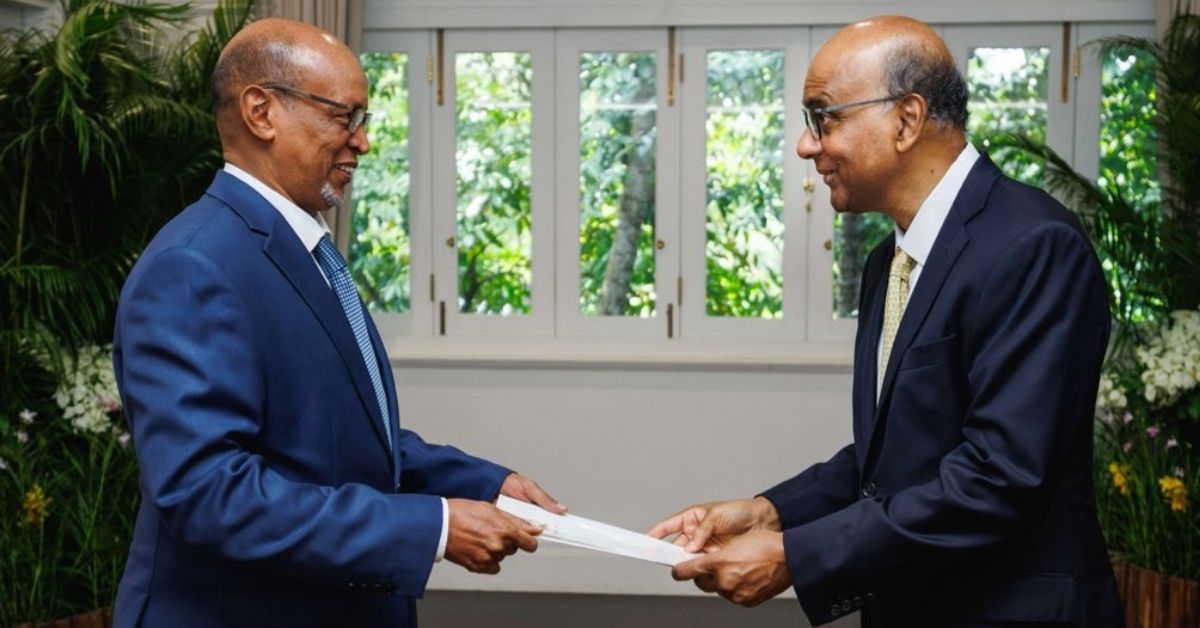
Kenyan diplomat Abdirashid Salat Abdille presented his credentials in Singapore on August 12 as Nairobi’s non-resident High Commissioner, adding the city-state to his portfolio alongside the Philippines. His base remains Jakarta, where Kenya opened a resident embassy in 2022. Photo: Singapore (MDDI).
It is a sweltering Sunday afternoon in South Jakarta.
Kenya’s ambassador to Indonesia, Abdirashid Salat Abdille, welcomes us into his residence, rich with the aroma of burning oud, for a Kenyan lunch and an unusually wide-ranging conversation about diplomacy, trade, technology, the welfare of Kenyans abroad, and what he hopes to accomplish before his tour ends.
Before the conversation begins, Salat observes his midday Dhuhr prayer. He supplicates with a dua and invites a fellow Muslim student from Padjadjaran University, our second visitor, to pray while his daughter serves me authentic Kenyan tea.
A few minutes later, Kenya’s man in Jakarta returns, dressed in a striking green and cream batik shirt adorned with intricate floral and geometric motifs.
Batik is Indonesia’s iconic wax-resist dyeing tradition, recognised by UNESCO as an Intangible Cultural Heritage and deeply embedded in the country’s identity. For an East African visitor, its role in Indonesian life feels familiar, almost like the cultural place occupied by kitenge at home.
Kenyan food (ugali, chapati, and nyama choma) already fills the table, but the envoy seems more interested in discussing the citizens he represents than the formalities of his office. We agree to prioritise the conversation before lunch.
Salat’s career background perfectly explains this people-first instinct. A human resources specialist by training, he spent years working as a labour officer, dealing with employment disputes, worker rights, and welfare.
That experience has naturally followed him into diplomacy.
“When you are in labour, you are also in diplomacy. The two go hand in hand,” he noted.
It is perhaps the simplest explanation of how he approaches his first diplomatic assignment.
Salat, who is from Wajir, took up his posting in Indonesia in June after presenting credentials to President Prabowo Subianto. He is Kenya’s resident ambassador to Jakarta and concurrently serves as a non-resident envoy to the Philippines and Singapore.
The Kenyans behind bars
His mantra, he says, is straightforward: everyone must respect everyone else’s rights, and everyone must obey the law. This philosophy becomes particularly clear when he discusses Kenyans serving long prison sentences across Southeast Asia.
There were initially seven Kenyans in the cases he was discussing. In fact, there were eight. One woman had just been released after serving 17 years in prison. The mission had to buy her a ticket home.
Others remain behind bars, serving sentences of between 15 and 25 years. The common denominator is drug trafficking, and what concerns Salat most is their age.
Many are between 25 and 30. According to the envoy, they often do not obtain drugs in Kenya. They travel to different cities, including in Africa and Latin America, collect them there, and transport them through other countries.
“Nothing else, drug trafficking. Drug trafficking. And these are young ladies, young people, from the age of 25 to a maximum of 30,” he lamented.
Four Kenyans are currently in prison in Singapore, he says. The city-state imposes the death penalty for drug trafficking, while Indonesia imposes life imprisonment in serious cases.
For the ambassador, diplomatic intervention has limits when citizens are caught under another country’s laws.
“It’s their laws, it’s clear, and it’s unfortunate.”
He recalls the case of a young Kenyan woman allegedly recruited by traffickers who became pregnant. The traffickers, he says, deliberately impregnated her so that she could conceal drugs while travelling.
“She gave birth in prison.”
The child was eventually brought back to Kenya in October 2025, when the baby was “about 18 months old”. These cases have shaped what has become a stern, paternal warning to young Kenyans tempted by shortcuts.
“Looking for money in the wrong way does not pay. It doesn’t pay completely. You better stay hungry rather than carrying drugs and be jailed.”
He describes it as “a very pathetic situation” to find fellow Kenyans serving 20 or 30 years in foreign prisons, noting that rigid laws and the absence of prisoner-exchange agreements, including a failed attempt with Indonesia, leave the mission with limited options.
The new threat: sweet-talking scammers
Drug trafficking is not the only problem. The mission is also seeing an increase in employment scams targeting young Kenyans.
“Some have been promised jobs with Indonesian football clubs, only to arrive in the country and discover that the clubs do not exist,” reveals the ambassador.
In a recent case, two Kenyan footballers were repatriated after being stranded in Bali and overstaying their visas by five or six months.
Salat’s advice is simple: “Do your due diligence.”
Before accepting a job abroad, Kenyans should verify the employer through the Ministry of Labour, the Department of Diaspora Affairs, and Kenyan missions abroad.
Technology, the outspoken, bespectacled diplomat points out, has made verification easier than ever.
“Young people are tech savvy and can check anything, anywhere, at any time.”
He also urges Kenyans living in Indonesia to register with the mission.
From protection to prosperity
But his agenda extends beyond consular protection. He was preparing to travel to Singapore to present his credentials, meet with investors, and finalise arrangements for President William Ruto’s planned visit to Southeast Asia, covering Indonesia, Singapore, and Malaysia.
The objective is clear: bring foreign investment home. Salat views Indonesia not merely as a market for Kenyan goods but as a source of technology, manufacturing expertise, and joint ventures.
Coffee, he argues, presents an obvious opportunity, particularly through value addition. Milk is another. Indonesia’s huge population and dairy shortage could create opportunities for Kenyan producers.
But the diplomat is thinking beyond raw exports.
“We want to take manufacturers to Kenya, not only them exporting goods.”
Indonesia’s textile sector particularly interests him, with batik manufacturing offering possibilities for joint ventures, technology transfer, and employment.
“Indonesia is the gateway to Southeast Asia,” he says. His economic argument works both ways. Kenya is the gateway to East Africa; Indonesia, with its huge population and strategic location, can offer Kenya an entry point into Southeast Asia.
To make that gateway more tangible, Salat envisions a Kenyan warehouse and trade hub in Jakarta where Kenyan companies could showcase their products and brands. The facility, he says, would give Kenyan manufacturers a permanent presence in the Indonesian market, help promote value-added goods, and potentially serve as a launchpad into the wider region.
The idea would mirror approaches such as Ghana’s Trade House in Nairobi, which provides a physical platform for Ghanaian businesses and products in Kenya.
For Salat, the Jakarta hub would be more than a showroom. It would be a practical instrument for deepening commercial ties and helping Kenyan businesses navigate a market that remains relatively unfamiliar to many of them.
The challenge, however, is making the machinery of government and business move faster. Tariff barriers remain a hurdle, while regulatory and standards differences can complicate trade.
Kenya’s Bureau of Standards and its Indonesian counterpart are expected to strengthen cooperation, while a joint business commission could provide a mechanism for addressing obstacles to trade.
But Salat is wary of a familiar diplomatic habit: signing agreements and forgetting about them.
“We will ensure we follow up on agreements signed and make sure they are actualised.”
He says the presidential visit will not be a “one-day affair” and will be a “continuous engagement”.
That caution extends to defence cooperation. Kenya and Indonesia have discussed a defence memorandum of understanding, but some issues remain unresolved.
Salat says Kenya has learned from past lessons and does not want to find itself again caught in a jurisdictional dispute involving foreign military personnel.
One outstanding question concerns what happens if a foreign soldier training in Kenya commits a criminal offence.
“We do not want another quagmire,” he says. “Kenya will enter into defence agreements that are beneficial to our security and the welfare of our citizenry.”
Beyond Jakarta
There is also a larger diplomatic ambition. The Kenyan mission is working towards accreditation with ASEAN.
If successful, the Jakarta mission would have an expanded platform for representing Kenyan interests across the Association of Southeast Asian Nations.
Education is another priority. Salat wants more Kenyan students studying in Indonesia and greater technology transfer between the two countries.
Even passports feature in his practical agenda. Kenyan citizens in Indonesia can currently process passports through Kenya’s immigration presence in Malaysia, while the mission is exploring arrangements to facilitate passport services locally when numbers justify it.
But perhaps the most revealing part of our conversation comes when Salat discusses what he hopes to leave behind. He is less interested in a long list of agreements or photographs from official ceremonies than in follow-through.
Governments, he believes, are good at holding meetings and signing agreements but less consistent at ensuring they produce tangible results. His ambition is practical: identify opportunities, connect people, solve problems, and keep following up.
“I’m very passionate about having adequate information on everybody so that I can, as much as is possible, make sure that their welfare is taken care of.”
He knows a mission cannot solve every problem. But knowing the problem, he believes, is the first step towards solving it.
One Kenya
There is another idea he returns to repeatedly: cohesion. He points to Indonesia as an example of a country that has maintained national cohesion despite its extraordinary diversity.
For Kenyans abroad, he has a simple message: “We don’t have any other Kenya. We have one, Kenya.”
The responsibility, he says, is to protect it, build it, and advance it. Days before our conversation, eight Kenyan students at Universitas Padjadjaran had graduated with master’s degrees in international relations and public administration after an exchange programme. Salat could not attend personally but sent mission staff to celebrate with them before their return home.
His gift was modest but thoughtful: a patterned piece of Indonesian batik that could be customised into whatever the students wished, accompanied by a written note expressing the mission’s solidarity.
He wants the mission to be present when Kenyans graduate, wherever they are, and urges students abroad to remember that they, too, represent their country. It is a remarkably personal approach to diplomacy.
And then there is the snake fruit.
The conversation eventually drifts away from prisoners, trade agreements, and ASEAN. Jakarta, Salat says, is “a very interesting city”.
I put to him the phrase “ordered chaos”, a description that seems fitting for the Indonesian capital’s restless rhythm. He takes it in good humour before turning to one of the city’s more visible features: its motorcycles.
He jokes that Kenya’s boda boda riders could come to Indonesia for benchmarking.
And then there is the fruit. He has developed a particular fondness for snake fruit, known locally as salak. It took him some time to learn its name, he says, but now it is among his favourites.
Perhaps that is an appropriate place to leave the conversation. An ambassador thousands of kilometres from home, trying to solve problems that sometimes have no easy diplomatic solution, pursuing investments that may take years to materialise, and finding small pleasures in a new country along the way.
His diplomatic philosophy ultimately returns to something uncomplicated: “Let’s be patriotic to our nation. Not to any individual. To our country.”
KFP Editor Mwangi Maina interviewed the Kenyan Ambassador on 9 August 2026 in Jakarta.
Your support empowers us to deliver quality global journalism. Whether big or small, every contribution is valuable to our mission and readers.





