

























Kenya-South Africa: Friends, Rivals, Partners
By Mwangi Maina
| May 30, 2026
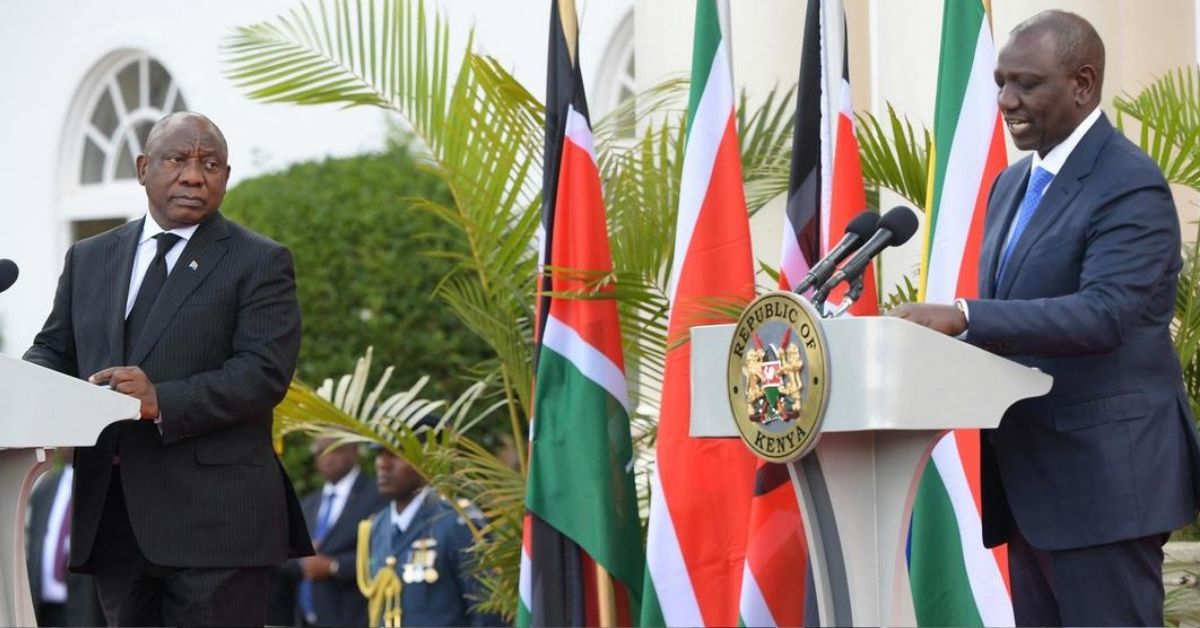
President Ruto heads to Pretoria as Kenya and South Africa navigate a partnership shaped by rivalry. Photo: AFP
President William Ruto will receive the full state-visit treatment in Pretoria next week.
There will be military honours, handshakes on the Union Buildings lawn, carefully worded communiqués and, inevitably, warm references to African solidarity.
Yet the relationship between Kenya and South Africa has always been more complicated than the diplomatic script suggests.
For years, Nairobi and Pretoria have described one another as strategic partners, champions of African integration and natural allies on the continent. Both are regional powerhouses. Both see themselves as gateways to their respective regions. Both speak the language of Pan-Africanism.
And both, quietly, compete.
That competition has become harder to ignore in recent months.
When South Africa hosted the first G20 summit on African soil last year, Kenya downgraded its representation and ultimately sent an ambassador.
This month, when Nairobi co-hosted the Africa Forward Summit with France, Pretoria returned the favour. South Africa skipped both presidential and ministerial participation before eventually dispatching a senior official.
Neither side has acknowledged any disagreement. They rarely do.
In diplomacy, countries almost never announce that relations have cooled. Instead, they communicate through protocol.
Rank matters. Representation matters. Who attends, who withdraws and who is quietly replaced often says more than an official statement ever will.
If summit attendance was the symptom, trade has long been the underlying irritation.
The public language of the relationship has remained remarkably warm. The private assessment has often been less flattering.
One of the most revealing glimpses came from a leaked American diplomatic cable in 2008. Tom Amolo, then Kenya’s director of political affairs and a former high commissioner to South Africa, described Pretoria as Kenya’s “emerging strategic competitor”.
The relationship was collegial, he said, until commercial interests entered the room.
“They quickly erect trade barriers when they see us coming,” he told American diplomats.
Nearly two decades later, the complaint still resonates.
South African companies have embedded themselves deeply in Kenya’s economy. Banks, retailers, telecommunications firms and manufacturers have all found a foothold in East Africa’s largest economy.
Kenyan firms, by contrast, have struggled to establish a meaningful presence south of the Limpopo.
The imbalance is striking. South African exports to Kenya exceeded Kenyan exports by more than tenfold in 2024, according to Economic Survey.
This is where Ruto’s visit becomes interesting.
The visa question, once a major grievance for Kenyans, has largely been resolved. The easier challenge has already been solved. The harder one remains.
Can Kenya persuade South Africa to open its market as enthusiastically as it embraces political partnership?
That question will hover over the South Africa-Kenya Business Forum taking place alongside the state visit. Such gatherings often receive less attention than presidential speeches. They are usually more consequential.
Political goodwill is easy to manufacture. Commercial confidence is not.
For all their differences, Kenya and South Africa need one another more than either side sometimes cares to admit. South Africa remains Africa’s most industrialised economy. Kenya has emerged as one of the continent’s most dynamic commercial and diplomatic hubs.
The challenge is that both countries increasingly occupy the same strategic space. They compete for investment. They compete for influence. They compete for diplomatic prestige. At times, they even compete for the title of Africa’s most important interlocutor with the outside world.
That makes the relationship simultaneously valuable and uncomfortable.
The toast that Ruto and Ramaphosa raise next week will celebrate friendship. The real significance of the visit lies elsewhere. It is whether Africa’s two ambitious middle powers can learn to cooperate without pretending they are not also rivals.
That is a much more interesting story than the official communiqués will reveal.
Your support empowers us to deliver quality global journalism. Whether big or small, every contribution is valuable to our mission and readers.





