





















Kenya–Tanzania Relations: Inside 50 Years of Love, Hate and Blame Games
By Mwangi Maina
| December 29, 2025
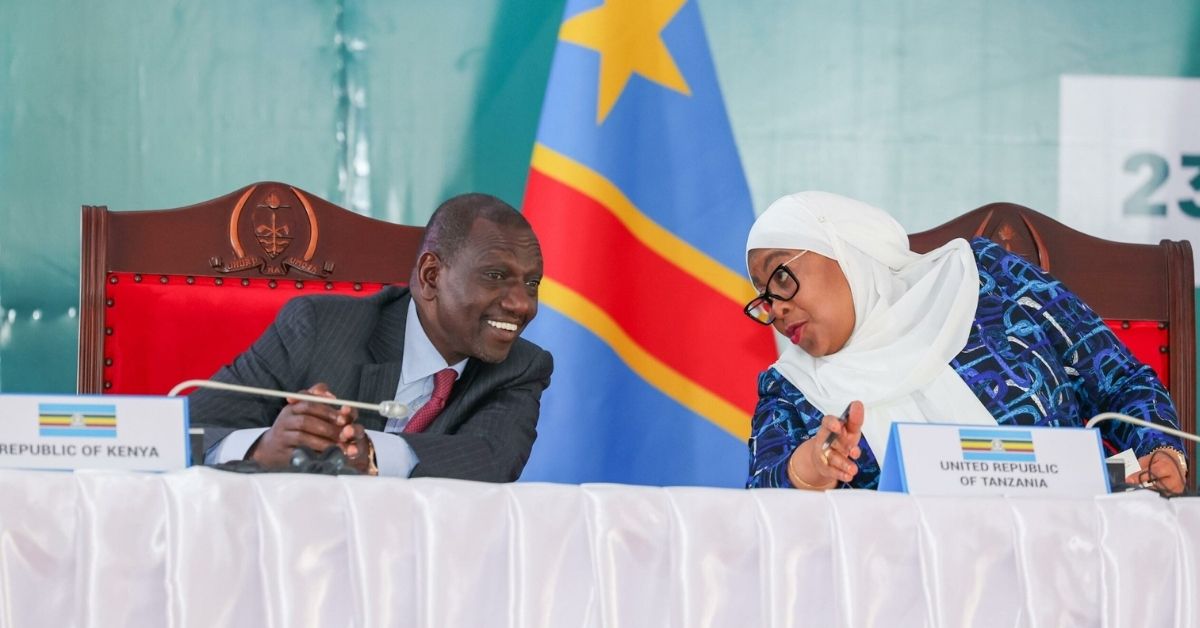
Kenyan President William Ruto and Tanzania’s embattled leader Samia Suluhu Hassan at a previous East African Community summit in Arusha. Photo: Handout
When Tanzanian President Samia Suluhu Hassan went live on national television on December 2, she was not merely addressing her nation, she was reviving a 50-year East African tradition.
The deadly October protests that rattled Tanzania, the first such unrest since independence, she insisted, were not solely the product of disputed elections or domestic frustrations. They were the work of external forces.
“Regarding the words I said there, I recall an occasion in this hall. I’ve forgotten what the event was, but I said those words because there were people coming to disturb our peace. They have ruined things where they come from, and now they are coming to ruin things here,” the Tanzania leader told a congregation of elders in Dar es Salaam.
“That upset them. It upset them a lot. And perhaps maybe to show that even this — is not clean as well.”
The words she was referring to, “wamechoma kwao, sasa wanakuja kuharibu kwetu,” she warned in May they’ve burned their own house, now they want to ruin ours.
The message, directed at Kenyan activists and lawyers deported earlier in the year for attempting to follow the treason case of opposition figure Tundu Lissu, was unmistakable.
“If they have been contained in their own country, let them not come here to meddle,” she said in May.
“They have already created chaos in their own country.”
For many Kenyans, this was a familiar melody. For older regional observers, it was déjà vu.
The Old Grammar of Blame
Kenya and Tanzania have always been neighbours with mismatched temperaments.
Kenya is noisy, politically caffeinated, civil-society-driven, and digitally combustible — a place where TikTok can topple a finance bill.
Tanzania, by contrast, prides itself on order, discipline and political choreography.
Whenever Tanzanian politics trembles, the instinctive response from Dar es Salaam is to glance north.
But this rivalry did not begin with hashtags or Gen-Z TikTokers.
Kenyatta, Nyerere and the First Rift
In the late 1960s and 1970s, Jomo Kenyatta and Julius Nyerere carved two competing visions of post-colonial Africa.
Kenya embraced capitalism, Western alignment and quiet pragmatism. Tanzania pursued socialism, revolutionary politics and ideological purity.
Declassified U.S. cables from 1976 describe Kenyatta as “preoccupied with Kenyan military weakness vis-à-vis Soviet-armed Uganda and Somalia.”
Beneath the diplomatic phrasing lay something simpler: both men feared each other’s influence.
Nyerere saw Kenya as capitalist, unequal and too cosy with the West “not truly African”, as one account puts it. Kenyatta saw Nyerere as ideological, unrealistic and meddlesome.
Both were charismatic elders who had led their countries to independence. But proximity bred suspicion.
Then came the Uganda War.
Enter Amin, Exit Trust
When Tanzanian troops marched into Uganda in 1978 to overthrow Idi Amin, they did not just topple a dictator. They reconfigured regional politics.
Kenyatta had just died; Daniel Moi had taken over. Kenya, long threatened by Amin, was suddenly uneasy about Tanzanian troops occupying Kampala.
American intelligence cables reveal that Tanzanian diplomats viewed Moi with open scepticism.
Salim Ahmed Salim, then Tanzania’s UN envoy and later prime minister, bluntly noted that Moi had “limited mental ability” and struggled to grasp the full weight of power in Kenya. It was the kind of judgment that captures the cold candour of the era.
Tanzanians also believed Kenya had quietly assisted Libya during the war, a charge Nairobi denied and resented Kenya’s refusal to share details of EAC assets after the community collapsed in 1977.
The result was an East African détente defined by trade, cooperation and permanent mistrust.
Half a century later, the ideological battles have faded. But the reflexes remain.
Digital mobilisation now jumps borders with ease. Kenyan activists travelled to Uganda to support Bobi Wine; Kampala detained them and, by President Museveni’s own admission, held them briefly “in a fridge”.
The two were later released after Kenyan pressure.
Samia’s rhetoric this year warning against “foreign-inspired chaos” fits squarely into that tradition of reciprocal suspicion.
And the Tanzania–Kenya economic skirmishes continue with clockwork regularity. When Nairobi slips on aviation protocols, Dar es Salaam does not issue reminders, it grounds Kenya Airways.
A Year of Unrest and Blame
The October 2025 upheaval in Tanzania, sparked by contested elections, shook a political culture that thrives on predictability. Young people took to the streets; security forces responded with deadly force; questions on legitimacy grew louder.
Tanzanians increasingly turned to Kenya’s freer media landscape for coverage. CNN’s Larry Madowo, a Kenyan, filed reports that irritated Dodoma not because they were inaccurate, but because they pierced through an otherwise tight information environment.
Whether CNN approved them or Kenya did was immaterial — to Tanzanian critics, Madowo was simply “a Kenyan”.
Blaming Kenya became easier — and more convenient — than acknowledging domestic dissent.
But Tanzania is not unique. Kenya has blamed outsiders before. Uganda too. In East Africa, sovereignty is often defended by pointing to the neighbour’s backyard.
The Magufuli Years and Other Oddities
The Samia era did not invent cross-border awkwardness. During the Uhuru Kenyatta–John Magufuli years, relations were a roller-coaster.
Magufuli once ordered the burning of 5,000 Kenyan one-day-old chicks at the Namanga border.
Uhuru later flew to Chato to reconcile, prayed for Magufuli’s bedridden mother, and received a gift of peacocks for his efforts — diplomacy in its most East African form.
Samia’s pointed remarks this December did not create a new rift. They simply reopened an old one.
As the year ends, Kenya and Tanzania find themselves exactly where they have always been — trading with each other, competing with each other, mistrusting each other, relying on each other.
Their economies are deeply interdependent. Their politics are tightly intertwined. Their citizens move across borders every day with ease that contradicts the rhetoric of their leaders.
For two nations that sometimes pretend not to need each other, the truth is simpler and more human:
They quarrel because they are close. They blame each other because they can. And they remain bound, whether they admit it or not, by history, geography, and necessity.
Your support empowers us to deliver quality global journalism. Whether big or small, every contribution is valuable to our mission and readers.