By Mike Obachi
| September 7, 2025
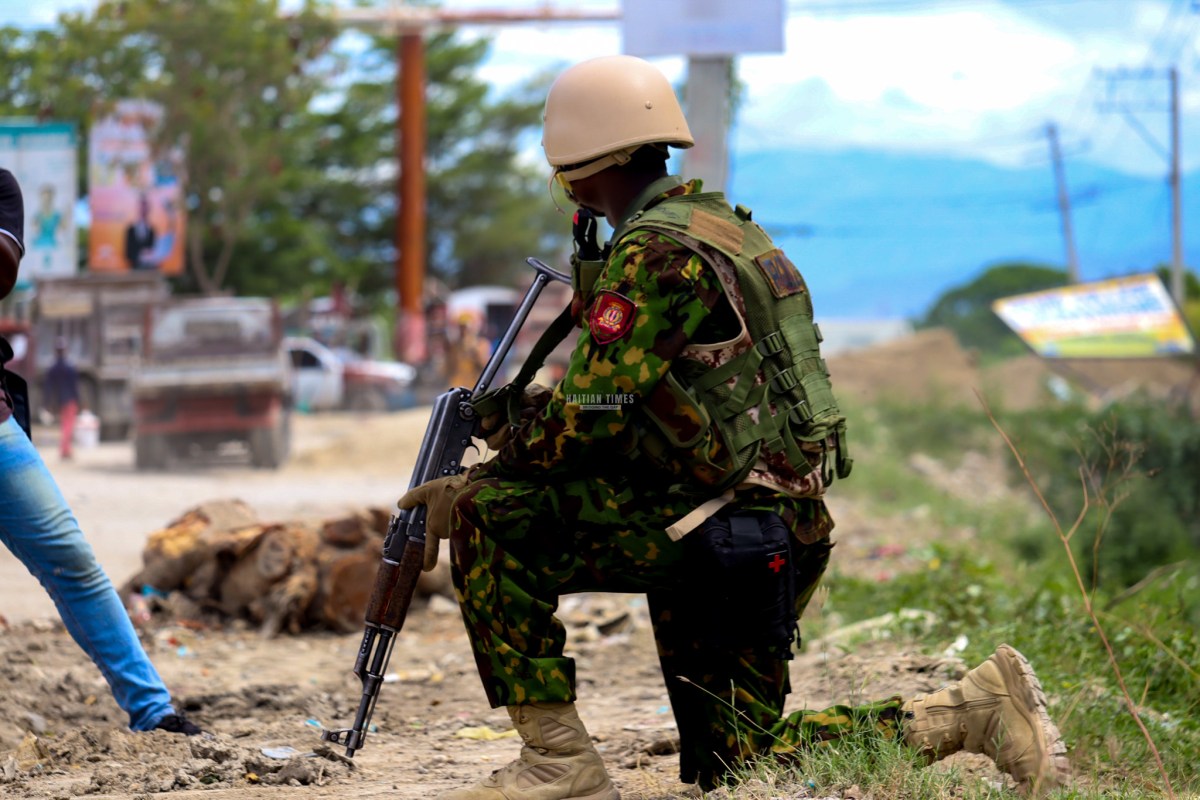
Kenyan police officer patrolling near Haitian capital city center. Photo: Arnold Junior Pierre
The island of Hispaniola has long been the stage for a fraught and uneasy relationship between Haiti and the Dominican Republic—centuries of shared borders, racial tensions, and stark economic disparities have shaped this reality.
For Haitians fleeing violence and poverty, the Dominican Republic has been at times a reluctant sanctuary, and at other times a closed door.
Now, into this long and complex dynamic, a new and unexpected player has entered: Kenya.
Kenya’s diplomatic relations with the Caribbean remained lukewarm for decades, despite the region’s contribution to Kenya’s independence struggle and the role of Caribbean intellectuals in shaping Kenya’s early institutions.
Jamaican nationalist Marcus Garvey and Pan-Africanist George Padmore inspired Kenya’s independence leaders, including Jomo Kenyatta, who also interacted with the “Motley group” in London.
Kenyatta’s legal defense during the Kapenguria trial drew on support from Dennis Pritt, Cecil Miller, and Ras Makonnen, who helped raise funds.
Kenyatta honored these ties by naming roads in Nairobi after Garvey, Padmore, W.E.B. Du Bois, Ralph Bunche, and Makonnen. He also appointed Cecil Miller, of Guyanese origin, as Kenya’s first black High Court judge and later Chief Justice, while Makonnen was made a senior official at the Ministry of Tourism.
President Daniel arap Moi became the first Kenyan head of state to visit Latin America in 1992, with a trip to Brazil, one of the first countries to establish diplomatic ties with Kenya back in 1967.
It was under President Mwai Kibaki that Kenya established a permanent diplomatic presence in Latin America with the opening of its embassy in Brasilia in 2006. In 2010, Brazil’s President Lula da Silva reciprocated with a state visit to Nairobi.
President Uhuru Kenyatta, however, significantly deepened ties with the Caribbean and Latin America. His outreach was partly motivated by the International Criminal Court (ICC) case, where he sought Caribbean support at the UN to push back against Rule 68, which was to be used against his deputy William Ruto and journalist Joshua Sang.
Antigua and Barbuda responded by granting Kenyans visa-free access.
Uhuru capitalized further when U.S. President Barack Obama normalized relations with Cuba in 2014. In 2018, Uhuru visited Havana, upgrading Kenya’s mission to an embassy. The following year, he visited Jamaica and Barbados, with Prime Minister Mia Mottley later attending Kenya’s independence celebrations in Nairobi.
Kenya also held the presidency of the Organisation of African, Caribbean and Pacific States (OACPS) from 2019 to 2022, hosted the CARICOM summit virtually in 2021, and saw Barbados open its first African diplomatic office in Nairobi.
Pivot
Kenya’s politics, however, remain subject to electoral turnover. New leaders bring new foreign policy priorities, and new risks.
In 2022, President William Ruto came to power promising a bold new foreign policy. His tenure has been marked by both breakthroughs and blunders.
Continentally, he antagonised Algeria and Morocco by wavering on Western Sahara, soured ties with Sudan and the DRC, and failed in his push to secure the African Union Commission chairmanship.
Globally, he scored notable wins: hosting King Charles, securing state visits to Washington and Beijing, and sealing a groundbreaking economic partnership with the UAE. His approach has been openly transactional, consistent with his mantra of “facing forward.”
Yet in the Caribbean, Ruto has shown little interest. His only trip was to Haiti in September 2024, signaling a pivot from Kenya’s traditional soft-power diplomacy toward hard power, as Nairobi committed to lead a Multinational Security Support (MSS) mission in Haiti.
This shift carries risks. Ruto’s decision to anchor Kenya’s engagement through the Dominican Republic, Haiti’s long-time rival raises questions about Kenya’s grasp of Caribbean history. Unlike his predecessors who favored ties with Barbados, Jamaica, and Brazil, Ruto appears to be charting a new, and potentially divisive, path.
Will Kenya’s leadership of the Haiti mission prove to be a strategic gamble that alienates its newfound Caribbean allies? Or can Nairobi balance hard power in Port-au-Prince with the soft diplomacy that once earned it goodwill across the Atlantic?
Your support empowers us to deliver quality global journalism. Whether big or small, every contribution is valuable to our mission and readers.