

























Kenya’s Singapore Ambition Confronts Reality
By Mwangi Maina
| August 26, 2025
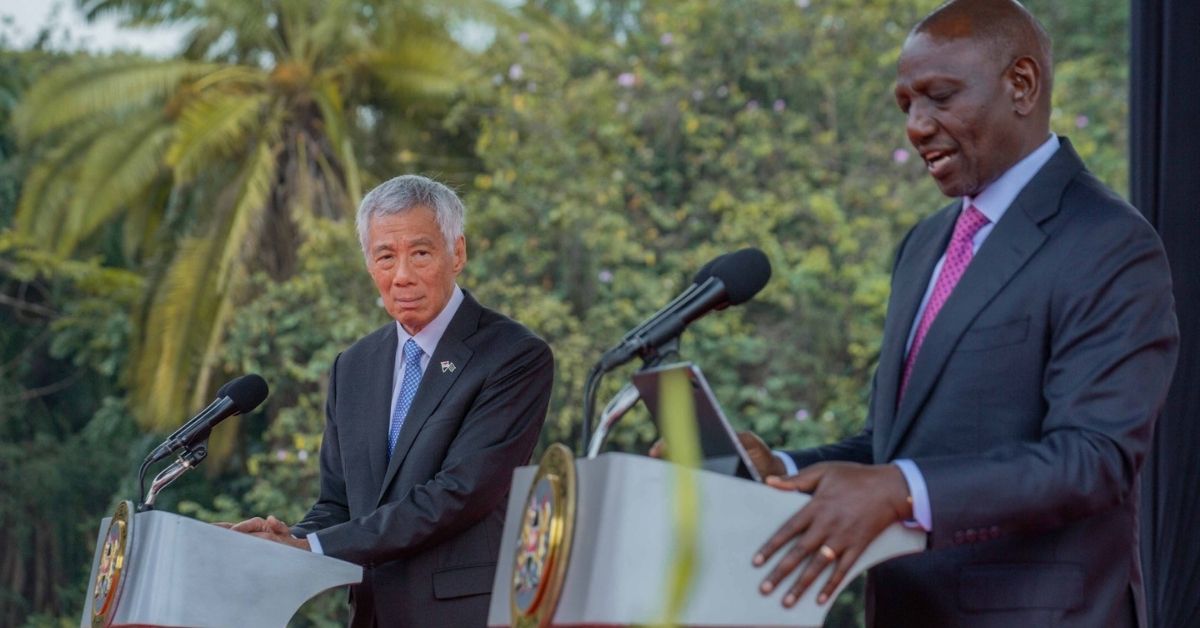
Kenyan President William Ruto with Singapore Premier Lee Hsien Loong in Nairobi on May 18, 2023. The two countries inked three deals at the meeting. Photo: State House, Nairobi
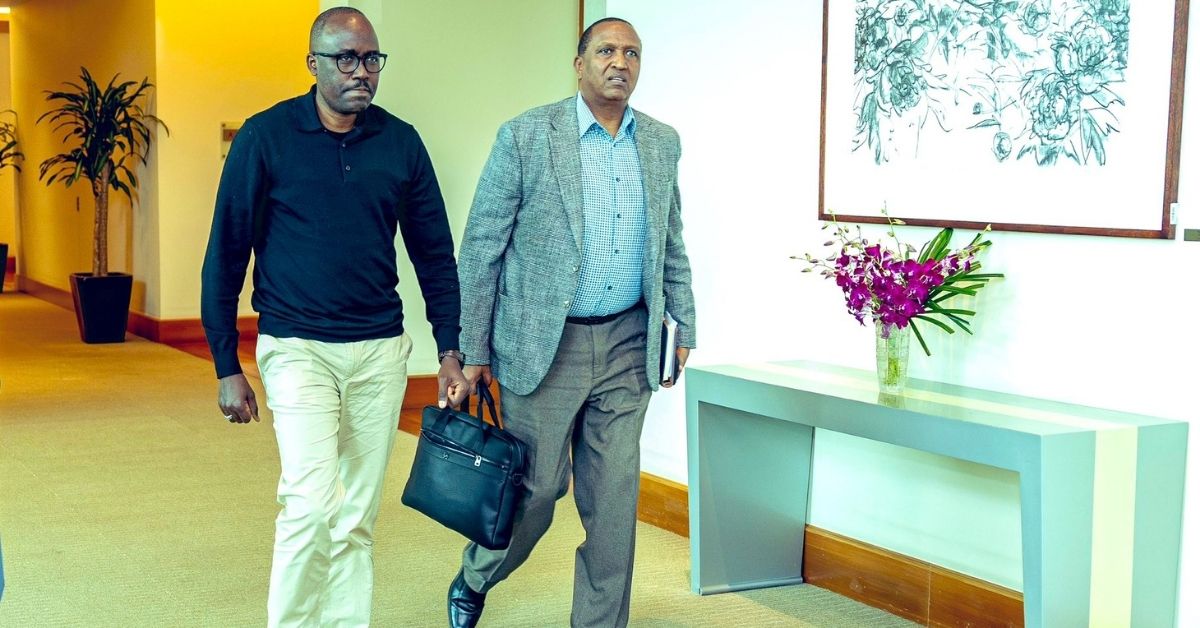
Kenya’s top foreign-policy bureaucrat, Korir Sing’oei, landed in Singapore on Monday to attend the 5th Singapore-Africa Ministerial Exchange.
Representing Foreign Minister Musalia Mudavadi, who had just returned from Japan’s TICAD summit, Sing’oei framed the visit as part of Nairobi’s “acceleration of South-South cooperation consistent with our foreign policy.”
His arrival coincided with renewed rhetoric from President William Ruto, who once again promised to make Kenya the “Singapore of Africa.”
In a recent speech, Ruto reminded his audience that Kenya and Singapore were on equal footing 60 years ago: at independence in 1963, Kenya’s GDP was $926.6m, slightly larger than Singapore’s $917.6m.
“We have all it takes to be just like Singapore,” he said, defending the “unpopular” economic decisions he claims will one day vindicate him.
The facts tell a harder story. Today, Singapore, with a population of 5.9m, boasts a GDP of $498bn; Kenya, with nearly ten times the people, manages $113.4bn.
Income per capita illustrates the gulf: $82,807 for Singapore versus $2,099 for Kenya.
Singapore’s trajectory, often mythologised, was born of painful decisions including its split from Malaysia, that founding Prime Minister Lee Kuan Yew admitted left him in tears.
It then became one of Asia’s “tigers,” alongside Hong Kong, South Korea and Taiwan, all driven by export-led growth, industrialisation, and relentless governance reforms. Singapore remains one of the world’s most efficient states, with corruption virtually absent and red tape slashed for both business and visitors.
Kenya, by contrast, remains hobbled by uneven infrastructure, governance failures and political instability.
As Washington Osiro, a Kenyan analyst, notes, “Kenya is neither Africa’s benchmark of competent and incorruptible government nor a cohesive and unified society where responsible citizens pick up after themselves or obey the most basic, if admittedly inconvenient public ordinances.”
Becoming Africa’s Singapore, he argues, “will demand more than rhetoric, it will require discipline, reforms, and credibility.”
Even Professor Tyler Cowen of George Mason University, who optimistically wrote in Bloomberg in 2023 that “Kenya is poised to become the Singapore of Africa,” conceded that the country’s appeal lies largely in relative stability compared to Nigeria, Ethiopia or South Africa.
The optimism is tempered by the reality of weak institutions, endemic corruption and public discontent at home. If symbolism matters, Sing’oei’s passage through Changi Airport ranked the world’s best for six consecutive years might have offered a humbling reminder.
Unlike Nairobi’s Jomo Kenyatta International, where rain routinely causes chaos, Changi has reimagined itself as a leisure hub: biometric passport-free exits, butterfly gardens, and the world’s largest indoor waterfall. For now, Kenya’s flagship airport still struggles with queues and power blackouts.
Still, Singapore takes Kenya seriously. It opened its third Africa business centre in Nairobi in 2018, after Johannesburg and Accra, and its non-resident ambassador to Nairobi presented credentials to Ruto this June.
At the ministerial this week, Kenya will join 13 other African countries, including Ghana—whose president, John Mahama, is coincidentally on a state visit to Singapore.
Kenya may flatter itself with the “Singapore of Africa” refrain, but the gulf between rhetoric and reality remains wide.
Your support empowers us to deliver quality global journalism. Whether big or small, every contribution is valuable to our mission and readers.





