















Washington Puts Kenya’s ‘Non-NATO Ally’ Status on Notice
By Mwangi Maina
| August 5, 2025

Flags flutter during preparations of the presidential inauguration for United States president-elect Donald Trump at the US Capitol building in Washington on Jan. 4, 2025. (Reuters/Fabrizio Bensch)
Barely a year after the Biden administration elevated Kenya to the coveted rank of Major Non-NATO Ally (MNNA), U.S. lawmakers are now officially questioning whether Nairobi still deserves the title.
The review—quietly embedded in an August congressional amendment highlights growing unease in Washington over President William Ruto’s increasingly warm relations with China, Russia, and Iran.
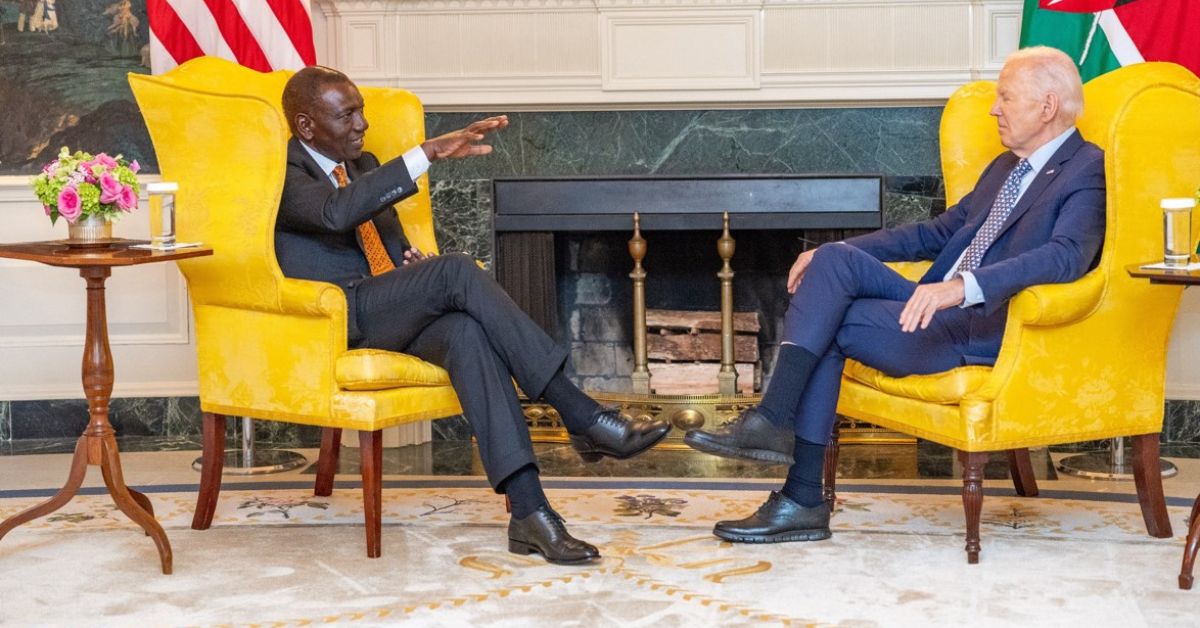
Kenya became the first sub-Saharan African nation to secure MNNA status during Ruto’s state visit to Washington in May 2024—the first such visit by an African head of state in 15 years.
The designation, largely symbolic but politically weighty, was Washington’s way of rewarding Nairobi’s counterterrorism cooperation and its support for Western positions, including its sharp condemnation of Russia’s invasion of Ukraine. Now, however, the relationship faces its sharpest test yet.
A 90-Day Review
A congressional directive seen by this outlet tasks U.S. Secretary of State Marco Rubio—working alongside the Pentagon and the Director of National Intelligence—with reviewing Kenya’s MNNA status within 90 days.
A classified report, due in 180 days, will examine:
Kenya’s counterterrorism cooperation in Africa and its role in Haiti.
The depth of Nairobi’s economic and security ties with China, Russia, and Iran.
Kenya’s continued value as a strategic economic partner.
The amendment is spearheaded by Senator James Risch, the hawkish Republican chair of the Senate Foreign Relations Committee, who has warned of what he calls an “alarming drift” in Kenya’s foreign policy.
His move mirrors Washington’s recent pressure campaign against South Africa over its BRICS alignment and its pro-Palestinian posture.
“This is not merely about trade—it’s about alignment,” Risch declared.
“President Ruto’s rhetoric in Beijing sounded less like hedging and more like allegiance.”
Ruto’s Pivot to the East
The immediate trigger appears to be Ruto’s April 2025 state visit to Beijing.
Standing beside Xi Jinping at a time of escalating U.S.-China trade tensions, Ruto decried “hegemonic power and unilateralism”—a pointed jab at Washington.
In a speech at Peking University, he went even further: “The current global order is broken, dysfunctional, and no longer fit for purpose. Kenya and China will act as co-architects of a new order—one that is fair, inclusive, and sustainable.”
For Washington, the language was a red line.
Joshua Meservey, a Senior Fellow at the Hudson Institute, told Congress that Ruto’s pivot “signals a lack of allegiance.”
His deepening engagement with Iran was especially provocative.
“Despite Iran’s backing of terror plots against his country, President Ruto referred to Iran as a ‘critical strategic partner,’” Meservey said.
Ruto hosted Iran’s late president, Ebrahim Raisi, in Nairobi in 2023, pledging to “heighten and strengthen” ties despite U.S. sanctions and Tehran’s pariah status in Washington.
Kenya’s Strategic Dilemma
The MNNA designation has always been more symbolic than practical.
It comes with no defence guarantees but offers preferential access to U.S. security cooperation and weapons sales.
Yet, Kenya’s military has largely received outdated equipment—most notably the aging helicopters blamed for the 2024 crash that killed General Francis Ogolla, Kenya’s only four-star general at the time.
Nonetheless, the status has served as a diplomatic badge of honor, bolstering Nairobi’s image as Washington’s anchor in East Africa.
Kenya hosts U.S. military installations in Manda and Wajir, provides a key counterterrorism platform, and has routinely supported U.S. positions at multilateral forums.
But Ruto’s balancing act—courting Beijing while cultivating Washington—has left both sides wary.
Nairobi has even signaled interest in joining BRICS, a move likely to tilt it further toward the East.
It is hardly impossible for a country to feast at both Beijing’s and Washington’s tables and expect to leave satisfied.
“This is an issue that majority of African states countries are currently grappling with,” says Mike Ombachi, an international relations analyst.
Washington’s Harder Questions
The congressional review goes beyond Kenya’s global alignment.
Lawmakers want a detailed account of the financial and political ties of Kenya’s ruling elite with China, Russia, and Iran.
They also seek intelligence on Nairobi’s alleged links—direct or indirect—to nonstate armed groups such as Sudan’s Rapid Support Forces (RSF) and Somalia’s al-Shabaab.
Congress further demands a review of Kenya’s participation in China’s Belt and Road Initiative, its debt profile, and its potential role as a financial hub for sanctioned individuals from Sudan, South Sudan, Somalia, and Uganda.
Washington is also asking for an assessment of how U.S. security assistance and intelligence sharing might have been used—or misused—by Nairobi, especially in light of recent allegations of extrajudicial killings and enforced disappearances during Kenya’s historic June 2024 protests.
Experts warn this level of scrutiny could prove politically damaging for Nairobi.
“This is a humiliating request,” says an analyst who has served closely with Western diplomats.
What Happens Next
Kenya’s bet is that it can hedge without paying a price.
But Washington appears poised to test that gamble. For Ruto, losing MNNA status would be more than symbolic—it would undermine his claim to have reset Kenya’s global standing.
Whether this review results in a formal downgrade or a quiet warning shot, it signals a new reality: Kenya’s days of unchallenged status as Washington’s “special ally” may be numbered.
Your support empowers us to deliver quality global journalism. Whether big or small, every contribution is valuable to our mission and readers.