

























Ruto’s Strategic Reversal: Tactical Adaptation or Weak Presidency?
| March 7, 2025
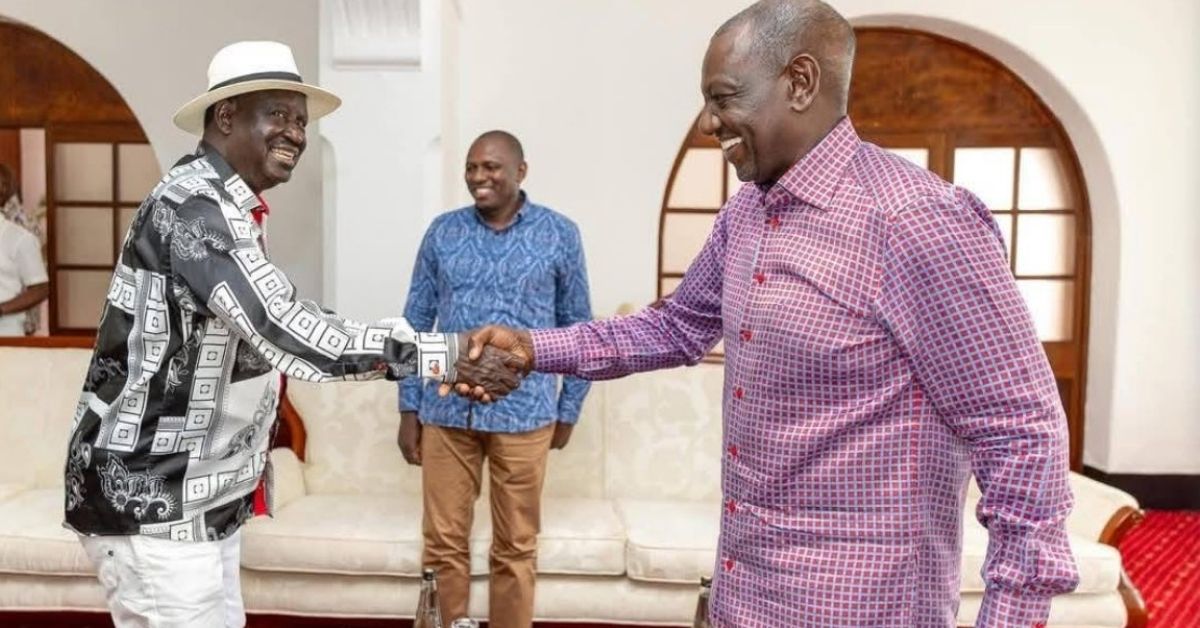
President William Ruto shakes hands with ODM leader Raila Odinga at Mombasa State House. Photo: Handout
Applying Political Theories to Kenya’s Evolving Power Dynamics
The Handshake That Was Never Meant to Be
In 2023, President William Ruto vowed that Kenya would never return to a “handshake conundrum,” dismissing it as a mongrel government that blurred the lines between the opposition and the ruling party.
However, by mid-2024, faced with intense protests and dwindling public confidence, Ruto pivoted—seeking an alliance with Raila Odinga, the very opposition figure he once condemned.
On Friday, President William Ruto’s United Democratic Alliance (UDA) and Raila Odinga’s Orange Democratic Movement (ODM) formalized their political pact, marking a significant shift in Kenya’s political landscape.
The agreement, signed at the Kenyatta International Convention Centre (KICC), signals an intention to work together within one government, despite years of political rivalry.
The partnership is being framed as a move driven by national interest rather than personal ambition.
However, skeptics argue that it is yet another elite power consolidation, reinforcing Kenya’s tradition of political realignments for survival rather than reform.
Was this a calculated survival move or a fumbling display of inconsistency? Applying Machiavelli, Pareto, the Overton Window, and Cognitive Dissonance, we analyse how Ruto’s shifting stance reflects broader political realities.
Machiavelli’s Realpolitik: Ruto’s Power Play
Machiavelli’s The Prince advices leaders to be pragmatic rather than ideological—shifting alliances and rhetoric to suit the moment.
Ruto’s sudden embrace of Raila reflects this Machiavellian approach. Having misjudged the depth of public discontent, he was forced to modify his position to prevent further regime instability.
Machiavellian takeaway: “A ruler must appear principled but be ready to abandon those principles when necessary.”
Ruto’s contradiction:
2023: “We will never have a mongrel government.”
2024: Engages Raila in an agreement that is, in essence, a handshake.
2025: Formally signs a political pact with Raila Odinga.
Does this make Ruto strategic or untrustworthy?
The Overton Window: Normalising What Was Once Unacceptable
The Overton Window describes how political ideas shift from radical to acceptable. Ruto framed Raila as an outsider to his government.
Yet, by 2024, intense protests and public frustration shifted the political landscape—forcing him to present Raila as a necessary stabiliser.
When leaders shift narratives drastically, are they adapting to reality or manipulating public sentiment?
Cognitive Dissonance: Ruto’s Contradictions and Public Perception
Cognitive dissonance occurs when actions contradict previously stated beliefs, forcing people to either change their behavior or justify the inconsistency.
Ruto resolved this by claiming his deal with Raila was not a “handshake” but rather a “national unity agreement.”
Psychological explanation:
How do leaders reconcile their contradictions? By repackaging them in new language.
Pareto’s Elite Circulation: Elites Preserve Power at All Costs
Pareto’s theory states that ruling elites never truly leave power—they reconfigure alliances to maintain control. Ruto, once an outsider battling the Kenyatta-Odinga dynasties, has now folded into the same elite club.
Elites rarely disappear—they adapt, absorb opposition figures, and neutralise threats to stay in power.
Tactical Genius or a Crisis of Legitimacy?
Ruto’s backpedaling may be strategic adaptation, but to the public, it may signal weak leadership—especially when public goods remain largely undelivered.
His inconsistent messaging undermines trust, but his ability to pivot when cornered is also a political survival skill.
The question remains:
Is Ruto mastering the game of power or losing credibility through contradictions?
Should Kenyan voters see the move as pragmatism or betrayal?
A Foreign Policy Parallel?
Kenya’s internal power struggles often mirror its foreign policy shifts. Ruto’s ability to maneuver between East and West, China and the US, shows a similar pattern of contradictions, pragmatism, and elite deal-making.
How does this situation play into Kenya’s foreign policy direction?
A leader who shifts domestically will likely do so geopolitically.
Should Kenya trust Ruto’s foreign policy vision when his domestic strategies seem reactionary?
Your support empowers us to deliver quality global journalism. Whether big or small, every contribution is valuable to our mission and readers.





