Kenya’s DRC Dilemma: Can You Mediate Without Diplomatic Recognition?
By Mwangi Maina
| February 7, 2025
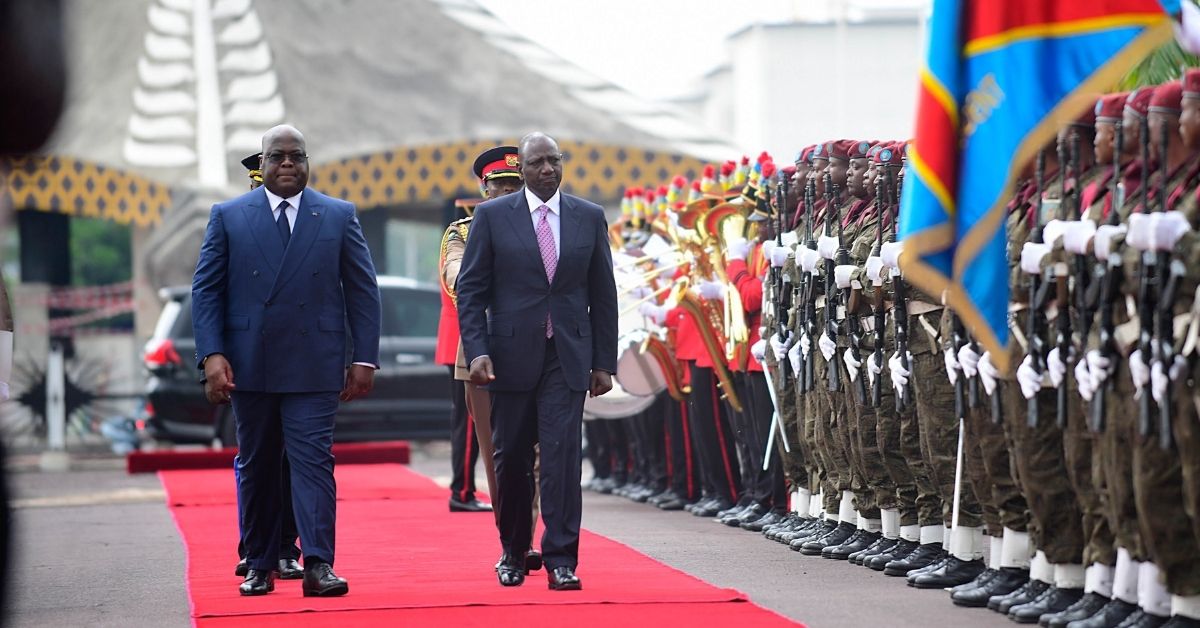
President William Ruto and Congolese President Felix Tshisekedi at the Palais de la Nation in Kinshasa during Ruto’s official visit in November 2022. His involvement in Congolese affairs has since sparked accusations of meddling. Photo: Handout
Kenya has invested heavily in regional peace efforts, positioning itself as a key mediator in the Democratic Republic of Congo (DRC)’s protracted conflict.
Yet, more than a year after appointing a new ambassador to Kinshasa, the Congolese government still refuses to accredit him—a snub that raises critical questions about Nairobi’s diplomatic standing in the region.
The recent ransacking of Kenya’s embassy in Kinshasa’s Gombe district by angry Congolese protesters only highlights the fragility of Nairobi’s engagement.
If Kinshasa still refuses to formally receive Kenya’s envoy, why is Nairobi doubling down on mediation efforts?
A Diplomatic Paradox
Kenya’s role in DRC peace efforts initially seemed strategic.
The EAC-led Nairobi Process, spearheaded by former President Uhuru Kenyatta, was meant to bring the Congolese government and armed groups to the negotiating table.
The Luanda Process, led by Angola under the African Union’s framework, focused on de-escalating tensions between Kinshasa and Kigali over Rwanda’s support for the M23 rebels.
Kenya, currently chairing the East African Community (EAC), is now pushing to merge these two tracks.
“These processes need to be harmonized and managed jointly for effective results,” said Kenya’s top diplomat, Musalia Mudavadi, during the EAC-SADC foreign ministers’ meeting in Dar es Salaam.
However, former President Kenyatta—who continues to lead the Nairobi Process—has a different view.
“The facilitator is of the opinion that the Inter-Congolese dialogue, (the Nairobi Process), must be restarted and fully funded,” Kenyatta states in a nine-page confidential report tabled ahead of the upcoming EAC-SADC leaders’ summit on February 8.
Unlike Mudavadi, Kenyatta does not explicitly call for a merger of the two processes but insists that Kinshasa must be fully committed to engaging all stakeholders “equitably and transparently.”
The divergence in approaches between Ruto’s administration and Kenyatta’s peace efforts signals friction.
Is Kenya trying to dilute Uhuru’s influence in the DRC mediation? That remains an open question.
What is clear, however, is that Kinshasa is increasingly leaning on SADC rather than the EAC—a shift that puts Kenya’s mediation role in question.
Does Kinshasa Trust Nairobi? A Diplomatic Snub That Speaks Volumes
Kenya has yet to publicly explain why its ambassador, Shem Amadi remains unaccredited in Kinshasa over a year after his appointment. But the silence is telling.
Kinshasa has largely pivoted toward SADC for military and diplomatic support. President Félix Tshisekedi has ignored several key EAC summits, including the most recent EAC Heads of State meeting chaired by Ruto, where Rwanda’s Paul Kagame was present.
Instead, Kinshasa has deepened ties with SADC, securing military backing from South Africa, Malawi, and Tanzania to combat M23 rebels—forces that took over from the EAC’s short-lived regional force, which Kinshasa unceremoniously ejected.
The fall of Goma last week only reinforced the shift.
At least 20 SADC peacekeepers, including 14 South Africans, 2 Malawians, and 2 Tanzanians, were killed as the Rwandan-backed M23 captured the North Kivu provincial capital.
If Kinshasa sees its security future tied to SADC rather than the EAC, where does this leave Kenya’s mediation ambitions?
Kinshasa’s Downgraded Ties With Nairobi
Diplomatic signals suggest Kinshasa has already downgraded its relations with Kenya.
- Kinshasa recalled its ambassador to Nairobi, John Nyakeru Kalunga for good, in July 2024, and has not replaced him.
- Kenya’s embassy in Kinshasa was ransacked by protesters, raising concerns about Nairobi’s security posture in DRC.
- The Kenyan consulate in Goma withdrew its staff to a neighboring country after the city fell to M23.
Yet, Nairobi continues to press on with mediation—despite Kinshasa’s reluctance.
Kenya’s Diplomatic Gamble: Is Mediation Without Recognition Sustainable?
Kenya remains deeply invested in the DRC—not just politically, but economically.
Nairobi played a key role in securing Kinshasa’s admission to the EAC and Kenyan businesses have aggressively expanded into the Congolese market.
But does economic interest alone justify Kenya’s unwavering mediation, even when Kinshasa seems uninterested? At what point does mediation without recognition become a liability?
Moreover, Kenya’s perceived neutrality has been questioned.
- President Tshisekedi publicly accused Ruto of siding with Rwanda, blaming him for the EAC’s weak response to the crisis.
- M23’s announcement of a new armed coalition at Nairobi’s Serena Hotel—the same hotel where Tshisekedi announced his 2018 presidential bid—fueled further suspicion about Kenya’s impartiality.
This mistrust was further exacerbated in April 2024 when Kenya Airways’ station manager in Kinshasa was arrested, leading the airline to suspend flights to DRC.
The matter was only resolved after Mudavadi personally intervened, but the diplomatic damage had been done.
Rethink or Double Down? Kenya’s Dilemma in Dar es Salaam
There was a low turn-out during the joint EAC-SADC foreign ministers meeting in Dar es Salaam. Only 12 out of 24 member states showed up.
The DRC effectively snubbed the talks, sending its ambassador to Botswana and SADC instead of a minister.
With regional leaders gathering in Dar es Salaam for the high-stakes summit, Nairobi faces a choice.
Push for direct engagement with Kinshasa to resolve the unaccredited envoy issue—a necessary step if Kenya’s mediation is to be taken seriously, reassess Kenya’s role in the DRC peace process—determine whether Nairobi’s efforts are actually yielding results or merely serving as a placeholder in a process where Kinshasa prefers SADC.
Align more closely with SADC’s approach—if Kinshasa sees SADC as its preferred security partner, Kenya may need to adjust its strategy to remain relevant in future peace efforts.
One thing is clear: Kenya cannot afford to continue mediating when Kinshasa won’t even recognize its envoy. If Nairobi fails to readjust, it risks becoming diplomatically sidelined in a conflict where it has invested so much.
Part II: How Kenya’s Diplomatic Missteps Fueled Kinshasa’s Mistrust (Coming Saturday).
Your support empowers us to deliver quality global journalism. Whether big or small, every contribution is valuable to our mission and readers.