

























ECOSOCC: AU Advisory Body Elects New Leadership Amid Favoritism Allegations
| December 20, 2024
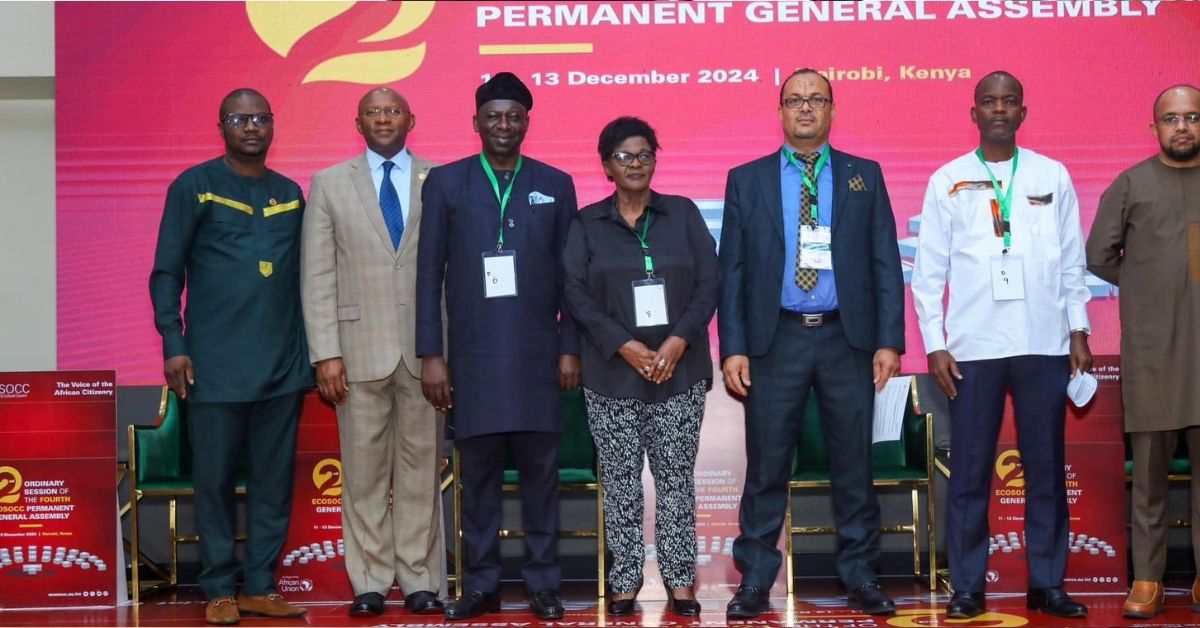
Delegates at the recently concluded ECOSOCC elections in Nairobi, Kenya. Photo: Handout
The African Union’s Economic, Social and Cultural Council (ECOSOCC) held the Second Ordinary Session of its Fourth Permanent General Assembly (PGA) in Nairobi on Friday, where it elected new leadership amid claims of favoritism and internal discontent.
ECOSOCC is the AU’s advisory organ composed of civil society organizations (CSOs). Its General Assembly includes two CSOs from each AU member state, 10 regional CSOs, eight continental CSOs, and 20 diaspora CSOs, as defined by the AU Executive Council.
This year’s elections came at a time when both the African Union and ECOSOCC leadership are under scrutiny for alleged underhand tactics and favoritism, potentially setting the stage for fresh challenges within the body.
According to a statement obtained by Kenyan Foreign Policy, the General Assembly elected a new team, including the Presiding Officer (PO), Deputy Presiding Officers, and chairs of sectoral cluster committees.
Louis Cheick Sissoko from Mali emerged as the new Presiding Officer.
Those elected also took the Oath of Office during the session. Additionally, a Disciplinary Committee, composed of former General Assembly members representing the five regions, was inaugurated.
In his acceptance speech, Presiding Officer-elect Sissoko expressed gratitude for his election and outlined a vision focusing on three strategic priorities: strengthening ECOSOCC’s impact within the African Union and internationally, optimizing internal operations, and mobilizing resources through innovative financing strategies.
“For two years, marked by pressing challenges and renewed hopes, we have collectively established ECOSOCC as a true lighthouse of resilience and a sanctuary of participatory governance,” Sissoko stated.
Controversy Over Leadership Eligibility
The elections have reignited debate about eligibility and fairness within ECOSOCC.
Kenyan Foreign Policy sought clarification from ECOSOCC Secretariat Head William Carew on why individuals from countries currently suspended from the African Union were allowed to contest and assume leadership positions.
Carew, referencing guidance from ECOSOCC’s legal team, stated:
“ECOSOCC is an advisory organ made up of civil society organizations (CSOs) and not representatives of AU Member States or governments. This distinction is fundamental to understanding the election process and the eligibility of candidates. Individuals from CSOs based in AU-suspended countries, such as Mali and Niger, can indeed be elected to ECOSOCC structures, including ECOSOCC leadership.”
However, critics have accused ECOSOCC of double standards. A source speaking anonymously argued that the organization previously barred candidates from suspended states, citing Sudan and Sierra Leone as examples.
“The election of candidates from AU-suspended countries shows clear double standards in the leadership and working of ECOSOCC. It should then explain why they suspended a Sudanese and a Sierra Leonean candidate from the body and from contesting respectively,” the source claimed.
ECOSOCC’s Secretariat defended its position, emphasizing that eligibility is determined by the accreditation and selection process of CSOs, not the political status of their home countries.
“The election process for ECOSOCC structures is governed by its own statutes and rules, which are distinct from elections within the AU’s intergovernmental processes,” the Secretariat stated.
Past Leadership Conflicts
Leadership disputes are not new to ECOSOCC. In 2022, divisions erupted when the AU suspended seven ECOSOCC members, citing misconduct.
Among the suspended members were two Nigerians, Tunji Asaolu and John Oba, alongside Abozer Elligai Elmana (Sudan), Abdurrahman Mokhtar (Libya), Roll Stephane Ngomat (Gabon), El Hacene Abdallah Bah Mbareck (Mauritania), and Shem Ochuodho (Kenya).
A statement from the AU at the time highlighted findings from a probe panel that revealed violations of ECOSOCC’s Rules of Procedure and the AU Code of Ethics and Conduct.
The matter remains contentious, with some of the suspended members seeking legal recourse. Court proceedings in Nairobi have faced delays, partly due to repeated no-shows by representatives of outgoing AU Chairman Moussa Faki.
Your support empowers us to deliver quality global journalism. Whether big or small, every contribution is valuable to our mission and readers.





