






South Sudanese Kiir Fires Army Chief, IGP, and BoSS Governor in Major Reshuffle
| December 10, 2024
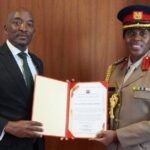
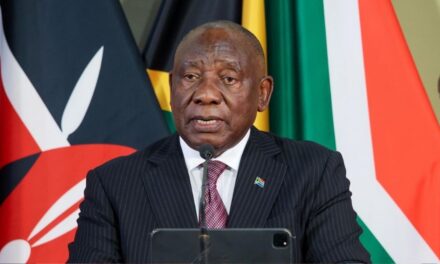
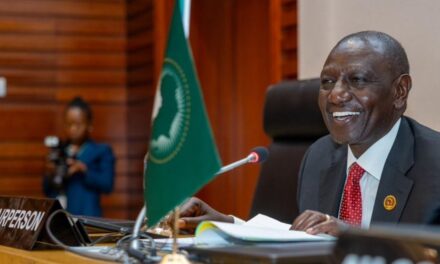
Kiir’s announcement late on Monday gave no reasons for the dismissals. It said Kiir had appointed Paul Nang Majok as the army’s chief of defence forces, replacing General Santino Wol. Photo: Handout
South Sudan’s President Salva Kiir Mayardit made sweeping changes on Monday within the country’s defence, policing, and financial institutions, dismissing top officials, including the Chief of Defence Forces and the Inspector General of Police.
The decrees, announced on state television, come amidst growing political and security challenges in the country.
“He [President Kiir] needs to bring people very close to himself, people that he may trust, people that he could be able to consolidate power and ensure that whatever chance comes with the security sector reform will not destabilise the plan he has as the commander-in-chief of all the security forces within the country,” said Dr Abraham Kuol Nyuon, a political analyst.
General Santino Deng Wol was relieved of his duties as Chief of Defence Forces and reassigned as Undersecretary in the Ministry of Defence and Veterans Affairs. He has been replaced by General Paul Nang Majok.
Additionally, Atak Santino Majak was removed from his position as Undersecretary of the Defence Ministry.
In the police sector, General Atem Marol Biar was dismissed as Inspector General of Police, with General Abraham Peter Manyuat taking over the role.
These changes occur as South Sudan continues efforts to unify its security forces, a key requirement of the 2018 peace agreement.
In the financial sector, Dr James Alic Garang was dismissed as Governor of the Bank of South Sudan. He has been replaced by Johnny Ohisa Damian, who previously held the role. The Finance Ministry also saw changes, with Garang Majak replaced by Arop Nuoi Arop as First Undersecretary.
These adjustments follow the October 2024 removal of General Akol Koor Kuc as Director General of the Internal Security Bureau of the National Security Service (NSS).
Kuc was controversially appointed Governor of Warrap State, only for the decision to be revoked upon his return to Juba.
Tensions escalated in November when armed violence erupted at Kuc’s residence during an attempted government arrest, resulting in a deadly clash between South Sudan People’s Defence Forces (SSPDF) soldiers and his bodyguards.
The incident left four dead and two injured, heightening tensions in the capital.
Army spokesperson Major General Lul Ruai Koang described the clash as a “misunderstanding” between security units tasked with protecting the former spy chief.
The reshuffles come at a critical time as South Sudan faces ongoing political instability and delayed elections, now rescheduled for December 2026.
Speaking about the reshuffles, Dr Abraham Kuol Nyuon from the University of Juba provided context, linking them to the Tumaini peace talks underway in Nairobi.
“The president might be thinking the people that he’s putting on board currently are people that he can remove with ease without being opposed. If he comes and tells them that they can step down for somebody else, rather than the people who stayed in power for long and have accumulated more power and believe that they are more powerful than anybody,” Nyuon said.
Nyuon added that President Kiir appears to be consolidating power within the security sector to implement the terms of the 2018 peace agreement and safeguard his vision for South Sudan’s future.
However, he warned of potential risks: “One of the major aspects of this is that if the president does not treat all these people he’s removing well by reassigning them to new roles, this could also create more problems.
There are no guarantees that those removed won’t join the opposition, and there is also no guarantee that they won’t create their own rebellion against the government.”
The Tumaini peace talks, critical to finalising the peace agreement, are addressing complex power-sharing issues between the government and opposition.
South Sudan was initially expected to transition into a democratic dispensation with elections set for December 22, 2024, as outlined in the 2018 peace deal that ended a five-year conflict.
However, in September, parties to the agreement extended the transitional government’s mandate, maintaining Kiir’s rule and pushing the elections to December 22, 2026, citing uncompleted tasks in the agreement.
While Kiir’s reshuffles may strengthen his control, they carry risks that could destabilise the fragile peace process if mishandled. The ongoing Tumaini talks will be pivotal in determining the country’s path forward.
Your support empowers us to deliver quality global journalism. Whether big or small, every contribution is valuable to our mission and readers.